
Posted by: Dimple Verma, RCIC-IRB #R708308
VG Immigration Services Canada
Published: March 14, 2026
You saved the money. You gathered the documents. You filed the application. And then IRCC sent it back — unread, unprocessed, and with a refund — because of a missing signature, an unsigned checklist, or a document without a certified translation.
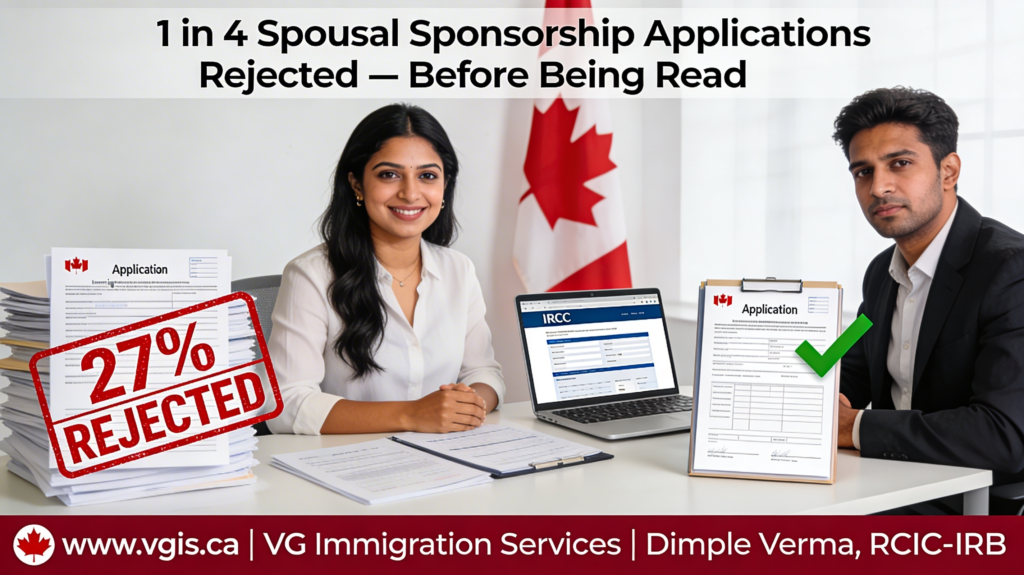
This is not a rare story. According to official IRCC data, 27% of inland spousal sponsorship applications submitted between January and October 2025 were returned without processing — that is more than 12,000 families whose applications never even made it to an officer’s desk.
Understanding why this happens — and how to prevent it — is one of the most important things any couple planning a spousal sponsorship application can do in 2026.
🗓️ 👉 Book a Free Consultation With Dimple Verma, RCIC-IRB — We review your spousal sponsorship file before you submit so it passes the first time.
The Numbers: How Many Applications Failed in 2025?
IRCC reviewed 45,235 inland spousal sponsorship applications between January and October 2025. Of those:
- ✅ 32,994 passed the completeness check and entered processing
- ❌ 12,241 failed and were returned without processing
That is a 27% failure rate — more than 1 in 4 applications returned before a single officer reviewed the couple’s relationship, documents, or eligibility.
Month-by-Month Breakdown: 2025 Inland Spousal Sponsorship
| Month | ✅ Passed | ❌ Failed | Failure Rate |
|---|---|---|---|
| January 2025 | 3,606 | 1,635 | 31.2% |
| February 2025 | 3,051 | 1,379 | 31.1% |
| March 2025 | 2,928 | 1,180 | 28.7% |
| April 2025 | 3,375 | 1,297 | 27.8% |
| May 2025 | 3,734 | 1,289 | 25.6% |
| June 2025 | 3,438 | 1,071 | 23.7% |
| July 2025 | 3,580 | 1,145 | 24.2% |
| August 2025 | 3,308 | 1,061 | 24.3% |
| September 2025 | 3,332 | 1,244 | 27.2% |
| October 2025 | 2,642 | 940 | 26.2% |
The failure rate was highest in January and February 2025 — over 31% — suggesting that many people filing at the start of the year do so without adequate preparation.
What Is the R10 Completeness Check?
The R10 completeness check is the very first step IRCC performs after receiving an inland spousal sponsorship application. It is named after Regulation 10 (R10) of the Immigration and Refugee Protection Regulations — the rule that defines what a complete application must include.
This check is purely administrative. IRCC is not assessing whether your relationship is genuine, whether you qualify as a sponsor, or whether your spouse is admissible to Canada. It is only checking one thing:
Is every required form present? Is every required signature included? Is every required document attached? Have all fees been paid and receipts included?
If the answer to any of those questions is no — the application is returned to you. Not refused. Not appealed. Simply sent back. You receive a refund and must start over.
This means thousands of Canadian couples are losing months of processing time — not because their application was refused on merit, but because of a missing page, an unsigned form, or an untranslated document.
💬 👉 Get Your Application Reviewed Before You Submit — VG Immigration conducts a full pre-submission review to catch every gap before IRCC sees it.
The 6 Most Common Reasons Applications Fail R10
After years of preparing spousal sponsorship applications, these are the mistakes we see most frequently at VG Immigration Services:
❌ 1. Missing Signatures
Every form has designated signature fields. Some require only the sponsor’s signature. Some require only the applicant’s. Some require both. Missing even one signature on any form is enough to fail the entire application and have it returned.
✅ VG Fix: We create a signature checklist for every form in the package and verify all signatures before submission.
❌ 2. Incomplete or Missing Document Checklists
The IMM 5287 (sponsor checklist) and IMM 5533 (sponsored person checklist) must be physically included in the submission. The checklist itself is a required document — many applicants assume it is just a guide and leave it out entirely.
✅ VG Fix: We include both checklists as active submission documents, properly completed.
❌ 3. Untranslated or Uncertified Documents
Any document not in English or French must be accompanied by a notarized certified translation or an affidavit from the translator. Marriage certificates, birth certificates, police clearances, and education documents from abroad are frequently submitted without translation — causing immediate R10 failure.
✅ VG Fix: We flag every non-English/French document at intake and arrange or verify certified translations before submission.
❌ 4. Missing Fee Receipts
The application fee structure for inland spousal sponsorship is:
| Fee | Amount |
|---|---|
| Sponsorship fee | $85 |
| Principal applicant processing fee | $545 |
| Right of permanent residence fee | $575 |
| Total (sponsor + applicant) | $1,205 |
| Dependent child (sponsorship + processing) | $170 per child |
| Biometrics | $85 per person / $170 for family |
All fees must be paid and receipts included before submission. Missing a receipt — even for a single fee — fails the R10 check.
✅ VG Fix: We verify every payment, confirm every receipt, and attach them properly to the correct form.
❌ 5. Blank Fields Not Marked “N/A”
If a section on a form does not apply to your situation, you cannot simply leave it blank. Every inapplicable field must be marked “Not Applicable” or “N/A” — otherwise IRCC treats it as an incomplete form.
✅ VG Fix: We complete every field on every form, marking N/A where applicable, before submission.
❌ 6. Missing Letters of Explanation for Unavailable Documents
If any required document is genuinely unavailable — for example, a birth certificate in a country where civil records were destroyed — you must include a Letter of Explanation (LOE) explaining why it cannot be provided and attaching supporting evidence. Failing to do so results in the application being returned.
✅ VG Fix: We identify unavailable documents at intake, draft a strong LOE with supporting evidence, and include it in the correct position within the application.
The Full Spousal Sponsorship Process: What Happens After R10
Understanding the complete process helps you know where your application stands at every stage:
Stage 1 — R10 Completeness Check
IRCC reviews the application for completeness. Pass = AOR issued and application moves forward. Fail = returned with refund.
Stage 2 — Acknowledgement of Receipt (AOR)
Once R10 is passed, IRCC issues an AOR letter to the sponsor’s MyCIC account (or by mail). This is the start of official processing.
Stage 3 — Sponsor Eligibility Assessment
IRCC assesses whether the Canadian citizen or PR is eligible to sponsor — income history, criminal record, previous sponsorships, and other factors.
- ✅ Sponsor approved: IRCC proceeds to assess the sponsored person
- ❌ Sponsor refused: You can choose to withdraw the application (partial refund) or continue processing the PR application without sponsorship approval (no refund)
Stage 4 — Sponsored Person Eligibility and Admissibility
IRCC assesses the spouse being sponsored for PR eligibility and admissibility — including medical exams, biometrics, and background checks.
Stage 5 — Final Decision
- ✅ Approved: IRCC requests passport submission and right of PR fee confirmation. The sponsored person completes PR confirmation through the Permanent Residence Portal.
- ❌ Refused: IRCC communicates reasons. Note: inland sponsorship refusals cannot be appealed the same way outland applications can.
⚠️ Critical point: Because inland refusals have limited appeal rights, getting the application right the first time is not just helpful — it is essential.
🗓️ 👉 Book a Free Consultation — Protect Your Spousal Sponsorship — One session with our RCIC team can prevent months of delays and a costly restart.
Step-by-Step Guide: How to Pass R10 Every Time
Here is the exact process IRCC recommends — and how VG Immigration goes beyond it:
Step 1 — Read the Complete Instruction Guide
Read IRCC’s full guide: “Sponsor your spouse, common-law partner, conjugal partner or dependent child — Complete Guide (IMM 5289)”. This single document contains eligibility requirements, form guidance, and document requirements for both the sponsor and the applicant.
Step 2 — Use Both Document Checklists
Pull both mandatory checklists:
- IMM 5287 — Sponsor’s document checklist
- IMM 5533 — Sponsored person’s checklist
Gather every document listed. For documents from abroad, arrange certified translations immediately.
Step 3 — Complete All Forms With Care
Fill every field. Mark inapplicable sections as N/A. Double-check which party signs which form. Pay attention to country-specific requirements for civil documents.
Step 4 — Pay All Fees and Attach Receipts
Pay the full fee set before submission and attach the receipt to the correct form. Consider paying the Right of PR fee ($575) upfront to avoid delays later.
Step 5 — Do a Full Pre-Submission Review
Check every form for missing signatures, every document for translation completeness, every fee for receipt attachment, and every checklist for inclusion in the package.
Step 6 — Submit and Monitor
Submit online through IRCC’s portal and monitor your MyCIC account for the AOR. After AOR, use IRCC’s Application Status Tracker (AST) to follow progress.
Inland vs. Outland: Which Should You Choose?
| Factor | Inland Sponsorship | Outland Sponsorship |
|---|---|---|
| Applicant location | Already in Canada | Outside Canada |
| Work while waiting | May qualify for open work permit | Must wait outside Canada |
| Appeal rights | ❌ Limited — cannot appeal refusal to IAD | ✅ Full appeal rights to IAD |
| Processing time | ~21 months | ~15 months |
| R10 failure risk | Same for both | Same for both |
| Best for | Couples already together in Canada | Couples separated internationally |
The appeal right difference is significant. Outland applicants can appeal a refusal to the Immigration Appeal Division (IAD). Inland applicants cannot — making accuracy at submission even more critical for inland cases.
Why VG Immigration Has a Near-Zero R10 Failure Rate
At VG Immigration Services, every spousal sponsorship application we prepare goes through a three-stage review process before submission:
Stage 1 — Document intake review: We review every document at intake, identify missing items, and flag translation and certification needs before drafting begins.
Stage 2 — Full application build: Our RCIC-led team completes every form, checks every signature field, marks every N/A field, drafts Letters of Explanation where needed, and verifies every fee receipt.
Stage 3 — Pre-submission final check: Dimple Verma, RCIC-IRB #R708308 personally reviews the complete package against the IMM 5287 and IMM 5533 checklists before submission.
This approach means our clients do not experience R10 failures — and their applications enter processing on the first submission, not after months of waiting to restart.
Beyond R10, we prepare your application to succeed at every stage:
- ✅ Relationship genuineness documentation — photos, communication history, financial ties, statutory declarations
- ✅ Sponsor eligibility strategy — addressing income history, past sponsorships, or criminal record issues proactively
- ✅ Admissibility preparation — managing medical exam timing, biometrics, and police certificate coordination
- ✅ Procedural Fairness Letter (PFL) responses — if IRCC raises concerns at any stage, we respond with a full legal strategy
- ✅ Refused applications — if your application was previously refused, we rebuild the file and address the specific refusal reasons
Frequently Asked Questions
Q: If my application fails R10, can I resubmit immediately?
Yes. IRCC returns the application with a refund and you can resubmit once you have corrected the issue. However, you lose months of processing time and must start the queue from scratch.
Q: Does R10 failure affect my immigration record?
A returned application is not a refusal — it does not create a negative record. However, repeated patterns of incomplete applications can raise questions in future processing.
Q: Can my spouse work in Canada while the inland sponsorship is processing?
Depending on their current status, they may be eligible for an open work permit while the inland sponsorship application is in process. This is separate from the sponsorship itself and requires its own application at the right time.
Q: What happens if the sponsor is refused but we want to continue?
You can elect to continue processing the sponsored person’s PR application even if the sponsorship portion is refused. In that case, no processing fees are refunded. This is a complex scenario and should be managed with professional advice.
Q: How long does inland spousal sponsorship take in 2026?
Current IRCC processing time for inland spousal sponsorship is approximately 21 months as of March 2026.
📌 This blog is for informational purposes only and does not constitute legal advice. Immigration rules change frequently. Always consult a licensed RCIC or immigration lawyer for advice specific to your situation.
👉 Stay Updated — Follow Us!
VG Immigration Services Canada keeps you informed on IRCC 2026 changes, TR to PR updates, OINP draws, and settlement service deadlines.
📸 Instagram: Follow @vgis_can — Daily immigration tips
🎥 TikTok: Follow @vgis_can — Punjabi/English explainers
💬 WhatsApp: Free Documents List — Instant settlement checklist
VG Immigration Services Inc.
📍 211B-9300 Goreway Drive, Brampton, ON L6P 4N1
📧 case@vg-immigration.com | immigration@vgis.ca
📱 +1 416-578-9269
🌐 www.vgis.ca
Book Consultation | Contact Us
Dimple Verma, RCIC-IRB #R708308