
Mark Carney Links Canada’s Recession to Lower Immigration: What It Means for Your PR Plan in 2026
Posted by: Dimple Verma, RCIC-IRB #R708308 | VG Immigration Services Canada
Published: June 4, 2026 at 7:15 AM ET
Carney Just Admitted Lower Immigration Is Hurting the Economy. He Did Not Announce a Reversal.
On June 2, 2026, walking into a cabinet meeting in Ottawa, Prime Minister Mark Carney made his first major public comments on Canada’s economy since Statistics Canada released GDP data on May 29, 2026 showing two consecutive quarters of contraction. The Prime Minister did not use the word “recession” — but he conceded, on the record, that “taking back control of immigration” and slower population growth are contributing to softer economic data.
Reach Newcomers to Canada
Banks, insurance, real estate, tax & accounting, telecom, healthcare & education. Ask about relevant native in-article placements.
Contact Us →This is the most important policy admission of 2026 for anyone with a Canadian immigration file. The federal government has officially acknowledged the trade-off between population control and economic growth. And yet — and this is the critical point — Carney did not announce a policy reversal, did not signal higher PR targets, and did not hint at a temporary resident expansion. What he signaled instead is a long, deliberate, controlled path that will likely keep PR targets at 380,000 through November 2026, with any broader rebalancing pushed to the November 2027 cycle.
For Express Entry candidates, PNP hopefuls, work permit holders, international students, and employers across Canada, that means the next 18 months are not a waiting game. They are a strategy game. Here is the full breakdown.
⚠️ PR Targets Are Holding. Should You Wait or Act Now?
Carney signaled that PR targets will likely hold at 380,000 through November 2026. That means competition stays tight, CRS cut-offs stay elevated, and the in-Canada transition pathways (CEC, PNP, healthcare, trades) are now the safest routes. Get an RCIC-built strategy that matches the new reality.
Key Highlights
- Carney’s June 2, 2026 statement: “This government’s been in the process of laying the foundations for a stronger, more resilient, more independent Canadian economy.” He acknowledged lower immigration is part of softer data, but did not promise higher targets.
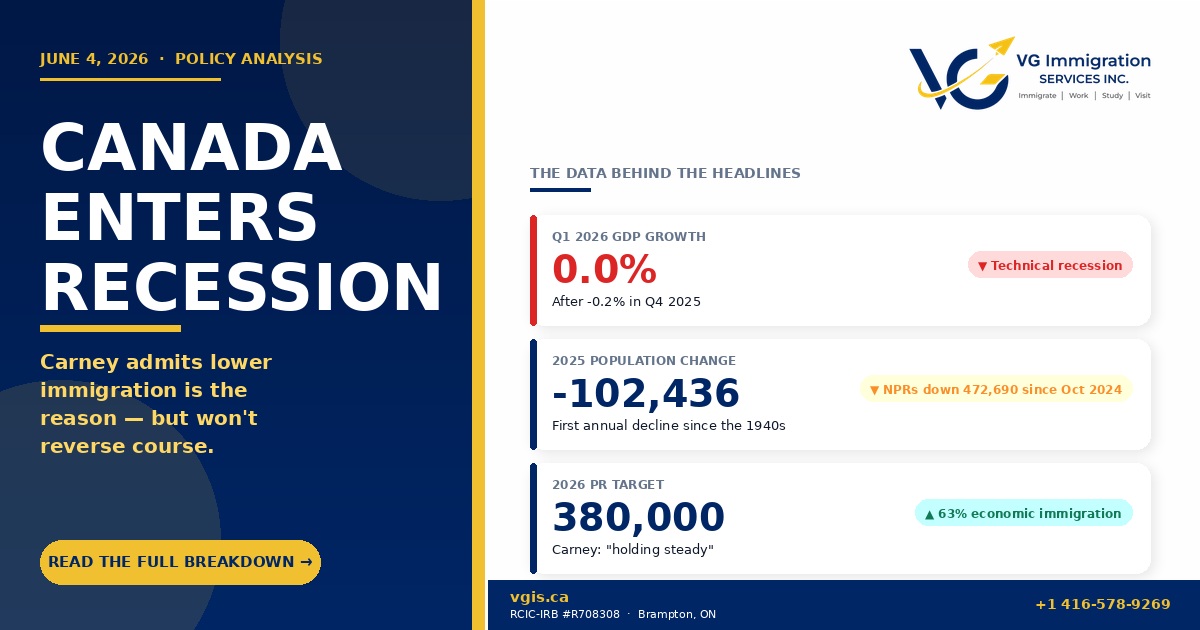
- Q4 2025 real GDP: down 0.2% quarter-over-quarter (annualized -1.0%).
- Q1 2026 real GDP: unchanged at 0.0% quarter-over-quarter (annualized -0.1%).
- Population: Declined by 103,504 in Q4 2025 and approximately 102,436 over full-year 2025 — the first annual decline in records dating back to the 1940s. Canada’s population stood at 41,472,081 on January 1, 2026.
- Non-permanent residents: Fell by 171,296 in Q4 2025. The non-permanent resident population dropped from 3,149,131 on October 1, 2024 to 2,676,441 on January 1, 2026.
- Unemployment: 6.9% nationally in April 2026; youth unemployment at 14.3%.
- 2026 PR target: 380,000. Economic immigration 239,800 (63%); family 84,000 (22%); refugees and protected persons 49,300 (13%); H&C and other 6,900 (2%).
- One-time transition initiative: Accelerate up to 33,000 temporary workers to PR in 2026 and 2027.
- Protected persons transition: Streamline approximately 115,000 protected persons already in Canada to PR over two years.
- Study permits in 2026: Up to 408,000 total — 155,000 newly arriving and 253,000 extensions for current and returning students.
- Express Entry priority categories continuing in 2026: Healthcare, skilled trades, French language, transportation, agriculture, STEM, and education.
The Statistics Canada Numbers Behind the Recession Debate
Two consecutive quarters of negative GDP is what economists commonly call a “technical recession.” That label triggered the national debate Carney was responding to. But the underlying data is more nuanced than the headline.
The GDP picture
- Real GDP per capita actually rose 0.2% in Q1 2026, because population declined for a second consecutive quarter while total output stayed flat. That is the rare scenario where the country’s economy and the average Canadian’s economic experience are diverging in opposite directions.
- Household spending grew 0.4% in Q1 2026 — consumers are not collapsing.
- Final domestic demand fell 0.1% in Q1 2026 — domestic activity is barely holding.
- Business capital investment declined for the fifth consecutive quarter — businesses are not building capacity.
- Residential investment fell 2.0%, with resale activity dropping 9.9%.
- Imports rose 2.9%, driven partly by gold; exports edged lower at -0.1%.
The population picture
The population data is the more politically explosive number. Canada has not had an annual population decline in any year on record going back to the 1940s. The 2025 decline of roughly 102,436 people is the consequence of the post-2024 federal cap on temporary residents combined with study permit restrictions, work permit reforms, and the wind-down of pandemic-era extensions.
Statistics Canada has noted the estimates are preliminary and may be revised because work and study permit extensions are not yet fully captured. The real decline could be smaller once final data is in — but the directional story is now settled.
What Carney Actually Said — and What He Carefully Did Not Say
What he said
- The government is “laying the foundations for a stronger, more resilient, more independent Canadian economy.”
- Population growth has flattened, slowed, or turned negative over the past two quarters.
- Spending growth has dropped from close to 10% to less than 2%.
- The broader strategy involves public investment, lower spending growth, trade diversification, and deliberate population control.
What he carefully did not say
- He did not use the word “recession.”
- He did not promise higher PR targets in November 2026.
- He did not signal a temporary resident expansion.
- He did not announce any new program or stream.
- He did not commit to reversing the post-2024 caps.
The political read is clear: this government is signaling that the recession (whether or not it is officially named) is a price they have decided to pay, at least through 2026, to demonstrate “control” of immigration and population growth. A more meaningful rebalancing — if it comes — is more likely in the November 2027 Levels Plan cycle.
🎯 In Canada on a Work Permit or Study Permit?
You are exactly the candidate the federal plan is prioritizing. In-Canada transitions — CEC, PNP, trades, healthcare — are described in the IRCC plan as the lowest-burden pathways. Translation: you have leverage. We’ll show you how to use it before the November 2026 plan refresh.
🚀 Start Onboarding 📅 Book a Consultation
Start your secure Immigration intake
Skip the back-and-forth. Complete a structured intake in 25 minutes. Reviewed by Dimple Verma, RCIC-IRB. No payment required to start.
What the IRCC 2026-2028 Immigration Levels Plan Actually Says
The IRCC Levels Plan, published November 5, 2025, sets the legal targets that drive every Express Entry round, every PNP allocation, and every category-based draw through 2028. Here is the breakdown for 2026:
2026 permanent resident admissions: 380,000 total
| Class | 2026 Target | Share |
|---|---|---|
| Economic immigration | 239,800 | 63% |
| Family reunification | 84,000 | 22% |
| Refugees and protected persons | 49,300 | 13% |
| H&C and other | 6,900 | 2% |
Economic immigration share rises to 64% in both 2027 and 2028 — a small but real tilt toward skills-based intake. That is the channel where Express Entry, PNP, and the in-Canada transitions live.
The one-time transitions that actually matter for people already here
- Accelerated transition of up to 33,000 temporary workers to PR in 2026 and 2027.
- Streamlined transition of approximately 115,000 protected persons already in Canada over two years.
These are the two specific levers IRCC has built into the plan to address the federal government’s own diagnosis: in-Canada transitions are the lowest-burden form of immigration because the candidate is already housed, already employed, already paying taxes, and already integrated. No new housing demand. No new settlement costs. Just a status change.
Study permit numbers for 2026
- Up to 408,000 total study permits in 2026.
- Of those, only 155,000 are newly arriving students.
- The remaining 253,000 are extensions for current and returning students.
The federal government’s bias toward extensions over new arrivals is now formal. If you are an existing student in Canada applying to extend, your application is in the priority lane that aligns with the federal plan. If you are a new applicant overseas, you are competing for the smaller, more selective slice.
Why “Immigration Is Not One Single Number”
The most important framing in the immigration policy debate right now — and the one that anyone planning their PR strategy needs to understand — is that immigration is not monolithic. There are at least nine distinct categories of newcomers, each with very different fiscal, labour market, and housing impacts:
- Refugees — Humanitarian admission based on protection needs under the 1951 UN Refugee Convention. Require settlement support, housing assistance, language training. Highest immediate cost.
- Asylum claimants — Processed through the Immigration and Refugee Board. May require emergency shelter and interim housing.
- Family-class immigrants — Sponsored by Canadian citizens or PRs; sponsor carries settlement responsibility. Moderate fiscal cost.
- Overseas economic immigrants — Selected for skills, language, education, settlement funds. New housing demand, but bring capital and labour market skills.
- Temporary foreign workers — Employer-tied permits via LMIA or International Mobility Program. Already housed and employed. Low immediate fiscal cost.
- International students — Tuition revenue for institutions. Drive rental demand. Mixed-quality DLI concerns.
- In-Canada workers transitioning to PR — Through CEC, PNP, trades. Lowest burden because already integrated.
- Protected persons transitioning to PR — Status change for people already living in Canada. No new population.
- Permit extensions and status changes — Renewals only. No new arrival.
The federal plan is now openly designed around this hierarchy. It is throttling categories 1-4 (especially refugees, overseas economic immigrants, and new international students), and protecting categories 5-9 (extensions, in-Canada transitions, employer-tied workers). For anyone already in Canada with a work permit or study permit, that is decisive information.
The Categories the Government Is Prioritizing in 2026
Express Entry category-based selection in 2026 prioritizes:
- Healthcare — Physicians, nurses, NOC 31 and 32 occupations across the country.
- Skilled trades — Construction, manufacturing, NOC 72 and 73 occupations.
- French-language proficiency — Any TEER level. The May 28, 2026 French round cleared at CRS 409 with 4,500 ITAs.
- Transportation — Long-haul drivers, transit operators, transportation supervisors.
- Agriculture and agri-food — Farm labour and supervisory roles.
- STEM — Software engineers, data scientists, electrical engineers, NOC 21 occupations.
- Education — Early childhood educators, elementary and secondary teachers.
The pathways named as “lowest burden” in the policy analysis are Canadian Experience Class, Provincial Nominee Program, healthcare streams, skilled trades categories, and regional pathways. If your file fits any of these, your strategy is straightforward. If it does not, your strategy needs to focus on getting it to fit.
What This Means for You
If you are already in Canada on a work permit
You are exactly where the federal plan wants you. The 33,000-spot accelerated transition for temporary workers is built for you. Your priorities are: (1) accumulate eligible Canadian work experience (12 months continuous skilled work for CEC), (2) push your language scores higher — every band counts in a tight CRS environment, (3) submit or refresh your Express Entry profile, and (4) consider whether a targeted PNP is faster than waiting for a federal round.
If you are an international student in Canada
The 253,000 extension slice is your protection. Your priorities are: (1) maintain academic standing and DLI compliance, (2) plan your PGWP timing carefully — the new language test field will become mandatory, (3) build the 12 months of post-graduation skilled work experience needed for CEC, and (4) keep a parallel PNP option ready in case your CRS sits below federal cut-offs.
If you are overseas with an Express Entry profile
Competition is intensifying. The general (CEC, FSW, FST) draws will likely continue at elevated cut-offs through 2026. Your highest-probability moves are: (1) language — especially French to access the dedicated French rounds at CRS 409 in May 2026, (2) NOC alignment to one of the category-based priority occupations, (3) a credible PNP nomination from a province with low EOI competition, or (4) a Canadian job offer through an LMIA-supported employer.
If you are an employer in Canada
The plan favors you. Employer-tied pathways — LMIA, PNP employer streams, Atlantic Immigration Program designated employers — are described as low-burden. The OINP redesign coming after the May 30, 2026 overhaul will likely further consolidate around an employer-job-offer model. Get your Employer Portal registrations current. Document your labour market need. We are seeing employer-supported files moving through provincial systems faster than general pool candidates.
If you are planning a 2027 application
November 2027 is when a meaningful rebalancing is more likely, according to the policy analysis. That makes 2026 your preparation year. Get your ECA done, language tests written, NOC strategy locked, and any Canadian credential (online graduate certificate, French upgrade, ECE diploma) in motion now so that when the window widens, you are first in line.
How VG Immigration Can Help
Dimple Verma, RCIC-IRB (R708308), Commissioner of Oaths, at VG Immigration Services has walked clients through every major policy shift since 2018 — including the 2024 caps, the 2025 OINP Employer Portal transition, the May 30, 2026 OINP overhaul, and now the Carney government’s policy direction.
For this policy environment specifically, we are:
- Building file-specific roadmaps tied to the IRCC 2026-2028 Levels Plan;
- Prioritizing in-Canada transition pathways (CEC, PNP, trades, healthcare) for clients on work and study permits;
- Maximizing CRS through targeted French upgrades, ECA refreshes, and NOC repositioning;
- Coordinating with employers on LMIA and PNP-aligned job offers before the November 2026 plan refresh;
- Identifying provincial alternatives (SINP, MPNP, AAIP, NLPNP, NBPNP, PEI PNP) for clients whose federal CRS is not competitive.
✅ Build Your 2026-2027 PR Roadmap with an RCIC
Dimple Verma, RCIC-IRB #R708308, will review your CRS, NOC, work history, and timeline to identify the highest-probability pathway under the current Levels Plan. Written action plan included.
📅 Book a Consultation | 🚀 Onboard Now | 💬 WhatsApp +1 416-578-9269
📅 Book a Consultation | Visit vgis.ca | 💬 WhatsApp
VG Immigration Services Inc. | 211B-9300 Goreway Drive, Brampton, ON L6P 4N1 | +1 416-578-9269 | immigration@vgis.ca
Disclaimer: This article reflects publicly available information as of June 4, 2026, including Statistics Canada GDP releases dated May 29, 2026, Statistics Canada population estimates for Q4 2025, the Labour Force Survey for April 2026, and the IRCC 2026-2028 Immigration Levels Plan published November 5, 2025. It is not legal advice. Immigration policy, levels targets, and Express Entry priorities are subject to change. Always verify with IRCC and a licensed RCIC before making decisions on your file.