
PGWP Non-Credit Program Refusals: IRCC’s June 24 Rule

Last updated: · By Dimple Verma, RCIC-IRB (R708308)
On 24 June 2026, IRCC quietly rewrote who qualifies for a Post-Graduation Work Permit — without amending a single line of the Immigration and Refugee Protection Regulations. A new bullet appeared on the “Who’s not eligible for a PGWP” list at canada.ca: “completed a non-credit program of study (except for a flight school program).” Thirteen days later, we saw the first refusal cross our desk citing exactly that new language. This post walks through where the rule actually lives, why it has no statutory anchor, what the Federal Court has said about similar policy pivots, and how affected graduates can push back.
Written by the team at VG Immigration Services under the professional supervision of Dimple Verma, RCIC-IRB (R708308). This article is legal information, not legal advice — every refusal is fact-specific. If you received a PGWP refusal that cites “non-credit program of study,” book a consultation so we can review your Global Case Management System notes and the officer’s reasoning line-by-line.
The 24 June 2026 policy shift — captured in the Wayback Machine
IRCC did not publish a news release. There was no Canada Gazette notice. The only way to see what changed is to compare archived versions of the eligibility page. The Internet Archive’s Wayback Machine crawled the page both before and after the shift, and the difference is on one bullet.
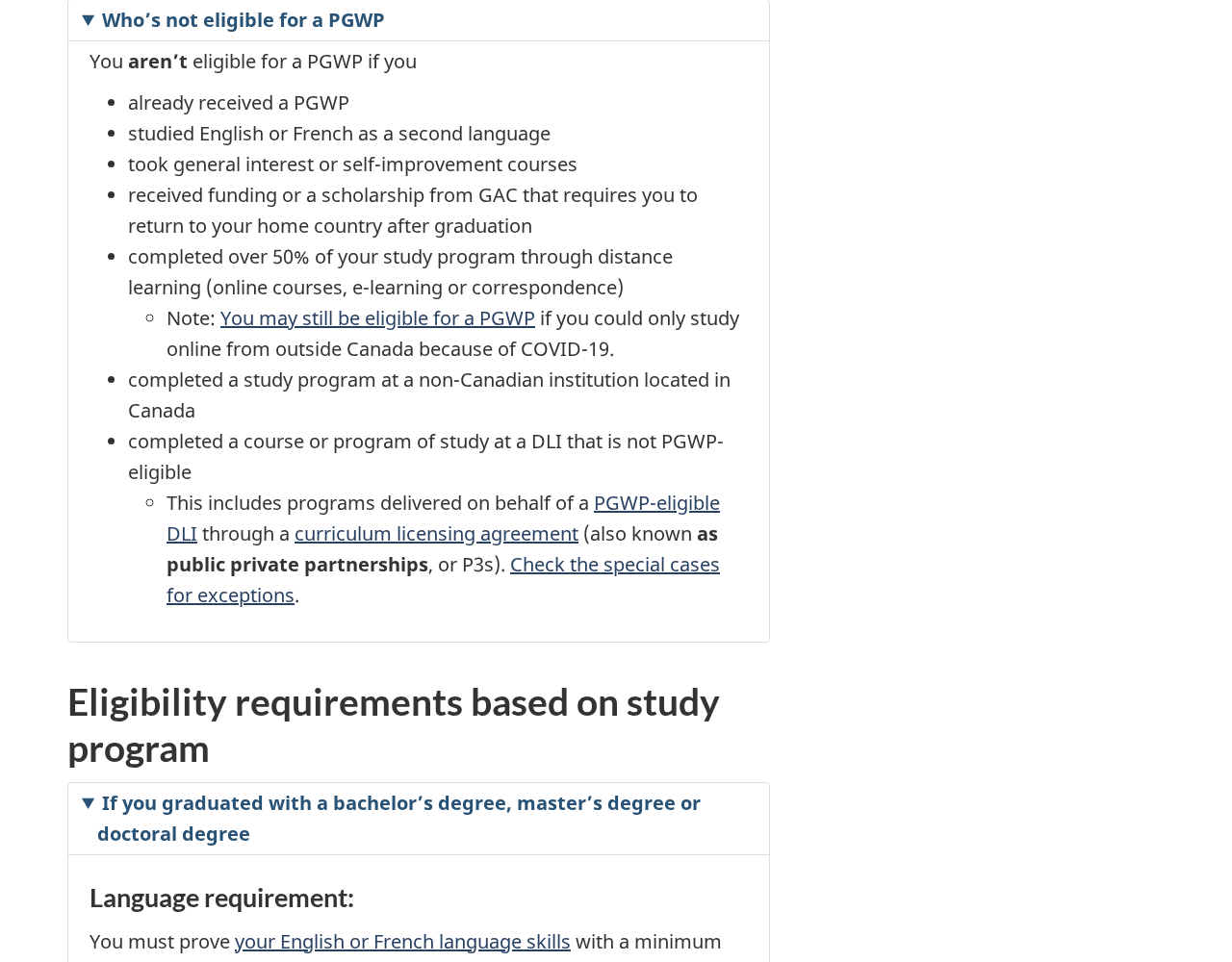
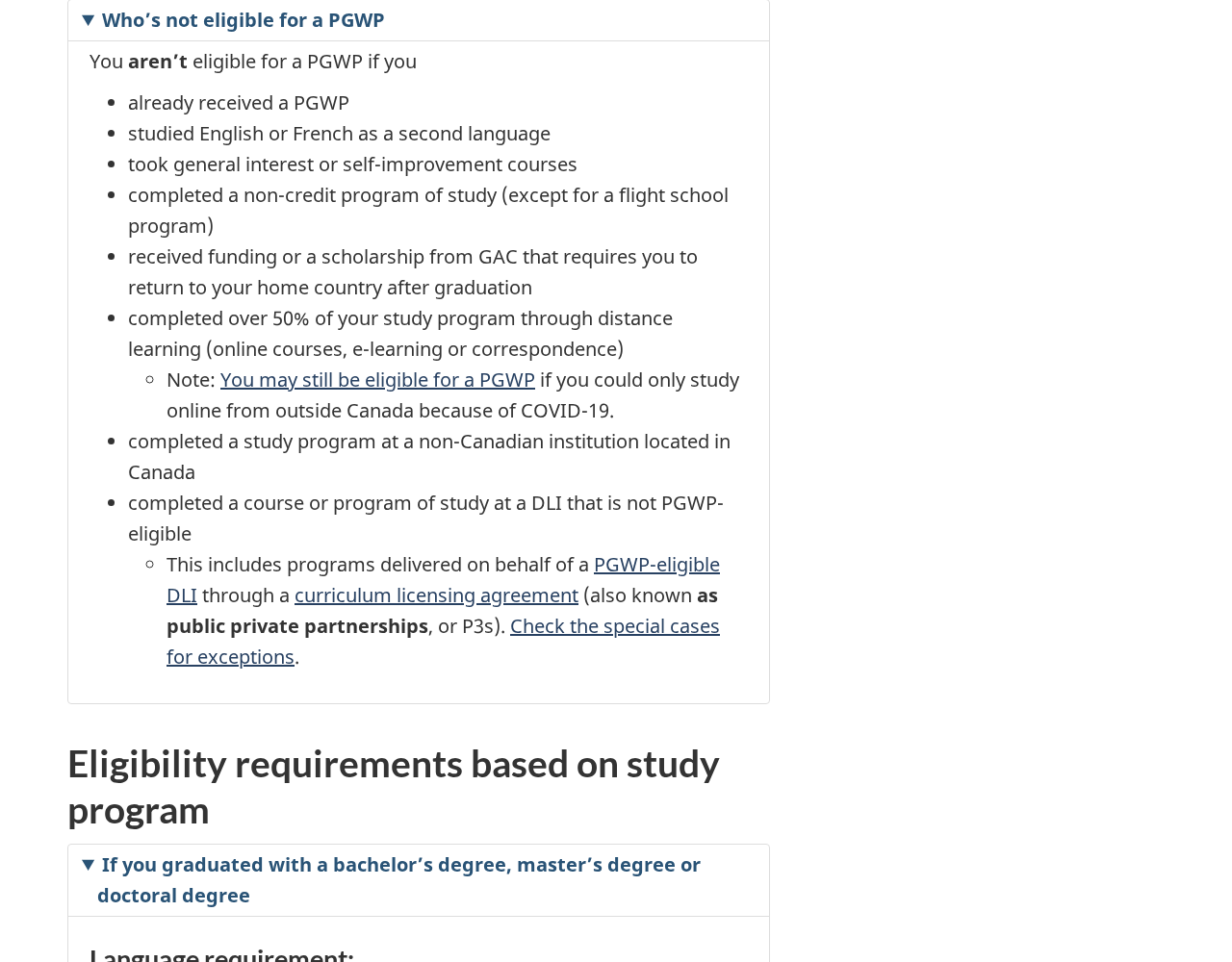
A companion page — “Get documents proving you meet PGWP eligibility” — was updated the same week to define the new gate: “A credit-earning program gives official credits toward a degree, diploma or certificate at a college or university.” Non-credit programs, by that definition, are excluded from the PGWP even when they end in a diploma or certificate from a Designated Learning Institution.
A real refusal, thirteen days later
Our client (details withheld to protect solicitor-client privilege) completed a Teacher Assistant Diploma at Portage College — a public Alberta DLI — delivered at the Campbell College partner campus. He entered Canada on 16 April 2024, finished the program, and filed his PGWP application on 28 March 2026. The refusal was issued on 7 July 2026. The Global Case Management System note reads, in full:
“The completed Teacher Assistant Diploma program is a non-credit program, as such the program does not meet the criteria for work authorization under R205(c)(ii). Application refused under R200(1)(c)(ii)…”
Two regulatory provisions. Neither of them contains the word “credit.” Let’s look at them.
Where the officer says the rule lives — and where it actually lives
The Immigration and Refugee Protection Regulations, SOR/2002-227, are the operating statute for every work permit issued in Canada. The two sections the refusal cites read (verbatim from justice.gc.ca):
Section 200(1)(c)(ii) — the general issuance rule
“Subject to subsections (2) and (3) — and, in respect of a foreign national who makes an application for a work permit as a member of the live-in caregiver class, subject to section 112 — an officer shall issue a work permit to a foreign national if, following an examination, it is established that the foreign national … (c) intends to perform work described in … (ii) section 205.”
Section 205(c)(ii) — the delegation to the Minister
“A work permit may be issued under section 200 to a foreign national who intends to perform work that … (c) is designated by the Minister as being work that can be performed by a foreign national on the basis of the following criteria, namely, … (ii) limited access to the Canadian labour market is necessary for reasons of public policy relating to the competitiveness of Canada’s academic institutions or economy.”
Notice what is not in the text of either section. The word “credit” does not appear. Neither does “diploma,” “certificate,” or “non-credit.” Section 205(c)(ii) is a delegation clause — it gives the Minister the authority to designate categories of work that a foreign national can perform without a Labour Market Impact Assessment. The PGWP is one such category. But the section itself contains no eligibility criteria for the graduate; it only sets the policy purpose (Canada’s academic and economic competitiveness).
So where does the “non-credit” rule actually live? In three places, none of them regulatory:
- The public “Who can apply” webpage at canada.ca — the page updated on 24 June 2026.
- The Program Delivery Instructions (PDIs) — IRCC’s internal operational manual, published online but explicitly labelled as guidance, not law.
- The “Get documents” page, updated the same week, which introduces the definition of “credit-earning program.”
No section of the IRPR was amended. No Ministerial Instruction was published in the Canada Gazette. The only 2026 IRPR amendment on record is SOR/2026-63, which deals with Provincial Nominee Program allocations — unrelated to PGWP eligibility. The rule the officer applied to refuse our client is, in the strict legal sense, a policy manual entry, not a regulation.
Start your secure Work Permit intake
Skip the back-and-forth. Complete a structured intake in 25 minutes. Reviewed by Dimple Verma, RCIC-IRB. No payment required to start.
Why is IRCC doing this now?
The context matters. Since 2024, IRCC has been tightening the PGWP in successive waves:
- 1 September 2024 — Private-college / public-partnership (curriculum licensing / P3) graduates lost PGWP eligibility.
- 1 November 2024 — New language and field-of-study requirements were added for college graduates.
- June 2026 — The “non-credit program” exclusion appeared on the eligibility page.
The department has publicly stated it is trying to reduce the temporary-resident population from roughly 6.5% to 5% of the Canadian population by 2027. The PGWP is one of the largest volume drivers of temporary residents. Every eligibility gate that can be tightened by policy — without the friction of a regulatory amendment — is being tightened.
“Non-credit” is a particularly efficient gate because a large share of continuing-education, corporate-training, and partner-campus programs at DLIs are structured as non-credit by design. Some are excellent, career-relevant programs. But because the credits do not “ladder” into a degree pathway, they now fall outside the PGWP even where the DLI itself is on the PGWP-eligible list.
The unfair edge: the school itself often admits the program is non-credit
Here is what makes these refusals particularly difficult: in many cases, the school’s own website confirms the program is non-credit — but that fact was not front-and-centre when the student enrolled, paid tuition, and completed the coursework. Portage College, for example, publishes the following statement on its Continuing Education page:
“Portage Certificate and Diploma programs that run at the Campbell College or CIOT locations are delivered exclusively in person and are non-credit.”
The CIOT Calgary campus, which delivers several Portage-branded diplomas, states even more directly on its Teacher Assistant program page: “PGWP Eligibility: Students starting after May 2024 will not be eligible for PGWP,” and “Academic Transfer Credits: No.”
The information is public — but it is buried, and it was not consistently disclosed to prospective international students in 2024 when many enrolled. Students paid for a diploma from a public DLI in good faith, believing PGWP eligibility followed. Now, mid-2026, the credit status of the program is being used to refuse the very work permit the diploma was meant to unlock.
What the Federal Court has said about this kind of policy pivot
The Federal Court has heard multiple PGWP-refusal judicial reviews in the last three years. Three lines of reasoning are especially relevant to a “non-credit” refusal:
1. IRCC is not bound to warn students about DLI-level eligibility problems
In Masam v Canada (MCI), 2018 FC 751, the Federal Court held that a study permit issued for a specific DLI does not create a duty on IRCC to notify the applicant that the program will not qualify for a PGWP. Being a DLI is necessary but not sufficient. This line of authority makes the “I paid tuition in good faith” argument, on its own, unlikely to win a judicial review.
2. PGWP criteria are strictly applied, and officer discretion is narrow
In Odeseye v Canada (MCI), 2025 FC 93 and Chahal v Canada (MCI), 2025 FC 1910, the Court confirmed that PGWP criteria — as set out in the operational instructions — are to be strictly applied, and officers have very limited residual discretion once an eligibility criterion is unmet. This is a headwind for reconsideration arguments premised on “the officer should have exercised discretion.”
3. Officers must engage with the applicant’s evidence — including school documentation
The Court has repeatedly quashed PGWP refusals where officers failed to engage with the applicant’s supporting documentation. In Tcerkovnaia v Canada (MCI), 2022 FC 861, the Court held that where an applicant tenders evidence from the institution about the nature of the program, the officer must actually consider it rather than rely solely on IRCC’s internal list. In Sharma v Canada (MCI), 2022 FC 779, procedural fairness was breached where the officer relied on information about the school that had not been shared with the applicant. And the reasonableness standard on judicial review, per Canada (MCI) v Vavilov, 2019 SCC 65, requires the decision maker’s reasoning to be transparent, intelligible, and justified against the applicable law and the record before them.
Three attack vectors — ranked by strength
Once you strip away the surface framing, a “non-credit” PGWP refusal actually opens three legal fronts. Not all are equally strong.
Vector 1 — Legitimate expectations (weak on its own)
The doctrine of legitimate expectations in Canadian administrative law is procedural, not substantive. Even where a student can prove they enrolled in reliance on published PGWP criteria that did not exclude “non-credit” programs, the doctrine will not force IRCC to issue the permit. At best, it may support an argument for a fair opportunity to respond before the refusal is finalized. It is a supplementary argument, not a lead argument.
Vector 2 — Reasonableness on the facts (moderate)
This is where Tcerkovnaia and Vavilov live. Was the “non-credit” characterization on the file supported by evidence the officer actually considered? Did the applicant tender academic transcripts, a program-completion letter, a registrar’s statement, or an institutional letter clarifying credit status? Did the officer engage with that evidence, or copy-paste a template refusal? If the officer relied entirely on IRCC’s internal characterization without engaging with the applicant’s tendered evidence, the refusal is vulnerable on reasonableness grounds.
Vector 3 — Ultra vires: no regulatory anchor for the “credit” rule (strongest, novel)
This is the argument the case law has not yet squarely addressed. The refusal is issued under R200(1)(c)(ii) and R205(c)(ii). Neither section contains the word “credit,” “diploma,” or “certificate.” The concept of a “credit-earning program” appears only in a webpage and in PDIs, neither of which is a regulation. Section 205(c) is a delegation to the Minister to designate categories of work — not a delegation to add substantive eligibility criteria to individual permits via webpage edits.
An applicant can therefore argue that adding “non-credit” as a substantive eligibility bar, in the absence of a Ministerial Instruction published in the Canada Gazette or a regulatory amendment, is ultra vires the framework of the IRPR. This argument survives a reasonableness review only if it is properly pleaded and supported by evidence about how the rule was introduced. It is a longer JR argument, but it is the strongest one.
The 6-month bar under R200(3)(e) — don’t overlook it
There is a serious downstream risk from a PGWP refusal that must be flagged. Under paragraph 200(3)(e) of the Regulations, an officer shall not issue a work permit if the foreign national has engaged in unauthorized work in Canada — including working after status has expired — during the 6 months preceding the current application. A PGWP refusal does not by itself make prior work unauthorized. But if the graduate was working on maintained status pending the PGWP decision and continues to work after the refusal is communicated, the R200(3)(e) clock starts. That can cascade into future work-permit refusals for the next six months, well beyond the immediate PGWP file.
If you receive a “non-credit” refusal and are currently working, stop, get counsel, and do not assume the refusal is only about the PGWP.
Reconsideration or judicial review — which one?
There are two remedies in practice, and they run on very different timelines.
- Reconsideration request — a written submission back to IRCC asking the same office to look at the file again. No filing fee, no court. Best used where there is new documentation the officer did not have — for example, a fresh institutional letter from the DLI clarifying that the program does award transferable credits, or a registrar’s statement contradicting the “non-credit” characterization. Reconsideration is discretionary; IRCC is not required to reopen the file. But it is the fastest and cheapest first step where the record can be strengthened.
- Judicial review at the Federal Court — an application for leave and judicial review filed within 15 days of receiving the refusal (for in-Canada decisions) or 60 days (for outside-Canada decisions). This is where the reasonableness and ultra vires arguments live. If the record already supports the arguments and reconsideration is likely to fail, JR is the direct path. Do not miss the deadline — the clock runs from receipt of the refusal letter, not from the date on the letter.
In many files, both steps are pursued in parallel: a reconsideration request is filed immediately, and a JR is filed to preserve the deadline while the reconsideration is being considered. If the reconsideration succeeds, the JR is discontinued.
If you received a “non-credit” PGWP refusal
The 15-day judicial review clock is the most important number on your refusal letter. Move quickly on the paperwork, but do not settle for the letter’s headline reason as the last word. In our experience, roughly half of “non-credit” refusals are refuseable on the record — either because the program in fact awards transferable credits and the officer’s characterization is wrong, or because the officer did not engage with the DLI documentation on file. The other half will need the ultra vires argument developed properly.
Book a consultation with the VG Immigration team. Bring the refusal letter, your Global Case Management System notes if you have them, your program transcripts, and your original letter of acceptance. We will review the file under professional supervision of Dimple Verma, RCIC-IRB (R708308), and give you a straight assessment of whether reconsideration, judicial review, or both is the right path.
Related reading on our blog: recent immigration updates and analysis, and case tools at app.vgis.ca.
Sources
- Immigration and Refugee Protection Regulations (SOR/2002-227), sections 200 and 205 — justice.gc.ca
- IRCC, “Who can apply for a Post-Graduation Work Permit” — canada.ca live page (date modified 2026-06-24)
- Wayback Machine snapshot, 6 June 2026 — before the update
- Wayback Machine snapshot, 8 July 2026 — after the update
- IRCC, “Get documents proving you meet PGWP eligibility” — canada.ca
- Portage College Continuing Education page — portagecollege.ca
- CIOT Calgary Teacher Assistant program page — ciotcalgary.ca
- Masam v Canada (MCI), 2018 FC 751 — CanLII
- Odeseye v Canada (MCI), 2025 FC 93 — CanLII
- Chahal v Canada (MCI), 2025 FC 1910 — CanLII
- Tcerkovnaia v Canada (MCI), 2022 FC 861 — CanLII
- Sharma v Canada (MCI), 2022 FC 779 — CanLII
- Canada (MCI) v Vavilov, 2019 SCC 65 — CanLII
Published by VG Immigration Services Inc. under the professional supervision of Dimple Verma, RCIC-IRB (R708308). This article is for legal information only and does not create a solicitor-client relationship. For advice specific to your file, book a consultation.