

Posted by: Dimple Verma, RCIC-IRB #R708308
VG Immigration Services Canada
Published: March 12, 2026
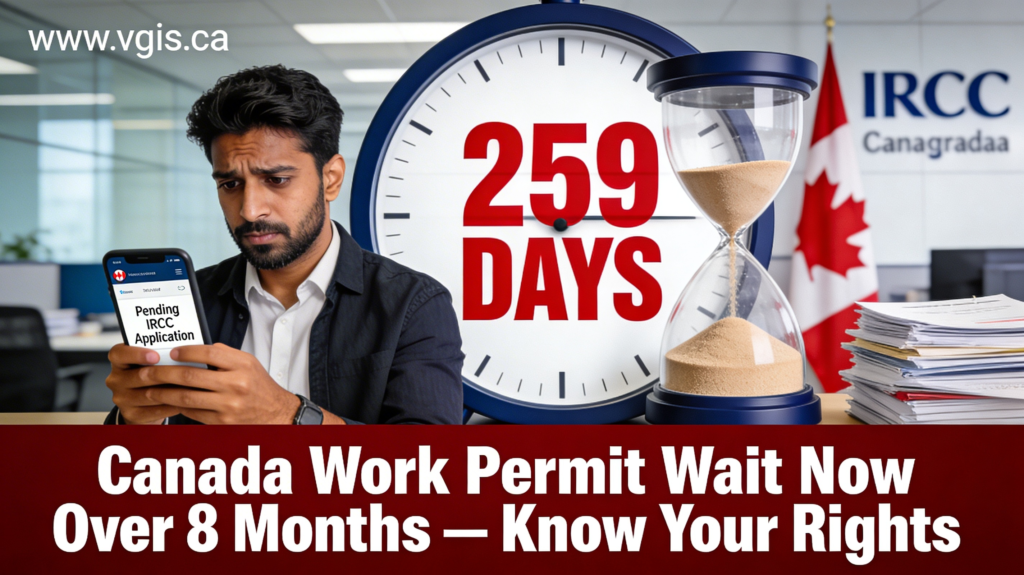
If you applied for a work permit extension from inside Canada in 2026, prepare yourself — the wait just hit a new record high. As of March 11, 2026, IRCC’s inland work permit processing time has reached 259 days — that is over 8.5 months of waiting for a document that thousands of temporary foreign workers need simply to keep earning a living in Canada.
And the numbers are still climbing — every single week.
📊 Work Permit Processing Times: March 2026 Snapshot
Here is where IRCC processing stands as of March 11, 2026:
| Application Type | Processing Time | Change Since Jan 28, 2026 |
|---|---|---|
| Inland Work Permit (Extension) | 259 days | +18 days |
| Visitor Record Extension | 245 days | +84 days |
| Study Permit Extension | 85 days | -19 days ✅ |
⚠️ These times represent 80% of applications — meaning 1 in 5 applicants waits even longer.
📈 How We Got Here: The Week-by-Week Climb
This is not a sudden spike. It is a persistent, relentless escalation that has added 49 days to the inland work permit timeline since the end of December 2025 alone:
| Period | Processing Time |
|---|---|
| End of December 2025 | ~210 days |
| January 28, 2026 | 241 days |
| February 2026 | 246 days |
| First week of March 2026 | 258 days |
| March 11, 2026 | 259 days |
What makes this especially alarming is the consistency. Unlike other IRCC categories that fluctuate up and down week to week, the inland work permit figure has moved in one direction only — upward — for every single update in 2026. There has not been a single week where it declined, held flat, or even slowed meaningfully. At the current pace of roughly 5 days per week, processing could exceed 300 days before summer 2026.
🔍 Why Is This Happening?
IRCC has not issued a formal explanation, but several factors are clearly driving the sustained increase:
1. Renewal wave hitting all at once
Canada admitted record numbers of temporary foreign workers in recent years. Many of those workers are now filing renewals and extensions simultaneously — creating a massive surge in the inland work permit pipeline.
2. Policy changes adding complexity
New compliance requirements for employers, tightened eligibility criteria, and Labour Market Impact Assessment (LMIA) rule adjustments introduced in late 2024–2025 added new documentation layers to every application — making each file take longer to adjudicate.
3. Complex immigration histories
Inland applicants often have complicated immigration backgrounds — employer changes, status transitions, previous refusals, or security flags. These trigger additional review steps that slow the entire queue.
4. Visitor extensions surging even faster
Visitor record extensions jumped 19 days in a single week, hitting 245 days as of March 11 — an 84-day increase since January 28. Both queues share the same IRCC processing infrastructure, creating ripple effects across categories.
5. Digital infrastructure strain
IRCC’s ongoing migration to new processing platforms creates temporary inefficiencies as officers adapt to new systems and workflows.
🛡️ What Is Implied Status — And Why It Could Save You
If your work permit expires while your renewal is pending, do not panic. Implied status is your legal protection.
Under Canadian immigration law, a temporary resident who submits a renewal or extension application before their current permit expires is considered to have maintained lawful status in Canada until IRCC renders a decision — even if processing takes 8+ months.
✅ What implied status allows you to do:
- Continue working under the same conditions as your expiring/expired permit
- Remain legally in Canada while IRCC processes your file
- Apply for PR through Express Entry, PNP, or other pathways simultaneously
❌ What implied status does NOT allow:
- Changing employers — employer-specific permit holders must stay with the same employer
- Travelling outside Canada — implied status applies within Canada only; leaving could jeopardize your re-entry without a valid physical permit
- Switching job roles — conditions of your previous permit apply until a new one is issued
💡 Pro tip from Dimple Verma, RCIC-IRB: Keep your application confirmation receipt, payment proof, and IRCC portal screenshot showing the pending application as your implied status documentation. Many workers are caught unprepared when employers ask for proof.
⚠️ The “Dummy Extension” Trap: A Warning
With 259-day waits, many temporary workers are filing dummy work permit extensions — applications submitted purely to maintain implied status with no genuine intent to continue under that permit — essentially using the system to extend their Canadian stay while waiting for other pathways.
Start your secure Work Permit intake
Skip the back-and-forth. Complete a structured intake in 25 minutes. Reviewed by Dimple Verma, RCIC-IRB. No payment required to start.
While this may provide short-term relief, it creates serious long-term consequences:
- Creates a pattern of status maintenance without progression — a red flag on future PR applications
- Does not count as qualifying work experience in the same way
- Delays integration into proper PR pathways like Express Entry or PNP
- If PR pathways become unavailable, you may find yourself in an increasingly difficult position
The smarter strategy: Use this waiting period to actively advance your permanent residence application rather than simply maintaining temporary status.
📅 What to Expect for the Rest of 2026
The outlook is cautious at best:
- No backlog reduction initiative has been announced by IRCC for inland work permits
- The government’s push to reduce temporary residents may paradoxically increase processing times as scrutiny tightens
- Many more work permits are expiring throughout 2026, meaning the renewal wave has not peaked yet
- 259 days should be treated as a floor, not a ceiling — planning for a 9-to-10-month wait is prudent
- Potential IRCC policy announcements later in 2026 could introduce automated tools or simplified renewal processes — but nothing has been confirmed
🚨 Visitor Record Extensions: The Hidden Emergency
While work permit holders worry about 259 days, visitor record extensions are in an even more alarming situation — jumping 19 days in a single week to reach 245 days as of March 11, 2026.
If you are on a visitor record and need to extend your stay in Canada, file immediately — do not wait. The longer you delay, the closer you get to a status gap that could disqualify you from critical pathways.
✅ What You Should Do Right Now
Whether your work permit expires in 3 months or 12 months, here is your action plan:
1. File your extension as early as possible
Do not wait until the last minute. With 259-day waits, filing 6–8 months before expiry gives you the best buffer and the strongest implied status protection.
2. Understand your implied status terms
Know exactly what your previous permit authorized — employer name, NOC code, location. Your implied status mirrors those exact conditions.
3. Do NOT travel outside Canada during processing
Unless absolutely necessary, stay in Canada while your renewal is pending. Re-entry without a valid physical permit is not guaranteed.
4. Pursue PR pathways simultaneously
A pending work permit renewal does not stop you from applying for Express Entry, PNP nominations, or spousal sponsorship. Use the wait time productively — not just to maintain status but to advance your permanent residence journey.
5. Document everything
Keep copies of your application confirmation, payment receipt, and IRCC portal screenshots. Employers, banks, and provincial health authorities may ask for proof of your legal status during the wait.
6. Consult a regulated RCIC now
With processing times at record highs and policy changes accelerating, a professional review of your file can identify faster pathways, prevent costly errors, and ensure your status is protected throughout the process.
💼 VG Immigration: Protecting Your Status While You Wait
At VG Immigration Services, we help temporary foreign workers in Canada navigate record-high processing delays without losing status, employment eligibility, or progress toward permanent residence.
We help you with:
- ✅ Work permit extension applications — filed correctly and on time to preserve implied status
- ✅ Implied status documentation — ensuring your employer and health coverage remain uninterrupted
- ✅ PR pathway acceleration — CEC, PNP, spousal, and TR to PR applications filed in parallel
- ✅ Employer change strategy — navigating mid-wait employer transitions without breaking your status
- ✅ Travel risk assessment — knowing when it is safe to travel and when it is not during your wait
- ✅ Refused and complex files — rebuilding applications after refusal or status gaps
With 259 days on the clock, every week you delay costs you protection. Book a Consultation and let us build a strategy around your specific permit, employer, and PR timeline today.
❓ Frequently Asked Questions
Q: Can I change jobs while waiting for my work permit renewal at 259 days?
If your permit is employer-specific, implied status only covers the same employer and conditions. To change employers, a new application with a valid LMIA (if required) must be filed. Open work permit holders have more flexibility.
Q: Does my LMIA expire during the 259-day wait?
An LMIA is valid for 6 months from issuance — but only for the purposes of submitting a work permit application. Once your application is filed within that 6-month window, the LMIA has served its purpose and its expiry does not affect your pending file.
Q: Can I apply for PR while waiting for my work permit renewal?
Absolutely. A pending work permit renewal does not disqualify you from any PR pathway. In fact, using the 259-day wait to advance a PR application is one of the smartest moves you can make.
Q: Will IRCC tell my employer about my application status?
No. IRCC communicates only with the applicant or their authorized representative. You are responsible for keeping your employer informed. Employers can use the IRCC Employer Portal to verify permit validity — but cannot see pending application details.
📌 This blog is for informational purposes only and does not constitute legal advice. Immigration rules change frequently. Always consult a licensed RCIC or immigration lawyer for advice specific to your situation.
👉 Stay Updated — Follow Us!
VG Immigration Services Canada keeps you informed on IRCC 2026 changes, TR to PR updates, OINP draws, and settlement service deadlines.
📸 Instagram: Follow @vgis_can — Daily immigration tips
🎥 TikTok: Follow @vgis_can — Punjabi/English explainers
💬 WhatsApp: Free Documents List — Instant settlement checklist
VG Immigration Services Inc.
📍 211B-9300 Goreway Drive, Brampton, ON L6P 4N1
📧 case@vg-immigration.com | immigration@vgis.ca
📱 +1 416-578-9269
🌐 www.vgis.ca
Book Consultation | Contact Us
Dimple Verma, RCIC-IRB #R708308
#WorkPermitCanada2026 #IRCCProcessingTimes #WorkPermitDelay #ImpliedStatus #TFW #TemporaryForeignWorker #WorkPermitExtension #CanadaImmigration2026 #IRCCBacklog #WorkPermitRenewal #VisitorExtension #ExpressEntry #CanadaPR #VGImmigration #DimpleVerma #RCIC #BramptonImmigration #TorontoImmigration #ImmigrationCanada #WorkInCanada
Discover more from VG Immigration Services INC.
Subscribe to get the latest posts sent to your email.