Bill C-12 Is Now Law: What Canada’s New Immigration & Asylum Act Means for You

Posted by: Dimple Verma, RCIC-IRB #R708308 | VG Immigration Services Canada
Published: March 27, 2026
On March 26, 2026, Bill C-12 — the Strengthening Canada’s Immigration System and Borders Act — received Royal Assent and officially became law. This is one of the most significant overhauls to Canada’s immigration and asylum framework in recent years, impacting refugee claimants, immigration document holders, and federal data-sharing practices.
Reach Newcomers to Canada
Banks, insurance, real estate, tax & accounting, telecom, healthcare & education. Native in-article placement, 40,000+ monthly newcomer readers.
Contact Us →If you or someone you know is navigating Canadian immigration — whether as a refugee claimant, temporary resident, or permanent residence applicant — this law directly affects you. Read carefully.
🗓️ Not sure how this affects your immigration status?
👉 Book a Consultation Now — Dimple Verma, RCIC-IRB, will review your specific case and advise you on how Bill C-12 impacts your pathway.
What Is Bill C-12?
Bill C-12, also known as the Strengthening Canada’s Immigration System and Borders Act, was introduced to address growing pressures on Canada’s immigration and asylum systems. The legislation targets four core areas:
- New eligibility requirements for asylum claims
- A modernized, streamlined asylum process
- Domestic information sharing between government departments
- New immigration document and application management authorities
Each area introduces real, immediate changes that both newcomers and existing residents need to understand.
1. New Asylum Eligibility Rules — Effective June 3, 2025
Two critical new rules are now in effect and apply to all asylum claims made on or after June 3, 2025:
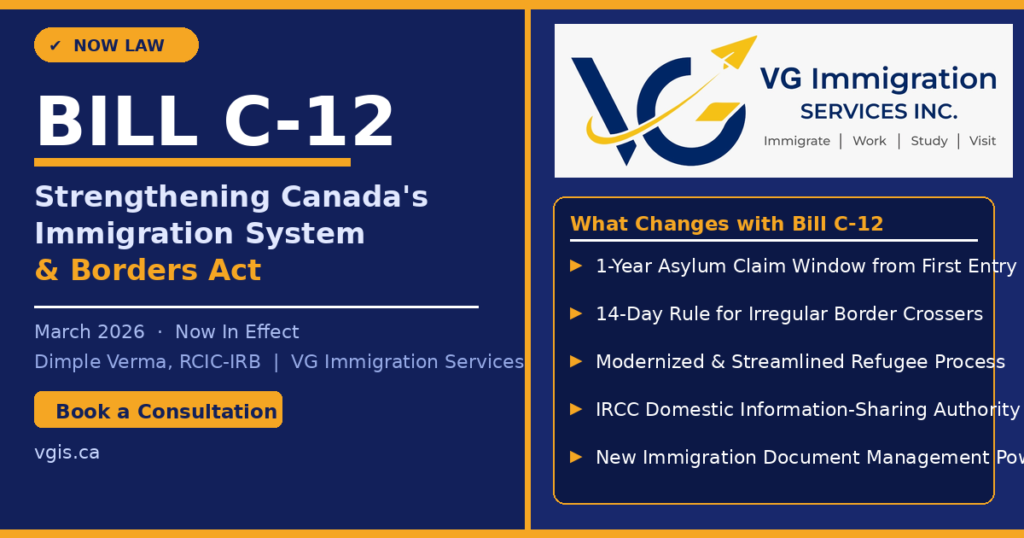
- The One-Year Rule: Asylum claims made more than one year after a person’s first entry into Canada (after June 24, 2020) will not be referred to the Immigration and Refugee Board (IRB) — regardless of whether the person left and re-entered Canada.
- The 14-Day Border Rule: Asylum claims from individuals who enter Canada between ports of entry along the Canada–US land border and wait more than 14 days to file will not be referred to the IRB.
These rules are designed to close loopholes and deter people from using asylum claims as an alternative immigration pathway.
⚠️ Important Note: Individuals affected by these new rules will still have access to a Pre-Removal Risk Assessment (PRRA) — ensuring they are not returned to countries where they face persecution, torture, or serious harm.
Special guidance will also apply for unaccompanied minors, recognizing that children may lack legal guardianship and face unique vulnerabilities.
💬 Are you or someone you know facing a refugee or asylum situation?
👉 Book a Consultation Now — We will assess your eligibility under the new rules and identify your best protection options.
2. A Modernized Asylum Process
Over the coming months, the federal government will update the Immigration and Refugee Protection Regulations to make the asylum process faster and fairer. Key changes include:
- Simplified online applications — fewer duplicate questions and forms
- Schedule-ready claims only — only complete, ready-to-decide claims will be referred to the IRB
- Presence requirement — the IRB will only decide claims while the claimant is physically in Canada; voluntarily returning to one’s home country before a decision means the claim is considered abandoned
- Removal of inactive cases from the system
- Faster voluntary departures — removal orders take effect the same day a claim is withdrawn
- Representative appointments for vulnerable claimants — including minors or those who do not understand the legal process
3. Domestic Information Sharing — A New Legal Framework
IRCC now has clear legal authority to share specific personal information within the department and with federal, provincial, and territorial government partners. This was previously a grey area — the new law formalizes and secures it.
Start your secure Immigration intake
Skip the back-and-forth. Complete a structured intake in 25 minutes. Reviewed by Dimple Verma, RCIC-IRB. No payment required to start.
What this means:
- IRCC can share identity, immigration status, and document information with government partners via written information-sharing agreements
- IRCC can now use data from one program to process another — for example, permanent residence data can be used to process citizenship applications more efficiently
- Provinces and territories cannot share your information with foreign countries without IRCC’s written permission and compliance with Canada’s international obligations
Privacy protections remain intact:
- A Privacy Impact Assessment (PIA) is required for every new use of personal information
- Information can only be shared with partners who are legally authorized to collect it, for specific, documented purposes
📌 Your rights under the Canadian Charter remain fully protected under the new information-sharing framework. For details, see our Privacy Policy.
4. New Immigration Document & Application Authorities
The Government of Canada now has powerful new tools to manage immigration documents and applications at scale — including visas, eTA (electronic travel authorizations), work permits, and study permits.
When it is in the “public interest” (covering fraud, administrative errors, public health, safety, or national security), IRCC may now:
- Cancel, suspend, or modify a large group of immigration documents
- Pause application intake
- Cancel or suspend application processing
Key safeguards:
- No single minister can make these decisions alone — each requires Governor in Council approval via Cabinet recommendation
- Every decision is published in the Canada Gazette and reported to Parliament
- These authorities do not affect asylum claims and cannot grant, change, or revoke permanent or temporary resident status
🗓️ Are you a permit or visa holder concerned about how this affects your status?
👉 Book a Consultation Now — Dimple Verma, RCIC-IRB, will review your document status and flag any risks.
What Bill C-12 Does NOT Change
It is equally important to know what did not change:
- The Safe Third Country Agreement remains in effect — people who claim at ports of entry along the Canada–US border are still returned to the US (unless they qualify for an exception)
- Permanent resident and temporary resident status cannot be revoked under the new document management authorities
- Asylum claims remain separate from the new document suspension/cancellation powers
Why This Matters for Your Immigration Journey
| Area | Before Bill C-12 | After Bill C-12 |
|---|---|---|
| Asylum eligibility window | Open-ended after entry | 1 year from first entry (post-June 24, 2020) |
| Border irregular claimants | No specific time limit | Must claim within 14 days of crossing |
| IRCC information sharing | Legally unclear/inconsistent | Formalized with privacy safeguards |
| Document management at scale | No Cabinet-level mechanism | Governor in Council required with public reporting |
| Vulnerable claimants | No representative support | Mandatory representative appointments available |
How VG Immigration Services Can Help
At VG Immigration Services, we stay ahead of every regulatory change — and Bill C-12 is one of the most impactful in years. Whether you are a refugee claimant, permit holder, or sponsoring a family member, our services include:
- ✅ Asylum Eligibility Assessment — We review your entry date, claim timeline, and current status to confirm whether the new 1-year and 14-day rules affect you
- ✅ PRRA & Protected Person Guidance — We advise individuals affected by the new eligibility rules on accessing Pre-Removal Risk Assessments
- ✅ Document & Permit Review — We monitor your permit/visa status in light of the new document management powers
- ✅ Full Immigration File Management — From Express Entry to refugee protection to citizenship, we manage every step with precision
- ✅ Privacy-Compliant Representation — All your personal data is handled under our Privacy Policy and in line with IRCC’s new information-sharing framework
🧭 Ready to understand how Bill C-12 affects your case?
👉 Book a Consultation Now — One session with Dimple Verma, RCIC-IRB, gives you clarity, strategy, and peace of mind.
Frequently Asked Questions
Q: I entered Canada in 2023 and have not yet filed an asylum claim. Am I affected?
Yes — if you entered after June 24, 2020 and more than one year has now passed since your first entry, your claim may no longer be referred to the IRB. You may still be eligible for a PRRA. Contact us immediately.
Q: I crossed the border irregularly and filed after 14 days. What happens to my claim?
Under the new law, your claim will not be referred to the IRB. However, you still have access to a Pre-Removal Risk Assessment. Speak with a licensed RCIC or immigration lawyer right away.
Q: Does this affect my work permit or study permit?
The new document management powers theoretically apply to permits in exceptional public interest situations (fraud, security). There is no current active suspension order. However, this is a new tool worth monitoring. Book a consultation if you have concerns.
Q: Are my personal records at IRCC now being shared more broadly?
Sharing is now more structured and legally authorized, but safeguards — including Privacy Impact Assessments and written agreements — must be in place. Your Charter rights remain protected. See our Privacy Policy for how we protect your data.
📌 This blog is for informational purposes only and does not constitute legal advice. Immigration laws and regulations change frequently. Always consult a licensed RCIC or immigration lawyer for advice on your specific situation. Refer to the official IRCC website for authoritative information.
👉 Stay Updated — Follow Us!
VG Immigration Services Canada keeps you informed on every immigration law change, Express Entry draw, PNP stream update, and PR opportunity across Canada.
📸 Instagram: Follow @vgis_can — Daily immigration tips
🎥 TikTok: Follow @vgis_can — Punjabi/English explainers
💬 WhatsApp: Chat with us — Free Documents List & Instant Help
VG Immigration Services Inc.
📍 211B-9300 Goreway Drive, Brampton, ON L6P 4N1
📧 immigration@vgis.ca
📱 +1 416-578-9269
🌐 www.vgis.ca | Book Consultation | Contact Us
Dimple Verma, RCIC-IRB #R708308