
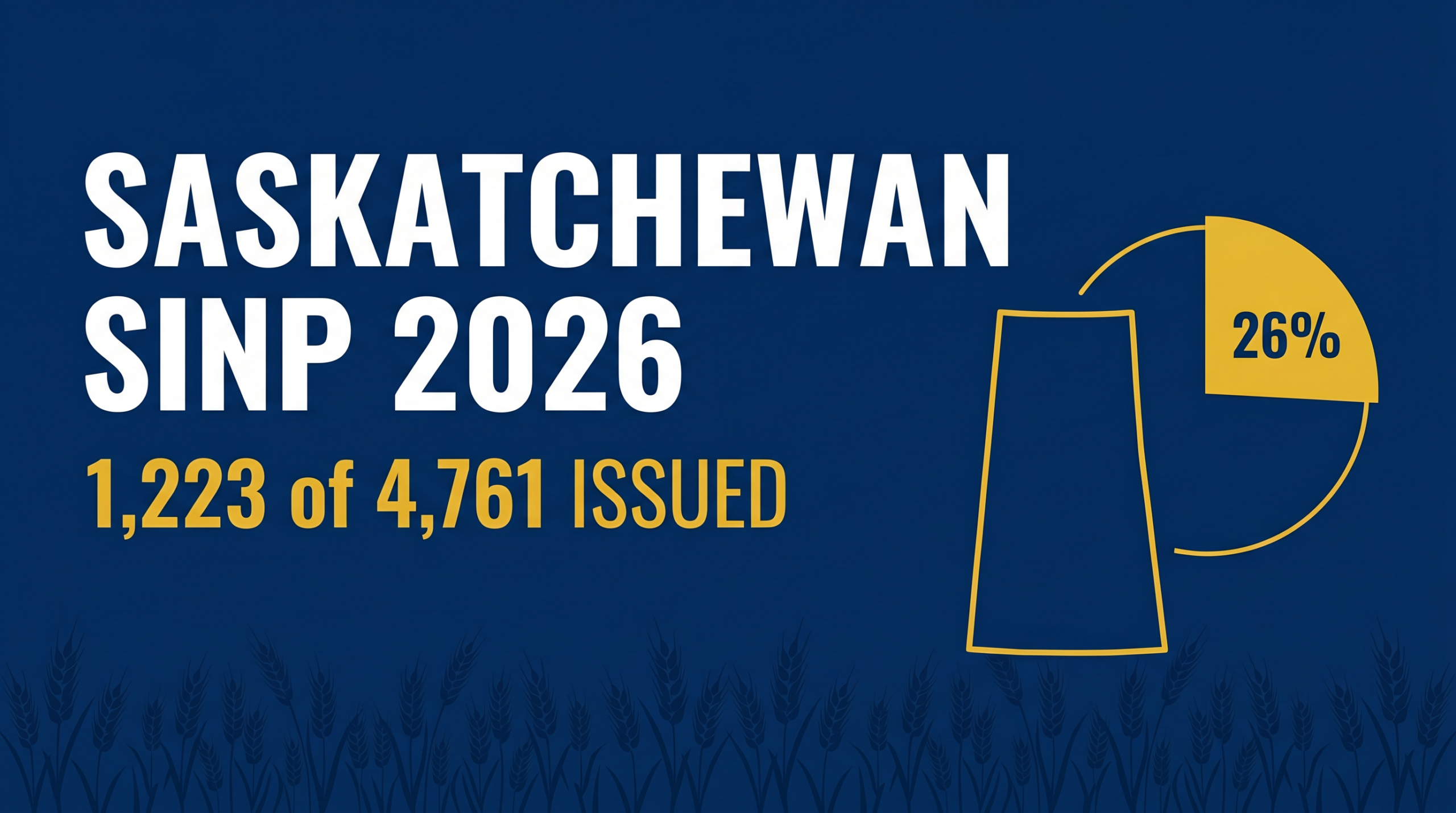
Saskatchewan SINP 2026: 26% of Nominations Already Used — What’s Left
Posted by: Dimple Verma, RCIC-IRB #R708308 | VG Immigration Services Canada
Published: April 22, 2026
Saskatchewan Has Already Used 26% of Its 2026 Nomination Quota — Here Is What You Need to Know
Saskatchewan’s International Nominee Program (SINP) entered 2026 with an ambitious target: 4,761 provincial nominations to attract skilled workers across a range of in-demand industries and help the province address its persistent labour market gaps. By mid-April 2026, 1,223 of those nominations — roughly one in four — had already been issued. That leaves 3,538 spots still on the table, but the pace of uptake varies meaningfully from one sector to the next. Whether you are a healthcare professional, a truck driver, or a recent graduate of a Saskatchewan college, understanding exactly where the remaining nominations sit — and what rules govern access to them — is the key to timing your SINP application strategically.
Reach Newcomers to Canada
Banks, insurance, real estate, tax & accounting, telecom, healthcare & education. Ask about relevant native in-article placements.
Contact Us →Key Highlights
- Saskatchewan’s total 2026 SINP allocation is 4,761 nominations.
- 1,223 nominations (26%) have been issued as of mid-April 2026, leaving 3,538 available for the rest of the year.
- Priority sectors have issued 689 of 2,380 allotted spots (29%), with 1,691 still remaining.
- Capped sectors (Accommodation & Food Services, Retail Trade & Other Services, Trucking) have collectively issued 308 of 1,190 allotted spots.
- Other sectors have issued 226 of 1,190 allotted spots (19%), leaving 964 available.
- The next capped-sector intake opens May 4, 2026 — 8:30 am CST for Trucking and Retail, 12:30 pm CST for Accommodation and Food.
- Saskatchewan issues nominations on a rolling or intake basis, not through regular draws — and updates its allocation data quarterly.
- 750 priority-sector nomination slots are exclusively reserved for graduates of Saskatchewan Designated Learning Institutions (DLIs) employed in priority sector occupations.
Priority Sectors: Where Most Nominations Are Flowing
The single largest block of Saskatchewan’s 2026 allocation — 2,380 nominations — is directed toward priority sectors. These are the industries where the province faces its most acute labour shortages, and they span a broad range of occupations: Healthcare, Agriculture, Skilled Trades, Mining, Manufacturing, Energy, and Technology. As of mid-April, 689 of these nominations (29%) had been issued, leaving 1,691 still available. For eligible workers, this is encouraging news: the priority sector stream has the most capacity of any category, and it carries no scheduled intake windows. Qualified applicants can submit at any point during the year without waiting for a specific date to open. That flexibility is a meaningful advantage when compared with the rigid intake schedule that governs the capped sectors.
Embedded within the priority sector allocation is a reserve that deserves careful attention: 750 of the 2,380 nominations are set aside exclusively for international graduates of Saskatchewan Designated Learning Institutions (DLIs) who are employed — or have accepted employment — in a priority sector occupation. This is not a general pool that any skilled worker can access; it is specifically for people who completed a recognized post-secondary program at a Saskatchewan institution and then transitioned into priority sector work in the province. Saskatchewan introduced this reserve to retain locally trained international talent and reduce the outflow of graduates to other provinces. If you fit this profile, you are competing for nominations from a dedicated pool rather than the broader stream, which meaningfully reduces your competition. Building your application while this reserve is still largely intact is a sound strategy.
Workers in Healthcare occupations — registered nurses, licensed practical nurses, physicians, and allied health professionals — represent a significant portion of priority sector nominees each year, reflecting the healthcare staffing pressures Saskatchewan shares with most Canadian provinces. Similarly, skilled tradespeople certified in Saskatchewan and workers in the agricultural and energy sectors continue to attract strong employer demand. If you currently hold a Saskatchewan job offer or are already working in the province in any of these fields, the priority sector SINP stream is likely your most direct route to a provincial nomination in 2026. The combination of high remaining quota, open-access timing, and strong employer sponsorship rates makes this the most active and accessible part of the SINP allocation right now.
Capped Sectors: First-Come, First-Served Intakes
Three sectors in Saskatchewan’s 2026 SINP operate under a fundamentally different structure from the rest of the program: Accommodation and Food Services, Retail Trade and Other Services, and Trucking. Collectively, these capped sectors share an allocation of 1,190 nominations for the year. Unlike the open-access priority and other sector streams, applications in these categories are accepted only during scheduled intake windows, and each window operates strictly on a first-come, first-served basis. When a given intake fills its quota, it closes — regardless of how many pending applications are still waiting. Employers and workers in these sectors must plan around the intake calendar, not just their own readiness.
Here is the full 2026 intake schedule for capped sectors:
Start your secure PNP intake
Skip the back-and-forth. Complete a structured intake in 25 minutes. Reviewed by Dimple Verma, RCIC-IRB. No payment required to start.
| Intake | Date | Details |
|---|---|---|
| Intake 1 | January 20, 2026 | Opened and completed |
| Intake 2 | March 2, 2026 | Opened and completed |
| Intake 3 | May 4, 2026 | Trucking & Retail: 8:30 am CST | Accommodation & Food: 12:30 pm CST |
| Intake 4 | July 6, 2026 | To be confirmed |
| Intake 5 | September 7, 2026 | To be confirmed |
| Intake 6 | November 2, 2026 | To be confirmed |
As of mid-April, each capped sector still had meaningful nominations available: Accommodation and Food Services had issued 188 of 714 allotted spots (26%), leaving 526. Retail Trade and Other Services had issued 74 of 238 (31%), leaving 164. Trucking had issued 46 of 238 (19%), leaving 192. The healthy remaining balances suggest there is genuine quota to compete for in May — but because intakes are first-come, first-served, the window can close faster than applicants expect. Employers and workers in these sectors should treat May 4 as a hard deadline and have all required documentation finalized before that date, not on it.
One critical eligibility rule applies specifically to capped sector applications: an employer may only submit a nomination during an intake window if the employee’s current work permit has six months or less remaining at the time of submission. This rule prevents employers from nominating workers who have substantial time left on their existing permits, and it is one of the most commonly overlooked conditions in the SINP capped sector stream. If your work permit still has more than six months remaining on May 4, you are not eligible for that intake regardless of how well-prepared your application is. This makes permit expiry planning an essential part of your overall immigration strategy — something a regulated immigration consultant can help you map out accurately.
Other Sectors and Remaining Quota
Beyond priority and capped sectors, Saskatchewan’s allocation includes a third broad category simply referred to as “Other Sectors,” with 1,190 nominations earmarked for 2026. This category encompasses occupations and industries that do not fall within the designated priority sectors or the three capped industries. Notably, it is the category with the most headroom in relative terms: only 226 of those spots (19%) had been issued by mid-April, leaving 964 nominations — more than 80% of the total — still available. Like the priority stream, other sectors operate without scheduled intake restrictions, so eligible applicants can submit at any time during the year.
The high availability in the other sectors category is partly a reflection of the fact that demand in these fields tends to be lower than in designated priority sectors. But it also represents a real opportunity for workers whose occupations sit outside the headline sectors. With nearly 964 nominations remaining and no competition from intake deadlines, well-qualified candidates in this stream have a viable pathway into Saskatchewan’s 2026 SINP allocation. That said, Saskatchewan only updates its allocation data on a quarterly basis, which means usage figures shared publicly can lag by weeks or months. Working with an immigration professional who monitors the SINP system regularly is the best way to stay current on real-time availability within this category.
What This Means for You
Looking at the full picture, Saskatchewan’s 2026 SINP is roughly three-quarters available — but that does not mean the door will stay open indefinitely. The program is functioning at a healthy pace, and nominations are being issued steadily across all three main categories. The sectors with the most remaining quota today will not necessarily hold that balance through the summer and fall. Candidates who are prepared and eligible should act now rather than assume there will be equal or better availability later in the year.
If you are currently employed in Saskatchewan in a priority sector occupation, your pathway is arguably the most straightforward: the stream is open, the quota is substantial, and the province actively wants to retain workers in your field. The same applies to DLI graduates working in priority occupations — your dedicated reserve of 750 nominations is a significant advantage. For capped sector workers, the immediate focus should be on May 4: confirm your permit status, work with your employer on the application, and ensure everything is submission-ready before that date arrives. Missing one intake in a capped sector means waiting roughly two months for the next one, and each passing intake chips away at the remaining quota.
More broadly, Saskatchewan deserves serious consideration as a provincial nomination pathway even for candidates who have been focusing on higher-profile provinces. The province’s allocation is more than 4,700 nominations — a meaningful number — and its lower public profile compared to Ontario or British Columbia means competition tends to be less intense. For workers with relevant experience and a Saskatchewan employer, the SINP in 2026 is one of the more accessible provincial pathways available in Canada right now. Whether you are already living in Saskatchewan or are exploring it as a destination, getting a clear assessment of your eligibility is the logical first step.
How VG Immigration Can Help
Navigating Canada’s immigration system requires expert guidance. Dimple Verma, RCIC-IRB (R708308), Commissioner of Oaths, at VG Immigration Services can help you understand your options and build the strongest possible application.
📅 Book a Consultation | Visit vgis.ca | 💬 WhatsApp
VG Immigration Services Inc. | 211B-9300 Goreway Drive, Brampton, ON L6P 4N1 | +1 416-578-9269 | immigration@vgis.ca