

By Dimple Verma, RCIC-IRB , Founder – VG Immigration Services Inc. | Last Updated: January 30, 2026
Introduction
Canada’s Express Entry system is entering February 2026 with the most candidate-friendly conditions seen in over two years, as sustained high-volume Canadian Experience Class (CEC) draws continue driving Comprehensive Ranking System (CRS) cutoff scores to historic lows. The January 21, 2026 CEC draw issued 6,000 Invitations to Apply (ITAs) at a CRS cutoff of just 509 — the lowest CEC score since 2021 — following an earlier January 7 draw that invited 8,000 candidates at 511.
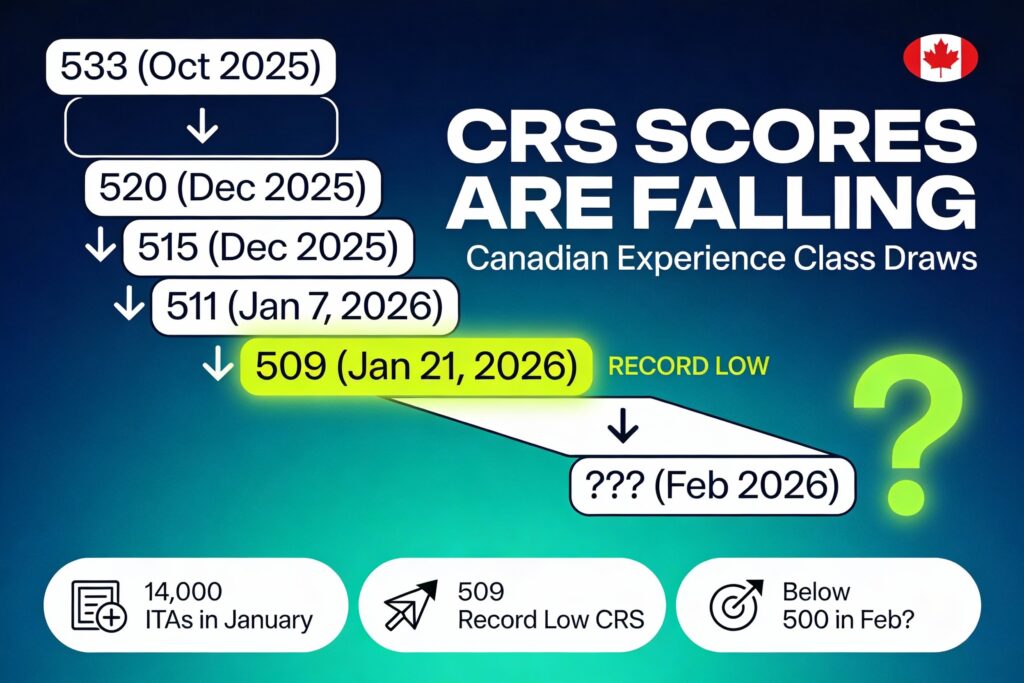
At VG Immigration Services Inc., we’ve been tracking Express Entry pool dynamics closely since Immigration, Refugees and Citizenship Canada (IRCC) shifted to a new operational rhythm in late October 2025: weekly Provincial Nominee Program (PNP) draws, followed by large CEC draws, supplemented by periodic category-based rounds targeting French speakers and healthcare workers. This pattern has resulted in 14,000 CEC invitations in January 2026 alone — a massive extraction of high-scoring candidates from the 501-600 CRS band that is creating unprecedented downward pressure on cutoff scores.
The question on every Express Entry candidate’s mind: Will CRS scores drop below 500 in February 2026?
This comprehensive analysis examines current pool composition using the January 19, 2026 snapshot (the last clean data before recent draws), forecasts likely draw sequences for early February based on IRCC’s established pattern, predicts CRS cutoff ranges for PNP, CEC, and category-based draws, and provides strategic guidance for candidates positioned between 450-520 CRS who may finally see their scores become competitive.
Contact us for personalized CRS optimization strategies and Express Entry profile assessments, or
Book an appointment to position yourself for February 2026 draws.
Understanding the Current Express Entry Landscape
IRCC’s New Draw Strategy (October 2025 – Present)
Since October 27, 2025, IRCC has operated Express Entry using a predictable weekly rhythm:
Weekly Pattern:
- Early Week (Monday/Tuesday): Provincial Nominee Program (PNP) draw (400-900 ITAs, CRS 700-760)
- Mid-Week (Wednesday/Thursday): Canadian Experience Class (CEC) draw (1,000-8,000 ITAs, CRS 509-533)
- Late Week or Following Week (Optional): Category-based draw (1,000-6,000 ITAs, varies by category)
Recent Draw History (October 2025 – January 2026):
| Date | Program | ITAs | CRS Cutoff | Notes |
|---|---|---|---|---|
| Jan 21, 2026 | CEC | 6,000 | 509 | Record low CEC since 2021 |
| Jan 20, 2026 | PNP | 681 | 746 | Standard PNP round |
| Jan 7, 2026 | CEC | 8,000 | 511 | Largest CEC draw since 2023 |
| Jan 5, 2026 | PNP | 574 | 711 | Lower PNP cutoff than typical |
| Dec 17, 2025 | French | 6,000 | 399 | Category-based |
| Dec 16, 2025 | CEC | 5,000 | 515 | Large CEC volume |
| Dec 15, 2025 | PNP | 399 | 731 | Standard PNP |
| Dec 11, 2025 | Healthcare | 1,000 | 476 | Category-based |
| Dec 10, 2025 | CEC | 6,000 | 520 | Continued CEC focus |
| Nov 28, 2025 | French | 6,000 | 408 | Category-based |
| Nov 26, 2025 | CEC | 1,000 | 531 | Smaller CEC round |
| Nov 14, 2025 | Healthcare | 3,500 | 462 | Large healthcare draw |
| Oct 27, 2025 | PNP | 302 | 761 | Pattern begins |
Key Observations:
✅ 14,000 CEC ITAs in January 2026 (8,000 + 6,000) vs. typical monthly totals of 2,000-4,000 in 2024-2025
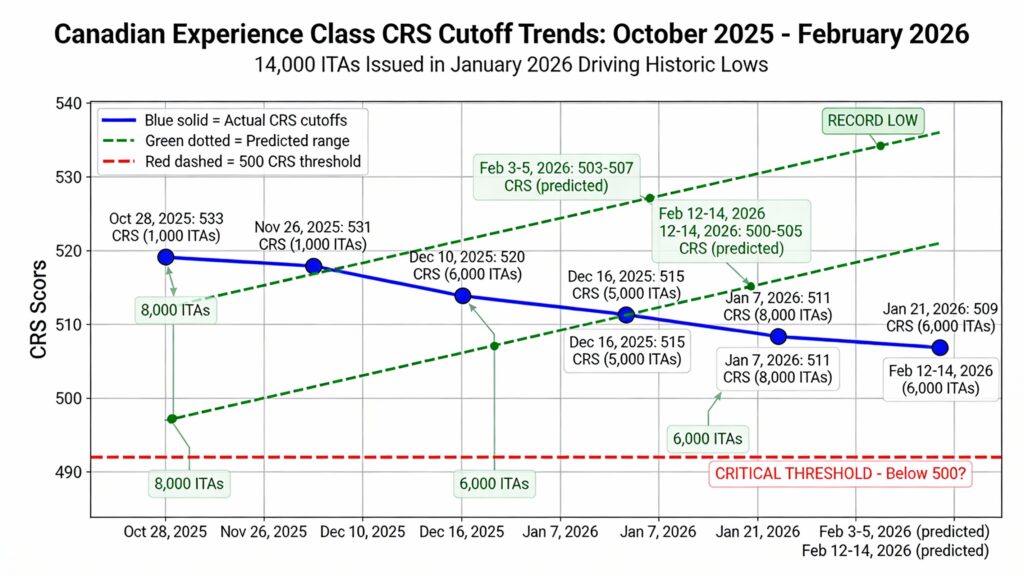
✅ CRS cutoffs dropping rapidly: 533 (Oct 28) → 520 (Dec 10) → 515 (Dec 16) → 511 (Jan 7) → 509 (Jan 21)
✅ Consistent PNP draws clear nominated candidates weekly at stable 700-760 range
✅ Category draws for French and Healthcare remain active (399-476 CRS) but don’t impact CEC pool significantly
Why This Matters: Canada’s 2026-2028 Immigration Levels Plan
The aggressive CEC draw volume aligns with Canada’s revised 2026-2028 Immigration Levels Plan released November 2025:
Permanent Residence Targets:
- 2026: 380,000 PR admissions (reduced from 395,000 in 2025)
- Economic class priority: 239,800 (63.1%) through Express Entry, PNPs, and business programs
- Focus shift: Prioritize candidates already in Canada with work experience (CEC) over Federal Skilled Worker (FSW) applicants abroad
Temporary Resident Reductions:
- Work permit caps: 230,000 total (2026), with International Mobility Program (LMIA-exempt) at 170,000 and Temporary Foreign Worker Program (LMIA-based) reduced to 60,000
- Student visa caps: 155,000 new study permits (2026)
- Goal: Reduce temporary resident population to below 5% of Canada’s total population by 2027
Strategic Implication:
IRCC is prioritizing candidates already in Canada (CEC-eligible workers and international graduates) over applicants residing abroad, explaining the sustained focus on large CEC draws while FSW remains dormant.
Express Entry Pool Analysis: January 19, 2026 Snapshot
Current Pool Composition
The most recent pool distribution data from January 19, 2026 (before the Jan 20-21 draws) shows:
| CRS Range | Candidates (Jan 19, 2026) | Candidates (Jan 4, 2026) | Candidates (Dec 14, 2025) | Change Since Dec 14 |
|---|---|---|---|---|
| 601-1200 | 677 | 559 | 390 | +287 |
| 501-600 | 16,341 | 21,013 | 21,792 | -5,451 |
| 491-500 | 13,278 | 12,873 | 12,315 | +963 |
| 481-490 | 12,942 | 12,499 | 12,149 | +793 |
| 471-480 | 15,965 | 15,435 | 14,859 | +1,106 |
| 461-470 | 15,320 | 14,881 | 14,535 | +785 |
| 451-500 | 72,714 | 70,523 | 68,700 | +4,014 |
| 401-450 | 66,836 | 65,120 | 66,948 | -112 |
| Below 400 | 80,552 | 79,339 | 79,472 | +1,080 |
| Total Pool | 237,120 | 236,554 | 237,302 | -182 |
Critical Insights from Pool Data
1. The 501-600 Band is Shrinking Fast
Despite 13,000 total ITAs issued between December 14, 2025 and January 19, 2026, the 501-600 range only decreased by 5,451 candidates — meaning approximately 7,500 new profiles entered this band during the same period. This demonstrates:
- High inflow rate: New candidates continually enter the 500+ zone through profile creation, CRS point gains (new work experience months, improved language scores, spouse education/language updates)
- Net reduction still occurring: Even with significant inflow, large draws are extracting more candidates than the pool can replace
After the January 21, 2026 draw (6,000 ITAs at 509):
Estimated remaining candidates in 501-600 range: ~13,300 (accounting for ~3,000 net removal)
2. The 491-500 Band is the New Battleground
With 13,278 candidates in the 491-500 range as of January 19, this segment represents:
- Near-term competitive scores if CRS continues dropping
- Largest concentration just below the current 509 cutoff
- High competition: Many candidates clustered at 495-500, making each CRS point difference significant
3. Massive Pool Depth Below 500
- 72,714 candidates in 451-500 range (30.7% of total pool)
- 66,836 candidates in 401-450 range (28.2% of total pool)
- 139,550 candidates below 500 (58.9% of entire Express Entry pool)
Strategic Reality: Even if CRS drops below 500, it will not remain there indefinitely due to enormous candidate volume waiting in the 450-499 zone. Any “below 500” scenario would likely be temporary unless IRCC sustains 6,000+ ITA rounds every week.
February 2026 Express Entry Draw Predictions
Forecast Methodology
✅ Observed pattern consistency since October 27, 2025 (PNP → CEC → optional category)
✅ Pool composition analysis using January 19, 2026 data adjusted for January 21 draw impact
✅ Historical cutoff trends from recent rounds (509-761 range depending on program)
✅ IRCC operational capacity averaging 6,000-10,000 weekly ITAs across all programs
Important Disclaimer: IRCC does not publish fixed draw schedules. Dates, formats, invitation volumes, and CRS cutoffs can change without notice based on operational priorities, policy shifts, or ministerial directives.
Predicted Draw #1: Provincial Nominee Program (PNP)
Expected Window: February 2-3, 2026 (Monday/Tuesday)
Predicted Details:
| Factor | Forecast |
|---|---|
| ITAs Issued | 400-900 |
| CRS Cutoff Range | 715-755 |
| Rationale | PNP draws invite candidates with provincial nominations (+600 CRS bonus). Recent PNP rounds: 699 (Nov 25), 711 (Jan 5), 729 (Dec 8), 731 (Dec 15), 738 (Nov 10), 746 (Jan 20), 761 (Oct 27). Cutoffs fluctuate based on nomination flow, not general pool depth. |
What Determines PNP Cutoffs:
- Nomination timing: When provinces issue nominations, candidates immediately gain +600 points, entering 600+ band
- Tie-breaker dates: Older profiles with nominations invited first at same score
- Provincial allocation: Some provinces more active than others (Ontario, BC, Alberta dominate)
Who Benefits:
- Candidates with Provincial Nominee Program certificates from Ontario (OINP), British Columbia (BC PNP), Alberta (AAIP), Saskatchewan (SINP), or other provinces
- Base CRS scores as low as 115-155 can be invited with +600 nomination boost
Strategic Note for PNP-Ineligible Candidates:
PNP draws do not impact CEC or FSW pools significantly. If you don’t have a nomination, ignore PNP draws when assessing your CEC/FSW competitiveness.
Predicted Draw #2: Canadian Experience Class (CEC)
Expected Window: February 3-5, 2026 (Tuesday/Wednesday)
Predicted Details:
| Factor | Forecast |
|---|---|
| ITAs Issued | 5,000-6,000 |
| CRS Cutoff Range | 503-507 |
| Confidence Level | High (assuming IRCC maintains January volume) |
Pool Math:
- January 19: 16,341 candidates in 501-600
- January 21 draw: 6,000 ITAs at 509 removed ~3,000 net candidates (accounting for inflow)
- Estimated current 501-600 pool: ~13,300 candidates
- Estimated 501-510 pool: ~6,500-7,500 candidates
If IRCC issues 5,000-6,000 ITAs in early February:
- Will need to dip into high 490s or low 500s to reach invitation target
- Cutoff pressure pushes toward 503-507 range
- Could reach 500-502 if draw occurs early in week before significant new profile inflow
- October 28, 2025: CEC at 533 (1,000 ITAs)
- December 10, 2025: CEC at 520 (6,000 ITAs)
- December 16, 2025: CEC at 515 (5,000 ITAs)
- January 7, 2026: CEC at 511 (8,000 ITAs)
- January 21, 2026: CEC at 509 (6,000 ITAs)
Trend: Each large CEC round (5,000+ ITAs) drops cutoff by 4-9 points. Continuing this trajectory: 509 → 503-507.
Who Benefits:
- Candidates with 1+ years Canadian work experience in NOC TEER 0, 1, 2, or 3 occupations
- Current CRS scores: 503-520 (highly competitive)
- Current CRS scores: 495-502 (possible if cutoff drops to lower end of prediction)
What Could Push Cutoff Lower (Toward 500-503)?
✅ IRCC issues 6,000+ ITAs (higher volume = deeper pool extraction)
✅ Short gap between draws (less time for pool to refill above cutoff)
✅ Minimal new profile creation in 500+ zone during draw week
What Could Keep Cutoff Higher (Toward 507-510)?
❌ IRCC reduces draw size to 3,000-4,000 ITAs
❌ Long gap between January 21 and February draw (10+ days allows pool refill)
❌ Surge of new 500+ profiles due to candidates gaining points (work experience anniversaries, language retests)
Predicted Draw #3 (Optional): Category-Based Draw
Expected Window: February 5-7, 2026 (Wednesday-Friday) or following week
Most Likely Categories:
Option A: French Language Proficiency
| Factor | Forecast |
|---|---|
| ITAs Issued | 5,000-6,000 |
| CRS Cutoff Range | 395-410 |
| Rationale | Recent French draws: 416 (Oct 29), 408 (Nov 28), 399 (Dec 17). Cutoffs declining as IRCC clears high-scoring French speakers. |
Who Benefits:
- Candidates with CLB 7+ in French (TEF Canada or TCF Canada test results)
- CRS as low as 395-410 (significantly lower than CEC/FSW general draws)
- Can be Federal Skilled Worker, CEC, or Canadian Experience Class candidates
Option B: Healthcare Occupations
| Factor | Forecast |
|---|---|
| ITAs Issued | 1,000-3,500 |
| CRS Cutoff Range | 470-485 |
| Rationale | Recent healthcare draws: 462 (Nov 14), 476 (Dec 11). Higher cutoffs than French due to smaller eligible pool. |
- Physicians (NOC 31100, 31101, 31102, 31103)
- Nurses (NOC 31300, 31301, 32101)
- Dentists and dental specialists (NOC 31110, 31111)
- Pharmacists (NOC 31120)
- Allied health professionals (physiotherapists, occupational therapists, respiratory therapists)
- Health support workers (NOC 33102, 33103)
Who Benefits:
- Healthcare professionals with CRS 470-490
- Faster pathway than waiting for CEC/FSW general draws if score below 500
Option C: STEM Occupations (Less Likely in Early February)
| Factor | Forecast |
|---|---|
| ITAs Issued | 1,000-3,000 (if occurs) |
| CRS Cutoff Range | 480-510 (speculative) |
| Rationale | No STEM-specific draws since June 2025. If resumed, would target tech/engineering occupations. |
Eligible Occupations:
- Software engineers and developers
- Data scientists and analysts
- Civil, mechanical, electrical engineers
- Mathematicians, statisticians, actuaries
The “Below 500” Question: Will It Happen in February 2026?
Scenario Analysis
Optimistic Scenario: CRS Drops to 498-502 by Mid-February
Conditions Required:
✅ IRCC maintains 5,000-6,000 ITA volume for CEC draws
✅ Two CEC draws in February (early Feb + mid-Feb) with minimal gap (7-10 days)
✅ Limited new profile creation in 500-510 zone (unlikely but possible if fewer candidates gain points)
✅ No major policy changes or draw pauses
Probability: 40-50% (plausible but not guaranteed)
Timeline: Mid-to-late February 2026 (second or third CEC draw of the month)
Base-Case Scenario: CRS Stays at 503-509 Throughout February
Conditions:
✅ IRCC issues 4,000-6,000 ITAs per CEC draw
✅ Normal new profile inflow replaces ~50% of invited candidates
✅ Standard 10-14 day gaps between CEC rounds
Probability: 40-50% (most realistic based on current trends)
Implication: Candidates with 503-520 CRS remain highly competitive; those below 500 should continue profile optimization strategies.
Pessimistic Scenario: CRS Rebounds to 510-520
Conditions:
❌ IRCC reduces CEC draw size to 1,000-3,000 ITAs (returns to pre-January 2026 volume)
❌ Long gaps between draws (14-21 days) allow pool refill
❌ Large category-based draws absorb IRCC’s weekly invitation capacity, reducing CEC frequency
❌ Policy shift deprioritizes CEC in favor of other programs
Probability: 10-15% (unlikely given January 2026 momentum, but IRCC has shifted strategies before)
Implication: January’s historic low cutoffs would prove temporary; candidates below 515 face renewed competition.
What “Below 500” Really Means
Even if CRS drops below 500 (e.g., 498), it does not mean:
- ❌ All candidates 450-499 will be invited
- ❌ Cutoffs will remain below 500 indefinitely
- ❌ Express Entry has become “easy”
What it DOES mean:
- ✅ Candidates in 495-502 range gain realistic chances (were shut out at 509-533)
- ✅ Pool dynamics shifted favorably for mid-range CEC profiles
- ✅ IRCC is prioritizing volume over maintaining artificially high cutoffs
- ✅ Window of opportunity for candidates who were 10-20 points away from recent cutoffs
Duration Expectation:
If CRS drops below 500, expect it to remain there for 1-3 months maximum before rebounding, unless IRCC sustains unprecedented 6,000+ weekly CEC draws (unlikely long-term).
Strategic Guidance for Express Entry Candidates
For Candidates with CRS 503-520 (Highly Competitive in February 2026)
- ✅ Above or near recent cutoff (509) — excellent chances in early February draw
- ✅ Profile created before October 2025 — tie-breaker advantage at same score
- ✅ CEC-eligible — benefit from large, frequent CEC draws
Action Steps:
1. Ensure Profile is Complete and Accurate
- Verify all work experience entries include correct NOC codes, job duties, employment dates
- Confirm language test results uploaded and valid (IELTS/CELPIP within 2 years)
- Check Educational Credential Assessment (ECA) is current and properly linked to profile
2. Monitor Draw Announcements Closely
- IRCC typically posts draw results same day or next morning
- Check IRCC Express Entry Rounds of Invitations page: www.canada.ca/express-entry-rounds
- Set up alerts through immigration news sites or consultant services
3. Be Ready to Submit PR Application Immediately After ITA
- ITAs expire 60 days from issue date
- Gather documents now:
- Police certificates (from all countries lived 6+ months since age 18; valid 6 months from issue)
- Medical examination (book with IRCC-approved panel physician; results valid 12 months)
- Proof of funds (if not working in Canada or CEC-exempt)
- Employment reference letters on company letterhead
- Marriage certificate, birth certificates (if applicable)
4. Don’t Make Major Changes to Profile
- Avoid declining CRS points unnecessarily (e.g., removing spouse from application, changing work experience entries)
- Any profile updates reset tie-breaker date (could disadvantage you)
For Candidates with CRS 495-502 (Possible in February, Likely by March 2026)
- ⚠️ Just below recent cutoff — realistic chances if CRS drops 4-7 points
- ⚠️ CEC-eligible — benefit if IRCC maintains large draw volumes
- ⚠️ Window of opportunity — February-March 2026 may be best timeframe
Action Steps:
1. Optimize CRS Score Immediately
Quick Point Gains (1-3 Months):
| Strategy | Potential Points | Timeline |
|---|---|---|
| Retake language test (aiming CLB 9+ in all skills) | +6-24 points | 2-4 weeks (test booking + results) |
| Spouse retakes language test (CLB 5+ → CLB 7+) | +5 points | 2-4 weeks |
| Complete Canadian credential (1-year certificate/diploma) | +15-30 points | 8-12 months (if enrolled; not viable for Feb 2026) |
| Gain additional work experience month (if nearing 1-year or 3-year anniversary) | +13-25 points | Wait for anniversary date |
| Add spouse education (bachelor’s degree + ECA) | +10 points | 6-8 weeks (ECA processing) |
| Obtain job offer with LMIA (50-200 points depending on NOC) | +50-200 points | 2-4 months (LMIA processing) |
| Provincial Nomination (+600 points, guaranteed ITA) | +600 points | 2-6 months (varies by province/program) |
Priority Actions for February 2026:
✅ Retake IELTS/CELPIP if you scored CLB 7-8 in any skill; aim for CLB 9+ across all four abilities
✅ Check work experience anniversary dates — if you’re 1-2 weeks from 1-year or 3-year mark, wait for automatic point increase
✅ Apply for Provincial Nominee Programs (OINP, BC PNP, Alberta AOS) as backup if CRS doesn’t drop enough
2. Monitor February Draws for Patterns
- If first February CEC draw issues 5,000+ ITAs and cutoff drops to 505-507, expect second draw to drop further
- If first draw reduces to 3,000 ITAs and cutoff stays at 509-511, February “below 500” scenario becomes unlikely
3. Prepare Dual Strategy: Express Entry + PNP
- Don’t rely solely on CEC draws dropping to your score
- Apply to Ontario Immigrant Nominee Program (OINP) Human Capital Priorities or BC PNP Skilled Worker if eligible
- Provincial nomination (+600 points) guarantees ITA regardless of base CRS
For Candidates with CRS 450-494 (Unlikely in February, Consider PNP or Profile Optimization)
- ❌ Well below recent cutoffs — CEC draws unlikely to drop to this range in February 2026
- ⚠️ Category-based draws possible — French (395-410) or Trades (430-450 predicted if resumed) could be options
- ✅ PNP viable — Provincial nomination (+600 points) is most realistic pathway
Action Steps:
1. Assess Category-Based Eligibility
- If you have CLB 7+ in French (TEF Canada or TCF Canada results), you could qualify for French draws at 395-410 CRS
- Recent French draws: 399 (Dec 17), 408 (Nov 28), 416 (Oct 29)
- Action: If not already tested, book TEF Canada or TCF Canada exam; results valid 2 years
- If you work in eligible healthcare NOCs (physicians, nurses, dentists, pharmacists, allied health), watch for healthcare draws at 470-485 CRS
- Action: Ensure your work experience and job title match Express Entry’s defined healthcare occupations
Trades Occupations (If Resumed):
- Historically targeted electricians, plumbers, carpenters, welders (NOC TEER 2-3 trades)
- Predicted CRS: 430-450 if IRCC resumes this category
- Action: Monitor for announcements; ensure NOC classification accurate in profile
2. Prioritize Provincial Nominee Programs (PNPs)
Fastest PNP Pathways for 450-494 CRS Candidates:
| Province/Program | Processing Time | Key Requirements | Strategic Fit |
|---|---|---|---|
| Ontario OINP – Human Capital Priorities | 60-90 days (after nomination) | CRS 450+ (varies by draw), NOC TEER 0/1/2/3, Canadian work experience or education preferred | Best for Toronto-area candidates with Canadian ties |
| British Columbia PNP – Skilled Worker | 60-90 days | BC job offer, wage meets median for occupation, eligible NOC | Best if you can secure BC employer sponsorship |
| Alberta AAIP – Alberta Opportunity Stream | 4-6 months | 12+ months Alberta work experience, eligible occupation, employer support | Best if already working in Alberta on work permit |
| Saskatchewan SINP – Express Entry | 6-8 months | Connection to Saskatchewan (work, education, family), in-demand occupation | Best if you have SK ties or occupation on demand list |
| Manitoba MPNP – Skilled Worker in Manitoba | 4-6 months | Manitoba work experience or education, employer support letter | Best if working/studying in Manitoba |
Action: Apply to 2-3 PNP streams simultaneously to maximize nomination chances.
3. Maximize CRS Through Strategic Profile Changes
Long-Term Point Gains (6-12 Months):
- Complete Canadian education: 1-2 year diploma or certificate from Canadian college = +15-30 points + potential CEC eligibility after graduation + work permit
- Secure LMIA-supported job offer: +50-200 points (requires employer willing to undergo LMIA process; 3-4 months timeline)
- Add spouse with strong profile: If currently single in profile, legally marry and add spouse with bachelor’s degree + CLB 7+ English = +10-20 points
Contact VG Immigration Services for CRS optimization consultations and PNP application support.
What to Watch: Signals That Indicate February Trends
Bullish Signals (Supporting Falling CEC Cutoffs)
✅ Early February CEC draw at 5,000+ ITAs — indicates IRCC maintaining high volume
✅ Cutoff drops again from 509 to 505-507 range — confirms downward trajectory
✅ Short gap between draws (7-10 days) — prevents pool from refilling above cutoff
✅ Second CEC draw in February at similar volume — sustained pressure on 500+ band
If You See These Signals: Expect CRS to continue dropping; candidates in 495-505 range should remain optimistic.
Bearish Signals (CRS Unlikely to Drop Further)
❌ IRCC skips CEC draw in first week of February — suggests pattern disruption
❌ CEC draw size reduces to 1,000-3,000 ITAs — insufficient volume to sustain downward pressure
❌ Cutoff rebounds upward (e.g., 512-515) — indicates pool refilled faster than expected
❌ Multiple category-based draws absorb weekly ITA capacity — reduces CEC frequency
If You See These Signals: February “below 500” scenario becomes unlikely; focus on PNPs or profile optimization rather than waiting for CEC cutoff drops.
PNP Outlook for February 2026
Expected PNP Cutoff Range: 715-755
Why PNP Cutoffs Remain Volatile:
PNP draws invite candidates with provincial nominations (+600 CRS bonus), meaning:
- Base CRS scores as low as 115-155 can reach 715-755 with nomination
- Cutoff depends on nomination timing (when provinces issue certificates, candidates enter 600+ band immediately)
- Tie-breaker dates matter significantly at same score (older profiles invited first)
Recent PNP Cutoff Fluctuations:
- November 25, 2025: 699 (lowest recent PNP cutoff; cleared deeper into nominated pool)
- January 5, 2026: 711
- December 8, 2025: 729
- January 20, 2026: 746
- October 27, 2025: 761 (highest recent PNP cutoff)
Provincial Nomination Activity (Most Active):
- Ontario (OINP): Human Capital Priorities, French-Speaking Skilled Worker, Express Entry streams
- British Columbia (BC PNP): Skilled Worker, International Graduate, Express Entry BC
- Alberta (AAIP): Express Entry Stream, Alberta Opportunity Stream
- Saskatchewan (SINP): Express Entry and Occupation In-Demand
Strategic Guidance:
If you receive provincial nomination, your base CRS becomes irrelevant — you’re guaranteed ITA in next PNP draw. Focus on securing nominations rather than obsessing over PNP cutoff predictions.
February 2026 Draw Forecast Summary Table
| Expected Date (ET) | Draw Type | ITAs | Predicted CRS | Confidence | Who Benefits |
|---|---|---|---|---|---|
| Feb 2-3, 2026 | PNP | 400-900 | 715-755 | High | Provincial nominees only |
| Feb 3-5, 2026 | CEC | 5,000-6,000 | 503-507 | High | CEC candidates 503+ |
| Feb 5-7, 2026 (optional) | French | 5,000-6,000 | 395-410 | Moderate | CLB 7+ French speakers |
| Feb 5-7, 2026 (optional) | Healthcare | 1,000-3,500 | 470-485 | Moderate | Healthcare professionals |
| Feb 10-12, 2026 | PNP | 400-900 | 710-750 | Moderate | Provincial nominees |
| Feb 12-14, 2026 | CEC | 4,000-6,000 | 500-505 | Moderate | CEC candidates 500+ (if cutoff continues dropping) |
| Feb 17-21, 2026 (optional) | Category-based | 1,000-6,000 | Varies | Low | Depends on category announced |
Total February 2026 Predicted ITAs: 16,000-22,000 across all programs
Most Important Dates for CEC Candidates:
📅 February 3-5: First CEC draw of month (critical to confirm trajectory)
📅 February 12-14: Second CEC draw (potential “below 500” scenario if volume sustained)
Frequently Asked Questions
Q1: If CRS drops to 505 in early February, should I wait for it to drop further before hoping for an ITA?
No. You cannot “choose” when to receive an ITA — if your CRS is above the cutoff when a draw occurs, you’re automatically in the candidate pool for invitation (subject to tie-breaker rules).
Strategy: Maintain your profile at optimal CRS; accept ITA whenever invited. Waiting for “better” draws risks:
- ❌ Cutoff rebounding upward unexpectedly
- ❌ Your profile expiring (12-month validity)
- ❌ Losing points due to age, work experience changes, or test expiry
Q2: Can I apply to both Express Entry and Provincial Nominee Programs simultaneously?
Yes. Having an active Express Entry profile is actually required for many PNP streams (called “enhanced” nominations).
Optimal Strategy:
- Create Express Entry profile
- Apply to eligible PNP programs (OINP, BC PNP, etc.)
- If you receive PNP nomination, accept it (+600 CRS points)
- Update Express Entry profile with nomination
- Receive guaranteed ITA in next PNP draw
- Submit PR application to IRCC
PNP and Express Entry work together, not as competing pathways.
Q3: Does having a job offer in Canada improve my chances of getting an ITA in CEC draws?
Not for CEC draws specifically. CEC draws do not require job offers — they invite based purely on CRS score for candidates with Canadian work experience.
However:
- ✅ LMIA-supported job offer adds +50-200 CRS points (significant advantage)
- ✅ Arranged employment factor in FSW points calculation (50 points)
- ✅ Some category-based draws may prioritize arranged employment in future
For CEC: Your past Canadian work experience qualifies you; current job offer doesn’t impact draw eligibility (but helps CRS score if LMIA-supported).
Q4: If I’m invited in a CEC draw but later lose my job, will my PR application be refused?
Scenario A: You have 1+ year Canadian work experience completed before ITA
- ✅ CEC requirement met — losing job after ITA doesn’t disqualify you
- Your PR application is based on past work experience that qualified you for CEC
- No current job offer required for CEC (unlike some FSW applications)
Scenario B: You’re still accumulating your 1-year work experience when ITA issued
- ⚠️ Must complete 1 year before submitting PR application (within 60 days of ITA)
- If you lose job before reaching 1 year, you may not have qualifying experience
Best Practice: Don’t accept ITA until you have 1 full year (1,560 hours) Canadian work experience documented with employment letters.
Q5: How quickly do Express Entry pool CRS distributions update after major draws?
Official IRCC updates: Every 2-4 weeks on the “Year-End Reports” page showing pool snapshots.
Real-time tracking: Not publicly available; estimates based on:
- Draw results (ITAs issued + cutoff)
- Observed patterns from previous cycles
- Immigration consultant data aggregation
Practical Implication: January 19, 2026 snapshot is most recent official data; next update likely late January or early February 2026.
How VG Immigration Services Can Help
At VG Immigration Services Inc., we provide comprehensive Express Entry and immigration support tailored to your CRS range and profile:
For Candidates Near Cutoff (CRS 503-520):
✅ Express Entry Profile Review: Verify accuracy, optimize presentation, ensure no errors that could delay ITAs
✅ Post-ITA PR Application Support: Document preparation, forms completion, submission within 60-day deadline
✅ Police Certificate Coordination: Guidance on obtaining certificates from multiple countries
✅ Medical Examination Booking: Connect with IRCC panel physicians, ensure timely completion
For Candidates Optimizing CRS (CRS 450-502):
✅ CRS Maximization Strategy: Identify quickest point gains (language retests, spouse factors, education credentials)
✅ Provincial Nominee Program Applications: OINP, BC PNP, Alberta, Saskatchewan streams
✅ LMIA-Based Job Offer Support: Employer coordination for 50-200 point job offer boosts
✅ Educational Credential Assessments (ECA): WES, IQAS, ICAS guidance and document preparation
For All Express Entry Candidates:
✅ Draw Monitoring and Alerts: Email notifications when draws occur, CRS cutoff analysis
✅ Profile Creation and Optimization: Ensuring all sections maximize points, proper NOC selection
✅ Language Test Strategy: IELTS vs. CELPIP guidance, score improvement tips
✅ Category-Based Draw Eligibility: French, Healthcare, STEM, Trades assessment
Book an appointment to discuss your Express Entry strategy for February 2026 and beyond:
📧 immigration@vgis.ca
📞 +1 (416) 578-9269
🌐 www.vgis.ca
Conclusion: February 2026 as a Pivotal Month for Express Entry
February 2026 represents a critical inflection point for Express Entry candidates, as IRCC’s sustained high-volume CEC draws continue exerting downward pressure on CRS cutoffs that haven’t been this low since 2021. With 14,000 CEC invitations issued in January 2026 alone and cutoffs dropping from 533 to 509 over three months, the trajectory clearly favors candidates in the 500-520 CRS range who were previously shut out of competitive rounds.
The question of whether CRS will drop below 500 in February hinges on one variable: whether IRCC maintains 5,000-6,000 ITA volumes for CEC draws. If the pattern established since October 2025 continues — PNP draws early in the week, large CEC draws mid-week, occasional category-based rounds — then a cutoff in the 498-505 range by mid-to-late February is plausible but not guaranteed. The massive pool depth in the 451-500 range (over 72,000 candidates) means any “below 500” scenario would likely be temporary unless IRCC commits to unprecedented long-term high-volume draws.
For candidates with CRS 503-520, February 2026 offers excellent chances for ITAs if you’re CEC-eligible. For those in the 495-502 range, this month may present a brief window of opportunity that won’t last indefinitely. And for candidates below 495, the strategic focus should shift to Provincial Nominee Programs and category-based draws (French, Healthcare) rather than hoping for general CEC cutoffs to drop 20-30 points.
At VG Immigration Services Inc., we’re committed to helping you navigate Express Entry’s evolving landscape with data-driven predictions, strategic profile optimization, and expert application support from profile creation through permanent residence approval.
Don’t wait for the perfect draw — optimize your profile now and position yourself for February 2026’s opportunities.
👉 Contact us for Express Entry assessments and CRS optimization strategies
👉 Book an appointment to prepare for February 2026 draws
VG Immigration Services Inc. — Your trusted partner for Express Entry success in 2026.