

Posted by: Dimple Verma, RCIC-IRB #R708308
VG Immigration Services Canada
Published: March 13, 2026
Imagine marrying the love of your life — a Canadian citizen — and finally applying to build your future together in Canada, only to have your application refused because of something you did months before you even met. That is exactly what happened to one applicant whose spousal sponsorship was denied by IRCC and upheld by the Federal Court of Canada on March 10, 2026 (Boit v. Minister of Citizenship and Immigration, 2026 FC 325).
This case is a cautionary tale every immigration applicant — and their family — needs to read before submitting a single form to IRCC.
What Is Spousal Sponsorship in Canada?
Spousal Sponsorship allows a Canadian citizen or permanent resident to sponsor their spouse, common-law partner, or conjugal partner for Canadian permanent residence. It falls under the Family Class of immigration, governed by the Immigration and Refugee Protection Act (IRPA) and its Regulations (IRPR).
Here is how it generally works:
- Who can sponsor: Canadian citizens or permanent residents who are 18 years or older and financially capable
- Who can be sponsored: A legally married spouse, common-law partner (living together for 12+ months), or conjugal partner
- Where to apply: Inland (if the sponsored partner is already in Canada) or Outland (from outside Canada)
- Processing time: Typically 12–24 months depending on stream and country of origin
- Key requirement: Both the sponsor and the applicant must meet eligibility criteria — and both must be completely honest throughout the entire process
⚖️ Honesty is not optional in immigration. It is the law. Section 16(1) of the IRPA requires every applicant to answer all questions truthfully and produce all documents required by an officer. This is the rule that brought this case crashing down.
The Story: What Happened
The applicant is a citizen of Kenya. On December 28, 2022, he married Sharon Kibet — a Canadian citizen. The couple had every right to apply for spousal sponsorship, and that is exactly what they did.
But before his spousal sponsorship, the applicant had applied for a Temporary Resident Visa (TRV) — a visitor visa — to come to Canada. And it was in that TRV application where a critical mistake was made.
Here is the full timeline:
| Date | Event |
|---|---|
| December 28, 2022 | Married Sharon Kibet, Canadian citizen |
| October 25, 2023 | Received multiple-entry TRV valid until November 7, 2027 |
| November 20, 2023 | TRV cancelled by IRCC |
| November 27, 2023 | IRCC letter issued — reasonable grounds to believe misrepresentation in TRV application (failure to declare paid representative) |
| December 1, 2023 | Travelled to Canada using visa stamp in passport |
| January 9, 2024 | IRCC issued formal misrepresentation finding — same day, spousal sponsorship application filed |
| October 8, 2024 | Spousal sponsorship refused — 5-year inadmissibility under s.40(2)(a) IRPA |
| March 10, 2026 | Federal Court dismissed judicial review — refusal upheld as entirely reasonable |
His marriage to a Canadian citizen did not save him. His child’s circumstances did not save him. The Federal Court upheld the refusal as entirely reasonable.
❌ The 4 Mistakes That Cost This Family Everything
❌ Mistake #1: Using a Ghost Consultant
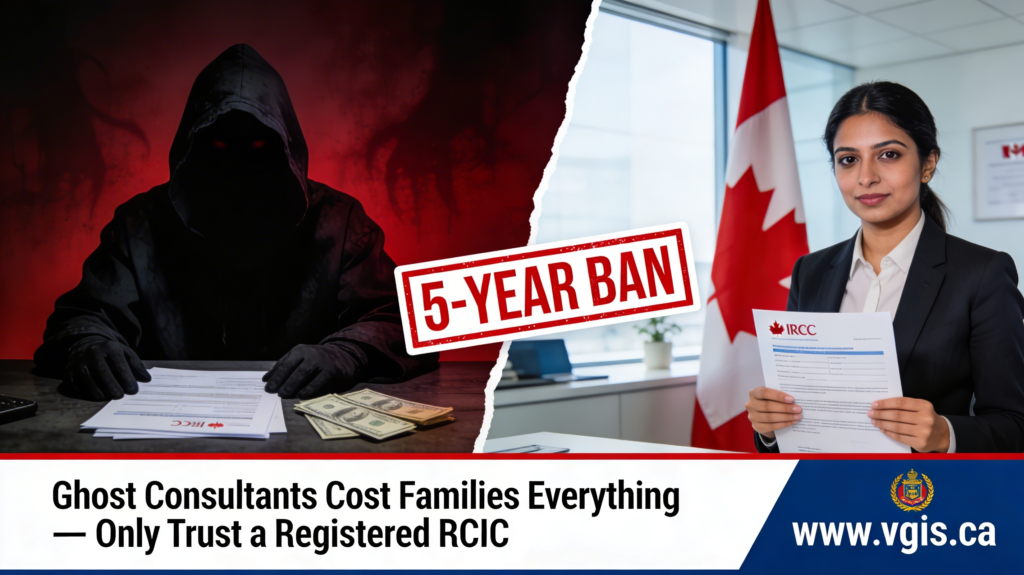
A ghost consultant is an unauthorized, unregistered person who charges money to help prepare and submit immigration applications — but does so secretly, without being declared to IRCC.
The applicant used a paid representative to help with his TRV application. The problem? He never disclosed this person to IRCC. Under IRPR section 10(2) and the IRPA’s duty of candour, if someone is being paid to help with an immigration application, they must be declared on Form IMM 5476 (Use of a Representative). Failing to do so is treated as hiding material information — and that is misrepresentation.
⚠️ Only RCICs (Regulated Canadian Immigration Consultants) registered with the College of Immigration and Citizenship Consultants (CICC) or licensed immigration lawyers can legally charge fees for immigration help in Canada.
✅ What should have been done: Disclose the representative on Form IMM 5476. If the representative was not RCIC-registered or a licensed lawyer, refuse their services entirely.
❌ Mistake #2: Misrepresentation on an Immigration Application
Misrepresentation under section 40(1)(a) of the IRPA means directly or indirectly providing false information, or withholding material facts, that could cause an error in the administration of immigration law.
You do not need to tell an outright lie — simply failing to mention something important, like a paid representative, qualifies as misrepresentation.
The consequences are severe and automatic:
- ❌ A 5-year inadmissibility ban from Canada
- ❌ Applied to all future applications — including spousal sponsorship
- ❌ “I didn’t think it mattered” is not a defence recognized by IRCC or the courts
✅ What should have been done: Answer every single question on every IRCC form with full honesty. When in doubt about what to disclose, consult a licensed RCIC before submitting — not after.
❌ Mistake #3: Not Challenging the Misrepresentation Finding in Time
When IRCC issued the formal finding of misrepresentation on January 9, 2024, the applicant had the legal right to apply for judicial review of that specific decision. He did not.
Instead, he applied for spousal sponsorship the same day — essentially moving forward while a misrepresentation flag was active on his file. When he later tried to argue against the misrepresentation finding through his spousal sponsorship judicial review, the Federal Court rejected this as a collateral attack — you cannot challenge an old IRCC decision indirectly through a new application.
✅ What should have been done: The moment a misrepresentation finding is issued, immediately consult a regulated immigration consultant or immigration lawyer to evaluate whether judicial review is viable. That is the window to fight back — and it must not be left unopened.
❌ Mistake #4: Assuming a Representative’s Mistake Is Not Your Responsibility
The applicant argued at court that he should not be held responsible for what his representative did or failed to disclose. The Federal Court disagreed entirely, citing Sandhu v Canada (Citizenship and Immigration), 2026 FC 212:
“Applicants are generally responsible for the consequences that follow their choice of representation.”
This is a foundational principle of Canadian immigration law. IRCC holds you — the applicant — accountable for everything submitted in your name, regardless of who prepared it.
✅ What should have been done: Only work with a CICC-registered RCIC or a licensed immigration lawyer. These professionals are legally accountable for their work. Ghost consultants face no accountability — but you still pay the full legal price for their mistakes.
💔 The Human Cost
What makes this case particularly heartbreaking is what was at stake. The applicant was not trying to game the system. He was married to a Canadian citizen. They had a child together. Justice Blackhawk acknowledged this directly in the ruling:
“I understand that the Applicant is of the view that the consequences that follow the finding of misrepresentation are unduly harsh. I also appreciate that the Decision impacts the Applicant’s spouse and child.”
And yet, the law left no room for compassion in this case. The 5-year inadmissibility bar stood. The spousal sponsorship was refused. The family remains separated — all because of one undisclosed representative.
🛡️ Protect Your Application: Quick Reference
| ❌ Mistake | ⚠️ Consequence | ✅ Solution |
|---|---|---|
| Used a ghost consultant | Misrepresentation finding | Use only a CICC-registered RCIC or lawyer |
| Did not declare representative on IMM 5476 | 5-year inadmissibility ban | Always file Form IMM 5476 for any paid help |
| Did not challenge the finding in time | Lost the right to fight back | Seek legal advice immediately on any IRCC finding |
| Assumed representative’s error wasn’t his problem | Court held him fully responsible | You own every word on your application |
🔍 How to Verify Your RCIC Is Legitimate
Before hiring anyone to help with your immigration application, verify them at the CICC public register:
- Visit www.college-ic.ca
- Click “Find a Regulated Professional”
- Search by name or RCIC registration number
- Confirm their status is “Active”
💡 Dimple Verma, RCIC-IRB #R708308 is fully registered and active with the CICC. You can verify this directly at college-ic.ca.
Never hand your immigration future to someone who cannot pass this simple check.
✅ How VG Immigration Protects Your Spousal Sponsorship
At VG Immigration Services, we are regulated professionals who sign every application we prepare — because we stand behind our work. We ensure:
- ✅ Every representative is properly disclosed on Form IMM 5476
- ✅ Every form is reviewed for accuracy and completeness before submission
- ✅ Every Procedural Fairness Letter (PFL) is responded to on time with a full legal strategy
- ✅ You are fully informed of your rights at every stage of the process
- ✅ Relationship genuineness documentation is prepared to the highest IRCC standards
- ✅ Complex and refused files are handled with experience and care
This case did not have to end this way. With the right guidance from the beginning, this family could have been together in Canada today. Don’t let one mistake define your future.
⚠️ Red Flags: Signs You Are Dealing With a Ghost Consultant
Watch out for these warning signs before hiring anyone:
- 🚩 They cannot provide their RCIC registration number
- 🚩 They operate only on WhatsApp or social media with no formal office or letterhead
- 🚩 They promise guaranteed approvals or “no problem” results
- 🚩 They ask you to sign forms and leave fields blank
- 🚩 They tell you not to mention them to IRCC
- 🚩 They charge cash only with no official receipt or contract
- 🚩 They are not listed at college-ic.ca
If any of these apply to someone you are considering — walk away immediately.
📋 Spousal Sponsorship: What You Actually Need
If you are planning a spousal sponsorship application, here is what a properly prepared file looks like:
Sponsor (Canadian citizen or PR):
- Proof of status (passport/PR card)
- Proof of Canadian income (NOA, pay stubs, T4)
- Signed sponsorship undertaking
Applicant (spouse being sponsored):
- Valid passport and travel history
- Police clearances from all countries of residence
- Medical examination results
- Proof of genuine relationship
Relationship Evidence:
- Marriage certificate (certified and translated if needed)
- Joint financial documents, photos, communication history
- Statutory declarations from witnesses
- Evidence of cohabitation or visits
📌 This blog is for informational purposes only and does not constitute legal advice. Immigration rules change frequently. Always consult a licensed RCIC or immigration lawyer for advice specific to your situation.
👉 Stay Updated — Follow Us!
VG Immigration Services Canada keeps you informed on IRCC 2026 changes, TR to PR updates, OINP draws, and settlement service deadlines.
📸 Instagram: Follow @vgis_can — Daily immigration tips
🎥 TikTok: Follow @vgis_can — Punjabi/English explainers
💬 WhatsApp: Free Documents List — Instant settlement checklist
VG Immigration Services Inc.
📍 211B-9300 Goreway Drive, Brampton, ON L6P 4N1
📧 case@vg-immigration.com | immigration@vgis.ca
📱 +1 416-578-9269
🌐 www.vgis.ca
Book Consultation | Contact Us
Dimple Verma, RCIC-IRB #R708308
#GhostConsultant #SpousalSponsorshipCanada #IRCCMisrepresentation #CanadaImmigration2026 #FamilyClass #SpouseSponsorship #RCIC #CICC #ImmigrationFraud #Form5476 #IRPASection40 #AuthorizedRepresentative #VGImmigration #DimpleVerma #BramptonImmigration #TorontoImmigration #CanadaPR2026 #FederalCourt #ImmigrationLaw #ProtectYourApplication