
Understanding PGWP Eligibility in 2026
Planning to study in Canada and work after graduation? The Post-Graduation Work Permit (PGWP) is one of the most valuable benefits for international students. However, not all study programs qualify for a PGWP—and this is a decision that can make or break your Canadian immigration goals.
In January 2026, Immigration, Refugees and Citizenship Canada (IRCC) confirmed major news: the eligible fields of study for PGWP will remain frozen throughout 2026, with no additions or removals.
This stability is great news for prospective international students. It means the eligible programs list won’t change during your studies, giving you certainty about your post-graduation work permit eligibility.
This comprehensive guide covers everything you need to know about PGWP eligibility, eligible fields of study, and how to verify your program qualifies.
What is a Post-Graduation Work Permit (PGWP)?
A Post-Graduation Work Permit (PGWP) is an open work permit that allows international students to work in Canada after graduation, without requiring a job offer or employer sponsorship.
Key PGWP Benefits:
- Open work permit – Work for any employer in Canada
- No job offer required – You don’t need an employer to sponsor you
- Valid for extended period – Duration depends on your study program length (up to 3 years)
- Path to permanent residence – PGWP work experience counts toward Express Entry and other immigration programs
- Flexible employment – Change jobs without reapplying for permit
Who Can Apply for PGWP?
To qualify for a PGWP, you must:
- Have completed a study program at a Designated Learning Institution (DLI) in Canada
- Have graduated from a program in an eligible field of study
- Apply for the PGWP within 180 days of receiving your official graduation notice
- Have valid status in Canada when you apply
Critical Requirement: Your program’s CIP code must be on IRCC’s eligible fields list, or you will not qualify for a PGWP—even if you complete your studies successfully.
PGWP Eligible Fields of Study: The 6 Main Categories
IRCC organizes PGWP-eligible fields of study into 6 broad categories. These categories will remain frozen throughout 2026, meaning no fields will be added or removed.
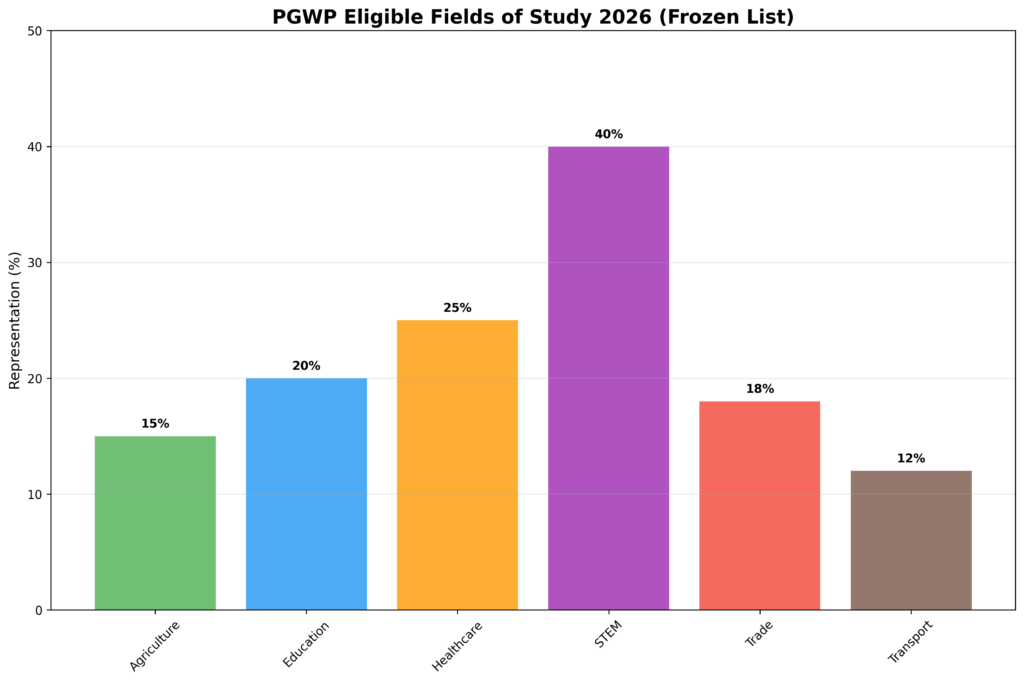
1. Agriculture and Agri-Food
Programs related to agriculture, crop production, livestock management, agricultural technology, food production, food safety, and agribusiness.
Why it matters: Canada’s agricultural sector needs skilled workers, and agricultural graduates often find strong employment opportunities.
2. Education
Programs in teaching, curriculum development, educational leadership, educational technology, and teacher training at all levels.
Why it matters: Canada has ongoing demand for educators, and international students with education degrees can apply for PGWP.
3. Health Care and Social Services
Programs in nursing, medical technology, physiotherapy, social work, mental health, public health, and other health-related fields.
Why it matters: Healthcare is one of Canada’s priority sectors, with strong demand for skilled health professionals and social service workers.
4. Science, Technology, Engineering and Math (STEM)
Programs in computer science, engineering, mathematics, physics, chemistry, information technology, software development, and related technical fields.
Why it matters: STEM is Canada’s most in-demand sector for both employers and immigration purposes. STEM graduates have excellent PGWP eligibility and strong job prospects.
5. Trade
Programs in skilled trades including plumbing, electrical work, carpentry, welding, automotive repair, heavy equipment operation, and construction trades.
Why it matters: Canada has significant shortages in skilled trades, and trade-trained workers have excellent PGWP eligibility and high earning potential.
6. Transport
Programs in transportation, logistics, aviation, maritime studies, transportation management, and related fields.
Why it matters: Transportation and logistics are growing sectors in Canada with consistent demand for qualified professionals.
Important: CIP Codes and Program-Specific Eligibility
Critical understanding: The 6 categories above do NOT mean all programs in those categories are automatically eligible for PGWP.
PGWP eligibility is determined at the CIP-code level, not the category level.
What is a CIP Code?
A CIP code (Classification of Instructional Programs) is a 6-digit standardized code that identifies specific educational programs in Canada. Each program has its own unique CIP code.
Why CIP Codes Matter:
- Your program must have a CIP code that appears on IRCC’s eligible fields list
- Two programs with similar names might have different CIP codes and different PGWP eligibility
- You must verify your specific program’s CIP code eligibility before enrolling
Example:
- Computer Science (CIP code XXXXX) = PGWP Eligible
- Computer Science (different institution, CIP code YYYYY) = May NOT be PGWP Eligible
This is why verifying your specific program’s CIP code is absolutely critical.
How to Check if Your Program is PGWP Eligible
Step 1: Find Your Program’s CIP Code
Before enrolling in any Canadian study program, obtain the 6-digit CIP code from your educational institution. This code should be listed in:
- Your program description
- Your admission letter
- Your institution’s website
- The program’s official documentation
Step 2: Search the Eligible Fields List
Once you have your CIP code, search IRCC’s official eligible fields list to confirm your program qualifies. You can search by:
- Exact 6-digit CIP code (most reliable method)
- Keywords from your program title (for browsing)
- Field of study category (Agriculture, Education, Healthcare, STEM, Trade, or Transport)
Step 3: Verify Before You Enroll
Do NOT enroll in a program without confirming its PGWP eligibility. Many international students have completed their studies only to discover their program wasn’t on the eligible list—losing their opportunity for a PGWP.
Important Consideration:
Programs are occasionally removed or modified. While IRCC confirmed NO changes will occur in 2026, it’s worth verifying your specific program’s status before finalizing your application.
The 2026 PGWP Freeze: What It Means for Students
What is the PGWP Freeze?
In January 2026, IRCC announced that no new eligible fields will be added and no currently eligible fields will be removed throughout the calendar year 2026.
This is significant because it provides stability and certainty to international students.
Why This Matters:
- Planning certainty – You know which fields are eligible for the entire year
- No surprise removals – Programs eligible today will remain eligible through December 2026
- Reduced uncertainty – Eliminates the risk of choosing a field that suddenly becomes ineligible
- For future years – The freeze applies to 2026; changes may occur in 2027 and beyond
What Students Should Know:
- If your program is on the eligible list now, it will remain eligible through 2026
- The freeze does NOT guarantee eligibility in future years
- You should still verify your specific program’s CIP code eligibility before enrolling
- Plan to complete your studies within 2026 if relying on current eligible fields
PGWP Duration: How Long Can You Work?
PGWP duration depends on the length of your study program:
- Less than 2 years: PGWP issued for same length as your program
- 2 years or more: PGWP issued for 3 years (maximum)
Examples:
- 1-year diploma program = 1-year PGWP
- 2-year degree program = 2-year PGWP
- 4-year degree program = 3-year PGWP (maximum)
Longer PGWP duration provides more time to work, gain Canadian experience, and progress toward permanent residence.
PGWP and Permanent Residence: Your Pathway
One of the biggest reasons to pursue a PGWP is its role in Canadian immigration:
Express Entry Path:
- Canadian work experience points – PGWP work counts as Canadian experience in Express Entry’s Comprehensive Ranking System (CRS)
- Increased CRS score – Adding 12+ months of Canadian work experience can significantly boost your Express Entry ranking
- Canadian Experience Class – International graduates with Canadian work experience are strong candidates for the CEC stream
Provincial Nominee Programs (PNP):
- Many provinces prioritize international graduates with Canadian work experience
- PGWP holders working in in-demand fields are attractive candidates for provincial nomination
- Provincial nomination adds 600 CRS points in Express Entry
Timeline to Permanent Residence:
Study (2-4 years) → PGWP (1-3 years) → Permanent Residence Application → Approval (6 months)
Many international graduates progress from student to temporary worker to permanent resident within 5-7 years.
PGWP Application Process
When to Apply:
- Apply within 180 days of receiving your graduation notice
- Do not delay – missing the deadline means losing PGWP eligibility
Where to Apply:
- Apply online through IRCC’s official portal
- Include proof of graduation
- Provide your DLI identification number
- Submit your passport and other required documents
Processing Time:
- Online applications typically processed within several weeks
- Processing may take longer during peak seasons
Important: Implied Status
Once you submit your PGWP application, you may be able to continue working under “implied status” while IRCC processes your application. Confirm current rules with IRCC before relying on this.
Common PGWP Mistakes to Avoid
- Not verifying CIP code eligibility before enrolling – This is the most costly mistake
- Applying for PGWP after the 180-day deadline – You lose eligibility permanently
- Choosing a program without checking eligible fields – Completing studies at a non-eligible program wastes time and money
- Assuming your program is eligible because it’s in a priority category – Category eligibility ≠ Program eligibility
- Not keeping records of your graduation notice – You need this to apply for PGWP
- Failing to maintain valid study permit status – You must be in valid status to apply for PGWP
How VG Immigration Can Help International Students
Planning to study in Canada and work after graduation? Navigating PGWP eligibility and immigration pathways can be complex.
VG Immigration specializes in:
- PGWP eligibility verification and program selection guidance
- International student visa applications
- Study permit extensions and renewals
- PGWP application preparation and submission
- Express Entry planning for international graduates
- Permanent residence pathway planning
- Provincial Nominee Program exploration
- Work permit and immigration strategy consultation
Our immigration specialists help international students maximize their opportunities for post-graduation work and permanent residence in Canada.
Contact VG Immigration Today
Planning to study in Canada and work after graduation?
Let us help you navigate PGWP eligibility and your path to Canadian permanent residence.
Get in touch with our immigration specialists:
Phone: Available through our contact link above
Social Media: Follow us for international student updates and immigration news. Connect with us on major social platforms. Ask questions and get quick responses through our social channels.
VG Immigration – Your trusted partner in Canadian student and work immigration.
We’re here to help you achieve your Canadian education and career goals.