
Posted by: Dimple Verma, RCIC-IRB #R708308 | VG Immigration Services Canada
Published: March 22, 2026
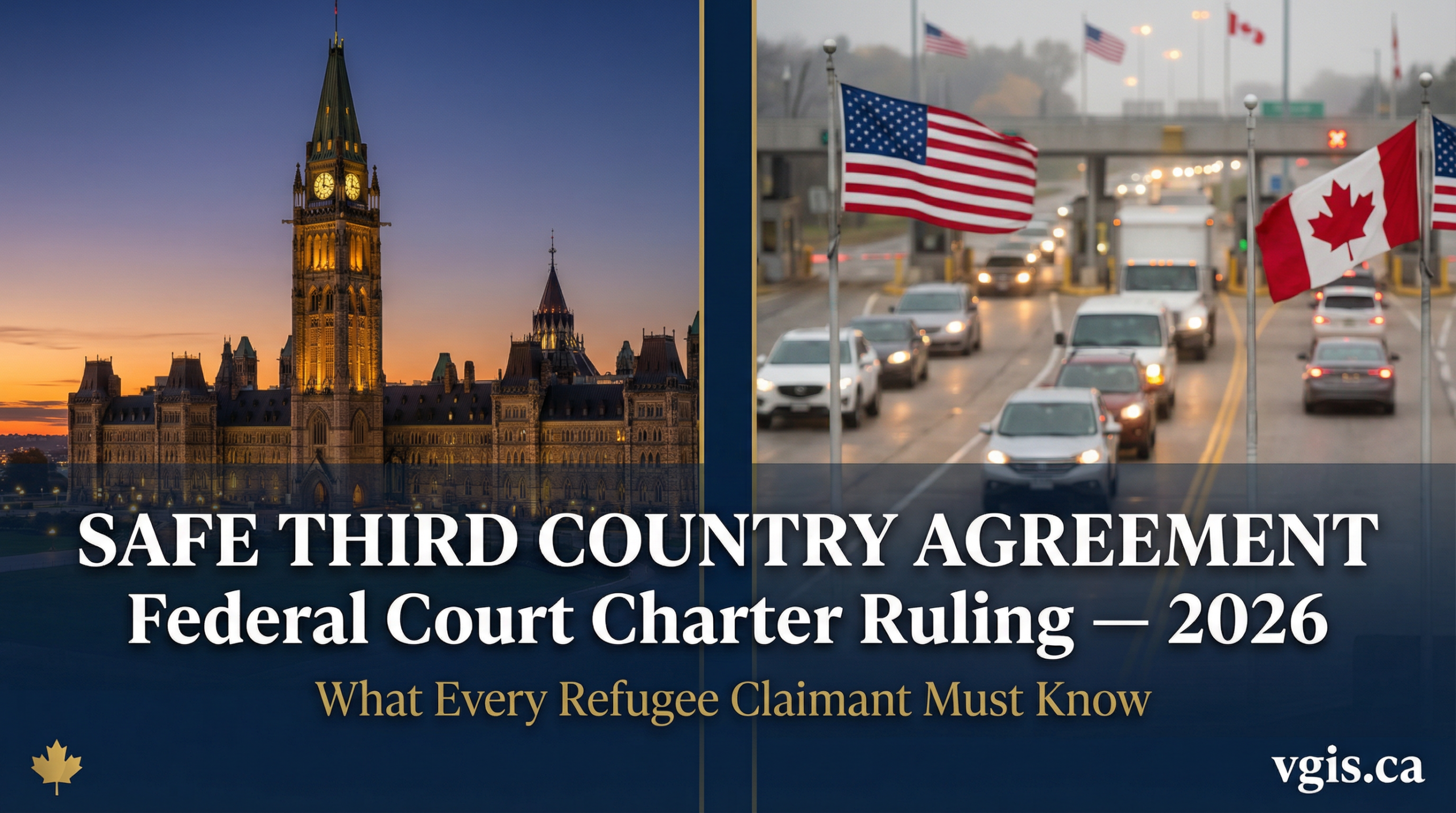
On March 17, 2026, the Federal Court of Canada issued a significant ruling in one of the most closely watched immigration cases in Canadian history — the ongoing Charter challenge to the Safe Third Country Agreement (STCA). The case, Canadian Council for Refugees, Amnesty International and Canadian Council of Churches v. Minister of Citizenship and Immigration (2026 FC 361), is a fight that has already reached the Supreme Court of Canada and is far from over.
If you are a refugee claimant, a family member crossing into Canada from the United States, or anyone concerned about refugee rights at the Canada-US border, this ruling directly affects you — and the battle for your rights is still being fought in court today.
🗓️ Not sure how the STCA affects your refugee claim or immigration options?
👉 Book a Consultation Now — Dimple Verma, RCIC-IRB, will review your specific situation and map your best pathway to protection in Canada.
What Is the Safe Third Country Agreement (STCA)?
The Safe Third Country Agreement is a treaty between Canada and the United States that was signed in 2002 and came into force in 2004. Under the STCA, refugee claimants who arrive at an official land port of entry from the United States are generally ineligible to make a refugee claim in Canada — because the US is designated a “safe third country.”
The rule is straightforward but its impact is profound:
- If you cross into Canada at an official Canada-US border crossing (like Peace Bridge, Rainbow Bridge, or Douglas), you will be turned back to the United States under the STCA
- You cannot file a refugee claim with the Immigration and Refugee Board (IRB) of Canada if you arrived via an official land port of entry from the US
- There are limited exceptions: unaccompanied minors, individuals with family members in Canada, and those facing the death penalty in the US
The STCA effectively forces many vulnerable refugees — including women fleeing gender-based violence, LGBTQ+ individuals, and people fleeing persecution — to cross irregularly (outside official ports of entry) to access Canada’s refugee system.
💬 Are you or a family member trying to enter Canada from the US to seek protection?
👉 Contact Us Today — We assess your eligibility for refugee protection, family sponsorship, or humanitarian and compassionate grounds.
The Charter Challenge — A Fight That Reached the Supreme Court of Canada
The case behind this ruling began as a constitutional challenge to the STCA brought by some of Canada’s most respected human rights organizations:
- Canadian Council for Refugees (CCR)
- Amnesty International
- Canadian Council of Churches
- Several individual refugee claimants including Syrian families and others fleeing persecution
The organizations argue that the STCA violates the Canadian Charter of Rights and Freedoms — specifically Section 15 (equality rights) — by disproportionately harming women, racialized refugees, and other vulnerable groups who are denied access to Canada’s refugee system simply because they transited through the United States.
Here is the legal journey this case has already traveled:
| Year | Court | What Happened |
|---|---|---|
| 2020 | Federal Court | Ruled the STCA violated the Charter (s.7 — life, liberty, security) |
| 2021 | Federal Court of Appeal | Overturned the 2020 decision |
| 2023 | Supreme Court of Canada | Sent the case back to Federal Court on the s.15 equality rights argument |
| 2026 | Federal Court | Current proceedings — Charter s.15 analysis underway |
This is a live, ongoing case — the Supreme Court’s 2023 decision (2023 SCC 17) did not end the challenge. It specifically said the equality rights argument under s.15 of the Charter must be properly examined at the Federal Court level. That examination is happening right now.
What Happened in the March 17, 2026 Ruling?
This latest decision (2026 FC 361) was not about the merits of the STCA itself — it was a procedural motion about whether the applicants could appeal an earlier order that refused to force the Canada Border Services Agency (CBSA) to hand over certain documents.
The applicants wanted the CBSA to produce two categories of documents critical to their s.15 Charter argument:
- Internal CBSA records showing how border officers exercise discretion on Temporary Resident Permits (TRPs) and deferral requests for people turned away under the STCA
- Draft versions of an internal CBSA Operational Bulletin (OB-2024-46) that governs how STCA exceptions are applied at the border
Justice Whyte Nowak dismissed the appeal on a technical but important ground: paragraph 72(2)(e) of the Immigration and Refugee Protection Act (IRPA) prohibits appeals of interlocutory (procedural) orders in immigration judicial review proceedings.
What this means in plain language:
- ❌ The CBSA does not have to produce these specific documents — for now
- ✅ The main Charter challenge to the STCA is still very much alive
- ✅ The Federal Court will still examine whether the STCA violates Section 15 equality rights
- ✅ This is a procedural setback, not a defeat on the substance of refugee rights
🗓️ Do you understand your rights at the Canada-US border?
👉 Book a Consultation Now — We explain exactly what the STCA means for your specific situation and what legal pathways are available to you.
Why This Case Matters for Refugees and Newcomers in 2026
The US Is No Longer Perceived as “Safe” by Many Refugee Advocates
Since the original STCA was signed in 2002, the immigration landscape in the United States has changed dramatically. Under the current US administration’s policies in 2025–2026, many refugee advocates argue that the US no longer qualifies as a “safe third country” for the following reasons:
- Increased deportations — including to countries where individuals face serious harm
- Reduced access to asylum — expedited removal policies and stricter credibility assessments
- Detention of asylum seekers — including families and children, under harsh conditions
- Narrowed asylum definitions — particularly affecting gender-based and gang-violence claims
- Uncertainty for LGBTQ+ claimants — rollbacks of protections that previously existed
These are precisely the conditions at the core of the s.15 Charter equality argument: that the STCA disproportionately harms groups already protected under the Charter.
The STCA Was Expanded in 2023 — Closing the Irregular Crossing Loophole
A critical development that makes this case even more urgent: in March 2023, Canada and the US expanded the STCA to apply across the entire land border, not just official ports of entry. Before this change, many refugee claimants avoided the STCA by crossing irregularly — for example, at Roxham Road in Quebec (which became famous as an unofficial crossing point).
The 2023 expansion means:
- ✅ Refugee claimants can no longer bypass the STCA by crossing irregularly
- ❌ Those apprehended anywhere along the land border from the US are now turned back
- ⚖️ This dramatically raised the stakes of the Charter challenge — and is why the case continues with renewed urgency
🧭 Wondering if you still have a pathway to refugee protection in Canada?
👉 Book a Consultation Now — There are still exceptions and alternative pathways. We identify every legal option available to you.
Who Is Affected? — STCA Exceptions That May Apply to You
Even with the expanded STCA, there are exceptions that may allow refugee claimants to file a claim in Canada despite arriving from the US:
| Exception | Who Qualifies |
|---|---|
| Family member exception | You have a family member (spouse, child, parent, sibling, grandparent, aunt/uncle, niece/nephew, cousin) who is a Canadian citizen, PR, refugee claimant, or protected person in Canada |
| Unaccompanied minor | You are under 18 and do not have a spouse or parent in the US |
| Document holder exception | You hold a valid Canadian visa or permit |
| Public interest exception | Rare — applied at CBSA discretion in exceptional humanitarian circumstances |
| Death penalty exception | You face or have faced the death penalty in the US or country of origin |
If you qualify for an exception, you may be able to make a refugee claim in Canada even if you arrive from the United States at the land border.
Additionally, inland claims — made within Canada — are not affected by the STCA. If you are already physically inside Canada, you may be able to make a refugee claim at an inland IRCC office.
✅ Not sure if an exception applies to you?
👉 Contact Us — We review your family connections, documents, and circumstances to determine if an STCA exception applies.
Refugee Protection Options in Canada — Beyond the STCA
Even if the STCA blocks a refugee claim at the border, there are other immigration pathways that may protect you. A licensed RCIC-IRB like Dimple Verma can assess all of the following:
- Refugee claim from inside Canada — If you are already in Canada, you can still file an inland refugee claim with the IRB
- Humanitarian and Compassionate (H&C) Application — For individuals with strong establishment in Canada, family ties, or children who would be adversely affected by removal
- Pre-Removal Risk Assessment (PRRA) — If you are facing removal, a PRRA assesses risks you face in your country of origin
- Government-Assisted Refugee (GAR) Program — For refugees referred by the UNHCR from abroad
- Private Sponsorship of Refugees (PSR) — Canadian groups or individuals can sponsor refugees directly from abroad
- Temporary Resident Permit (TRP) — Discretionary, for compelling humanitarian situations
🗓️ Don’t wait until you are at the border with no options.
👉 Book a Consultation Now — We plan your refugee or humanitarian pathway before a crisis, not during one.
What Happens Next in the STCA Charter Case?
The Section 15 Charter challenge is still proceeding at the Federal Court. Key things to watch for:
- Federal Court hearing on the s.15 merits — Justice must now assess whether the STCA disproportionately harms groups protected under the equality rights guarantee
- Evidence about how the CBSA implements STCA exceptions — the document production dispute in this ruling reflects the ongoing fight to make the government’s decision-making transparent
- Potential for another Supreme Court appeal — whichever side loses the s.15 ruling at the Federal Court is likely to appeal, and the case could return to the SCC
- Policy changes — any shift in US asylum law or Canadian immigration policy could affect how the courts view the “safety” of the US as a third country
This is one of the most consequential immigration cases in Canadian history, and its outcome will shape refugee rights at the Canada-US border for generations.
How VG Immigration Services Helps Refugee Claimants and Vulnerable Applicants
At VG Immigration Services, Dimple Verma, RCIC-IRB, represents clients before the Immigration and Refugee Board (IRB), including the Refugee Protection Division (RPD) and Refugee Appeal Division (RAD). Our services for refugee and humanitarian clients include:
- ✅ STCA Exception Assessment — We analyze your family ties, documents, and circumstances to identify if you qualify for an STCA exception at the border
- ✅ Inland Refugee Claim Preparation — Complete IRB claim preparation, Basis of Claim (BOC) form, country condition research, and hearing representation
- ✅ RAD Appeals — If your RPD claim was refused, we assess appeal grounds and represent you before the Refugee Appeal Division
- ✅ H&C and PRRA Applications — Humanitarian applications and risk assessments for individuals facing removal
- ✅ Private Refugee Sponsorship Guidance — Helping Canadian families and groups sponsor loved ones through the PSR program
- ✅ Judicial Review Applications — Working with immigration lawyers where Federal Court review of an IRB decision is appropriate
🗓️ Every situation is unique. The STCA, Charter rights, and refugee procedures are complex.
👉 Book a Consultation Now — Get a clear assessment of your rights and options from a licensed RCIC-IRB with IRB hearing experience.
Frequently Asked Questions
Q: Does the STCA apply if I fly into Canada from the US?
No — the STCA only applies at the land border. If you fly directly into a Canadian airport from the US, the STCA does not apply and you may make a refugee claim upon arrival.
Q: What if I already have a removal order and I crossed from the US?
If you are subject to a removal order, contact a licensed RCIC-IRB or immigration lawyer immediately. A Pre-Removal Risk Assessment (PRRA) may be available to assess risks in your country of origin before removal is carried out.
Q: My refugee claim was denied. Can I still stay in Canada?
Depending on your circumstances, you may have options including a RAD appeal, Judicial Review at the Federal Court, an H&C application, or a PRRA if facing removal. Time limits apply — act immediately after a refusal.
Q: Can I sponsor my family member who is a refugee in the US to come to Canada?
Yes — if your family member in the US qualifies as a refugee, Private Sponsorship of Refugees (PSR) or the Government-Assisted Refugee (GAR) program may apply. Additionally, the family member exception under the STCA may allow them to make a refugee claim directly at the Canadian border.
Q: Does the outcome of the STCA Charter case affect existing refugee claimants?
A favourable ruling could have retroactive implications for individuals who were turned back under the STCA. However, this is legally complex. Speak to a licensed RCIC-IRB to understand what any ruling could mean for your specific case.
📌 This blog is for informational purposes only and does not constitute legal advice. Immigration law, STCA provisions, and Federal Court rulings are subject to change. Always consult a licensed RCIC-IRB or immigration lawyer for advice tailored to your specific situation. For information on how VG Immigration Services handles your personal information, please review our Privacy Policy.
👉 Stay Updated — Follow Us!
VG Immigration Services Canada keeps you informed on every major immigration ruling, refugee law update, border policy change, and PR opportunity across Canada.
📸 Instagram: Follow @vgis_can — Daily immigration tips & updates
🎥 TikTok: Follow @vgis_can — Explainer videos in Punjabi & English
💬 WhatsApp: Chat with Us Now — Quick questions answered fast
🔗 LinkedIn/Blinq: Connect with Dimple Verma, RCIC-IRB
VG Immigration Services Inc.
📍 211B-9300 Goreway Drive, Brampton, ON L6P 4N1
📧 immigration@vgis.ca
📱 +1 (416) 578-9269
🌐 www.vgis.ca | Book Consultation | Contact Us
Dimple Verma, RCIC-IRB #R708308