
Ontario Overhauls All 9 OINP Streams Effective May 30, 2026: Full Breakdown of O. Reg. 47/26
Posted by: Dimple Verma, RCIC-IRB #R708308 | VG Immigration Services Canada
Published: June 1, 2026 at 9:15 AM ET
Ontario Just Revoked All 9 OINP Streams. Here’s What Actually Changed on May 30, 2026.
On May 30, 2026, the most consequential overhaul of the Ontario Immigrant Nominee Program (OINP) in over a decade officially came into force. Under Ontario Regulation 47/26 — amending Ontario Regulation 421/17 made under the Ontario Immigration Act, 2015 — every existing OINP nomination category lost its legal foundation. Targeted draw authority has been formally codified across all streams. Employer registration is now a mandatory regulatory precondition, not an operational courtesy. And while the redesigned stream architecture has not yet been published, applicants and employers are now operating under a transition framework with very little written guidance.
Reach Newcomers to Canada
Banks, insurance, real estate, tax & accounting, telecom, healthcare & education. Ask about relevant native in-article placements.
Contact Us →This is not a tweak. It is a structural reset. If you currently hold an OINP nomination, an active EOI, a pending Notification of Interest (NOI), or an employer-supported application, you need to understand exactly what changed in the regulation, what remains protected, and what to do in the next 30-60 days.
⚠️ Affected by the OINP Overhaul? Don’t Wait.
If you had an EOI in any of the 9 revoked streams, a pending NOI, or an employer job offer in progress, your status under the new framework is uncertain. Book a consultation with an RCIC today — we’ll review your file, your category, and the strongest pivot before the June grace window closes.
Key Highlights
- Effective date: May 30, 2026. The regulation amending O. Reg. 421/17 was filed as O. Reg. 47/26 on March 16, 2026 and came into force on May 30.
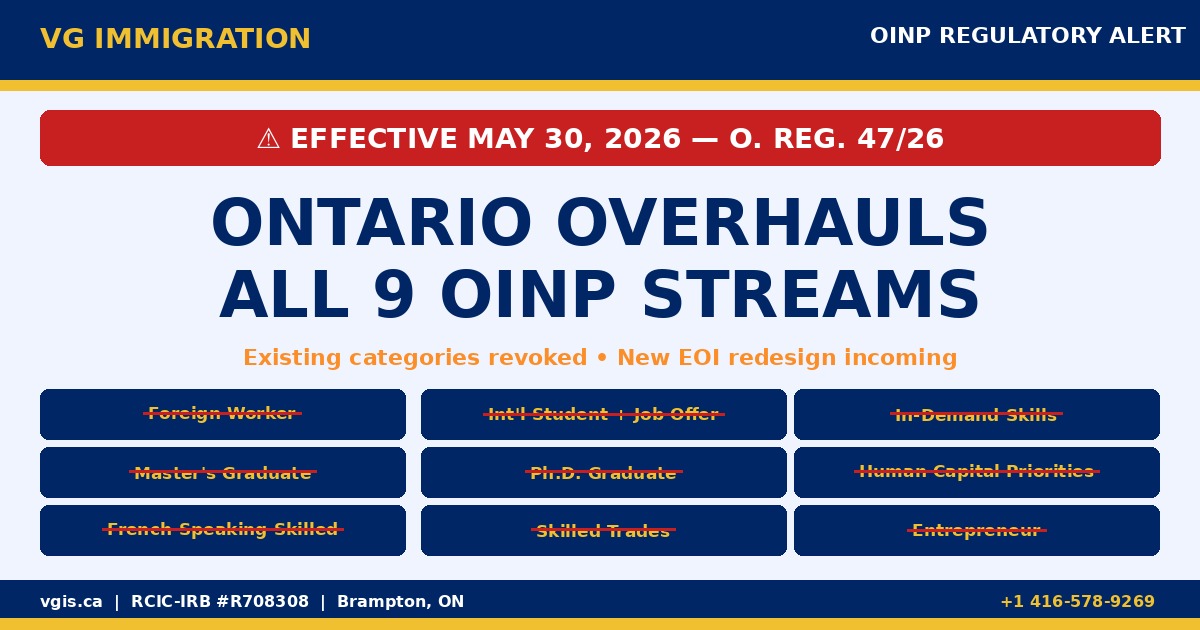
- 9 of 9 streams revoked: Foreign Worker; International Student with a Job Offer; In-Demand Skills; Master’s Graduate; Ph.D. Graduate; Human Capital Priorities; French-Speaking Skilled Worker; Skilled Trades; Entrepreneur — every active OINP stream lost its existing legal basis.
- Targeted draw authority codified: The OINP director now has explicit regulatory authority to issue general or targeted invitations to apply (ITAs) and notifications of interest (NOIs) across all categories. Under targeted draws, only candidates who meet director-set labour market or human capital attributes are ranked.
- Employer verification is now law: Candidates in any category requiring an Ontario job offer cannot apply unless their employer has registered with the OINP director through the Employer Portal and submitted the job offer. This was operational reality since 2025 — it is now in the regulation.
- Entrepreneur stream completely revoked: Section 3 of O. Reg. 421/17 (the two-stage entrepreneur process) is revoked entirely as of May 30.
- Transition guidance is thin: According to Ontario’s official program update, applications already in the system are generally expected to be assessed under the rules in effect at the time of application — but the regulation itself does not contain explicit transitional provisions.
- Proposed redesign (not yet in force): A two-phase replacement was consulted in December 2025: Phase 1 merges the three employer job-offer streams into one stream with TEER 0-3 and TEER 4-5 tracks; Phase 2 introduces a Priority Healthcare stream, Entrepreneur stream, and Exceptional Talent stream.
The Full Regulatory Picture: What O. Reg. 47/26 Actually Did
To understand the scope of the change, you have to read the regulation alongside O. Reg. 421/17 — the parent regulation it amends. Here is what the May 30 amendments did, section by section, based on the consolidated text published on Ontario’s e-Laws.
1. The 9 stream revocations
O. Reg. 421/17 lists nine categories of applicants for a certificate of nomination under subsection 2(1). The May 30 amendments revoke or substantially amend the operational sections that each category depends on:
- Foreign Worker category — Section 3.1(3) is revoked and replaced by O. Reg. 47/26, s. 2(4). Section 3.1(4) is revoked.
- International Student with a Job Offer category — Section 3.1(2) is revoked and replaced by O. Reg. 47/26, s. 2(4). Section 3.1(4) is revoked.
- In-Demand Skills category — Section 3.1(2) is revoked and replaced by O. Reg. 47/26, s. 2(4). Section 3.1(4) is revoked.
- Master’s Graduate category — Section 3.1(4) is revoked.
- Ph.D. Graduate category — Section 3.1(4) is revoked.
- Human Capital Priorities category — Section 3.2 is amended to substitute new wording for the portion before paragraph 1, via O. Reg. 47/26, s. 3(2, 3).
- French-Speaking Skilled Worker category — Section 3.2 is amended on the same terms.
- Skilled Trades category — Section 3.2 is amended on the same terms.
- Entrepreneur category — Section 3 (the entire two-stage application process) is revoked.
The practical effect: as of May 30, the operational mechanisms that allowed each stream to issue invitations to apply, accept applications, and issue nominations were either removed or restructured. The categories still appear in subsection 2(1), but the procedural scaffolding that made them work has been replaced.
2. Codification of targeted draws — section 3.2
The Human Capital Priorities, French-Speaking Skilled Worker, and Skilled Trades streams all operate through the Express Entry-linked process in section 3.2 of O. Reg. 421/17. Before May 30, that section gave the director broad discretion in practice but only basic regulatory language. The amended version explicitly authorizes:
- Section 3.2(2): The director decides for each category whether to issue general or targeted notifications of interest, after considering any direction provided by the Minister.
- Section 3.2(3): For general NOIs, the director ranks Express Entry candidates by their CRS score and issues NOIs to all candidates in the category whose CRS is within the range determined by the director.
- Section 3.2(4): For targeted NOIs, the director ranks only candidates whose Express Entry profile shows one or more labour market or human capital attributes that satisfy targets set by the director, and issues NOIs only to those candidates whose CRS is within the determined range.
This is the regulatory backing that legitimizes targeted Express Entry-aligned OINP draws — for example, the draws Ontario has been running for tech occupations, healthcare occupations, education, construction, and French language. Going forward, the director can also target by employer size, region, settlement priorities, or wage attributes, with explicit legislative authority.
3. Employer registration and verification — section 3.1
The new section 3.1 framework, as amended by O. Reg. 47/26, s. 2(4), formalizes what was previously administered through the Employer Portal:
- For any applicant in a category that requires an Ontario job offer, the applicant cannot register an Expression of Interest unless their employer has registered as an employer with the director and submitted a copy of the job offer that was given to the applicant.
- Previously, the regulation had section 3.1(4) which required employers seeking approval of an employment position to register before applying. That section is now revoked because employer registration is being baked into the EOI step itself, rather than treated as a parallel approval process.
- The provision references O. Reg. 149/25, s. 2(2) as the prior amendment that introduced the employer-registration requirement at the regulation level. O. Reg. 47/26 builds on that foundation.
4. Ranking criteria for EOI categories — section 3.1(1)5
Section 3.1(1)5 lists the five families of attributes that may be used to award points in EOI rankings, as published on the Ministry’s website:
- The applicant’s level and field of education and where they completed their studies.
- The applicant’s proficiency in English or French.
- Whether the applicant intends to settle outside the Greater Toronto Area.
- The applicant’s skill and work experience level, earnings history, and any other factor relevant to their employment prospects in Ontario’s labour and employment market.
- Immediate labour market needs in the province or region of the province.
This framework — and especially category 5 — is what enables the director to launch occupation-specific, region-specific, or employer-specific draws. The amendments retain this structure, meaning the points framework for EOI streams continues to be set out at the Ministry website rather than fixed in the regulation. That gives Ontario operational flexibility but also reduces predictability for applicants.
Start your secure OINP intake
Skip the back-and-forth. Complete a structured intake in 25 minutes. Reviewed by Dimple Verma, RCIC-IRB. No payment required to start.
5. Suspension and return factors — section 7
Section 7 of O. Reg. 421/17 already gives the director broad authority to suspend receiving applications or return applications and fees when nominations have not yet been decided, based on 19 listed factors including allocation of nomination spots, federal acceptance rates of permanent residence applications, compliance concerns, government policy priorities, unemployment rate, labour market needs, housing availability and cost, funding for health and social services, lawful work status, Canadian work experience, and others.
This section has not been revoked. In a transition period like the one we are now in, expect the director to actively use section 7 — particularly the factors related to nomination allocation, policy priorities, and labour market — to pause categories, return applications, or reshape the pool while the redesigned streams roll out.
🎯 Employer With OINP-Pending Hires?
Employer registration with the OINP director is now formally codified as a precondition to any job-offer-based nomination. If you haven’t registered through the Employer Portal — or your existing registration needs an updated job offer — we’ll prepare the package and submit it for you.
The Proposed Replacement Streams (Phase 1 and Phase 2)
Ontario consulted stakeholders in December 2025 (consultation closed January 1, 2026) on a two-phase redesign of OINP. None of these streams are yet in regulation — but they are the working blueprint for what will replace the nine revoked categories.
Phase 1 (proposed): A single merged Employer Job Offer stream
- The three current employer-job-offer streams (Foreign Worker, International Student with a Job Offer, In-Demand Skills) would be combined into one stream.
- The merged stream would have two tracks:
- Higher-skilled track — TEER 0, 1, 2, 3 occupations under the National Occupational Classification (NOC) 2021.
- Lower-skilled track — TEER 4, 5 occupations under NOC 2021.
- Eligibility criteria for each track are not yet published.
Phase 2 (proposed): Three new pathways replacing the remaining streams
- Priority Healthcare stream — Expected to replace and expand the healthcare workforce pathway that was previously addressed only through targeted Human Capital Priorities draws.
- Entrepreneur stream — A redesigned investment-and-business pathway to replace the revoked Section 3 entrepreneur process.
- Exceptional Talent stream — A new pathway specifically targeting high-skilled candidates outside the standard CRS framework.
Until these are formally enacted by regulation, the OINP is in an interim phase: existing categories are revoked in their original form, the director has expanded targeted-draw authority, and the new stream architecture is still being drafted.
What This Means If You Already Have an EOI, NOI, or Application
If you have a Notification of Interest already issued before May 30
You can submit your application within the validity window of your NOI. The Ontario program update confirms: “All applications received under the existing OINP framework will be assessed in accordance with the eligibility requirements in place at the time of application.” Practically, this means submit promptly, ensure your supporting documents fully evidence the eligibility criteria as they read on the day you submit, and avoid any changes to your file that could be re-characterized as a new application.
If you have an EOI registered but no NOI/ITA yet
Your profile may or may not carry over to the new framework. Ontario has not confirmed whether existing EOI profiles will be migrated, withdrawn, or require re-registration. The historical precedent — during the Employer Portal transition in July 2025, Ontario withdrew existing profiles — suggests re-registration is a real possibility. Monitor your account in the OINP portal closely. Keep your supporting documents (language results, ECA, reference letters, employer letters) up to date so you can re-register quickly.
If you have a job offer from an Ontario employer
The single most important question is: is your employer registered with the OINP director through the Employer Portal? If they are not, you cannot register an EOI under the post-May 30 framework. We are advising every employer-sponsored client to verify their employer’s registration status as the first step in any application strategy.
If you are an entrepreneur applicant
Section 3 — the entire two-stage Entrepreneur process — is revoked. Stage 1 letters of confirmation issued before May 30 should still be valid for the temporary work permit they support, but you should expect any post-revocation entrepreneur application to be assessed under the upcoming redesigned Entrepreneur stream. If you are mid-business-establishment, document every commitment, hire, and investment now — the new criteria will likely revisit minimum investment thresholds, jurisdictional requirements, and active management.
If you are in the Human Capital Priorities, French-Speaking Skilled Worker, or Skilled Trades streams
Section 3.2 was amended, not revoked outright. Targeted draw authority has been strengthened. Expect Ontario to continue running occupation- and language-targeted draws but with a more explicit legal foundation. French-speaking candidates remain a priority — the May 28, 2026 federal French-language Express Entry round at CRS 409 confirms how leveraged French is across all PNPs.
What This Means for You: 6 Practical Steps to Take in June 2026
- Pull your file out and audit it. Identify the exact stream, your category, the date of your EOI registration, and any NOI/ITA dates. If you cannot find your EOI registration number, log into your account and screenshot everything now.
- Confirm employer registration. If your file relies on a job offer, ask the employer’s HR or owner to log in to the Employer Portal and confirm their registration status and whether your offer is properly attached.
- Refresh language results. A current IELTS, CELPIP, TEF Canada, or TCF Canada within 24 months will be essential under the new targeted draws. If yours is older than 18 months, write a new one in the next 60 days.
- Update your ECA. Ensure your Educational Credential Assessment from WES, ICAS, IQAS, or another designated organization is valid and reflects your highest credential.
- Strengthen your Express Entry profile. Whether or not OINP is your primary pathway, an Express Entry profile is now the gateway to the three streams operating under section 3.2. Submit or refresh your federal profile and ensure your CRS reflects every claimable point.
- Have a Plan B PNP ready. If Ontario’s redesigned streams do not match your profile, you should already know whether Saskatchewan (SINP), Manitoba (MPNP), British Columbia (BC PNP), Alberta (AAIP), or one of the Atlantic provinces is a credible alternative — and what it would take to qualify.
How VG Immigration Can Help
Dimple Verma, RCIC-IRB (R708308), Commissioner of Oaths, at VG Immigration Services has guided dozens of clients through OINP nominations, employer applications, NOIs, and post-nomination Express Entry submissions. With the May 30 overhaul now live, we are:
- Reviewing every client’s existing OINP file against the new regulation;
- Coordinating directly with Ontario employers to verify Employer Portal registration and update job offers;
- Filing in-validity NOI-based applications fast, to lock in the “rules in effect at the time of application” assessment standard;
- Building parallel federal Express Entry strategies so clients have CRS-driven options regardless of which redesigned OINP stream eventually replaces theirs;
- Identifying realistic PNP alternatives for clients whose profile no longer fits Ontario’s redesigned priorities.
We have direct experience with both the EOI side and the employer-portal side of the OINP. If you are an applicant, an Ontario employer, or both, we will give you a written, file-specific action plan based on the regulation, the policy guidance, and the operational reality at the Ministry.
✅ Need a Second Opinion on Your OINP File?
Dimple Verma, RCIC-IRB #R708308, has guided dozens of Ontario nominees through the EOI, NOI, and post-nomination process. Get a structured file review with a written action plan — Express Entry alternatives, employer-side strategy, or pivot to another PNP if Ontario’s redesign no longer fits.
📅 Book a Consultation | 🚀 Onboard Now | 💬 WhatsApp +1 416-578-9269
📅 Book a Consultation | Visit vgis.ca | 💬 WhatsApp
VG Immigration Services Inc. | 211B-9300 Goreway Drive, Brampton, ON L6P 4N1 | +1 416-578-9269 | immigration@vgis.ca
Disclaimer: This article is general information about Ontario Regulation 421/17 as amended by Ontario Regulation 47/26, effective May 30, 2026, based on the consolidated regulation on Ontario’s e-Laws and the Ontario program update page. It is not legal advice. Regulatory text, transitional rules, and operational guidance may evolve as Ontario publishes the redesigned stream architecture. Always verify with the Ontario Immigrant Nominee Program and a licensed RCIC before taking action on your file.