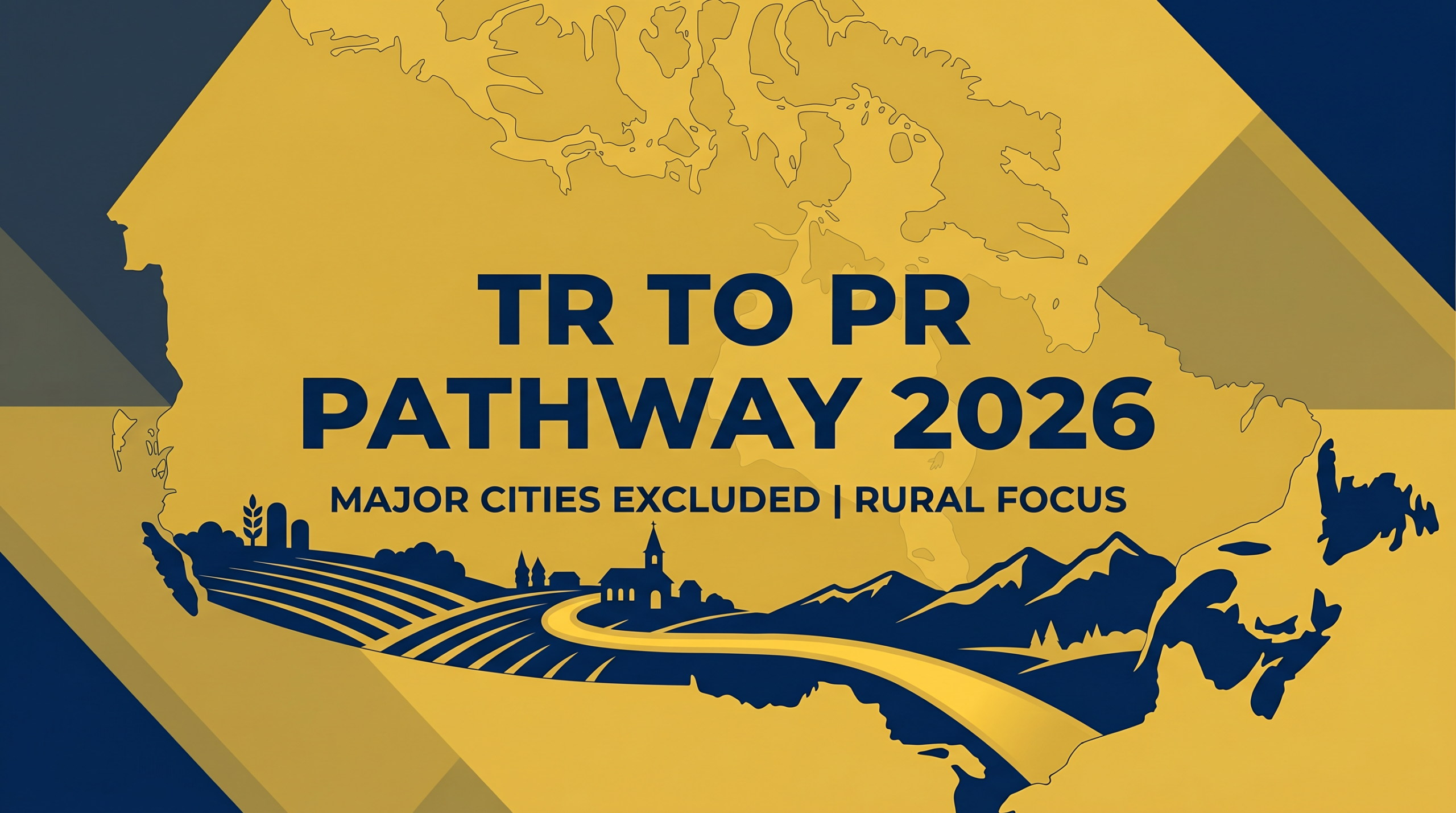
TR to PR Pathway 2026: Major Cities Excluded — Are You Eligible?
Posted by: Dimple Verma, RCIC-IRB #R708308 | VG Immigration Services Canada
Published: April 21, 2026
Canada’s 2026 TR to PR Pathway Is Here — But 84% of Canadians Live in Excluded Zones
Canada’s much-anticipated 2026 TR to PR Pathway has arrived — but there’s a critical catch that could disqualify the vast majority of temporary workers currently living in Canada. In an April 18, 2026 interview with I’m Canada, Immigration Minister Lena Metlege Diab confirmed that every Census Metropolitan Area (CMA) in the country is excluded from this new pathway. That means if you live and work in Toronto, Vancouver, Montreal, Calgary, or any of Canada’s other major cities, you do not qualify — regardless of your occupation, experience, or how long you’ve been contributing to Canada’s economy. If you’re a temporary worker in a smaller, rural Canadian community, however, this could be your moment to make Canada your permanent home. Here’s everything you need to know right now.
Reach Newcomers to Canada
Banks, insurance, real estate, tax & accounting, telecom, healthcare & education. Ask about relevant native in-article placements.
Contact Us →Key Highlights
- 33,000 spots total — 16,500 per year across 2026 and 2027
- All 41 Census Metropolitan Areas are excluded — only rural and smaller communities qualify
- One-time federal measure targeting temporary foreign workers already in Canada
- Priority sectors: healthcare, agriculture, construction, transportation, hospitality, and skilled trades
- Application portal not yet open — expected to launch April 2026
- First-come, first-served: the 2021 pathway hit its cap within days — this one will move just as fast
- Documents should be gathered NOW — do not wait for the portal to open
- Expected processing time: 6–12 months after submission
Breaking: Major Cities Excluded from the TR to PR Pathway
This is the detail that changes everything for thousands of hopeful applicants. During her April 18, 2026 interview with I’m Canada, Minister Diab explicitly confirmed that all Census Metropolitan Areas — Statistics Canada’s designation for urban regions with a core population of at least 100,000 people and an urban core of at least 50,000 — are off the table entirely. Canada has 41 CMAs in total, and together they are home to approximately 84% of the Canadian population according to 2021 census data.
The following cities and their surrounding metro regions are among those explicitly excluded:
- Toronto
- Vancouver
- Montréal
- Calgary
- Edmonton
- Ottawa–Gatineau
- Winnipeg
- Québec City
- Hamilton
- Kitchener–Cambridge–Waterloo
- Halifax
- Victoria
- Oshawa
- London
- St. Catharines–Niagara
- Windsor
- Saskatoon
- Regina
- Sherbrooke
- Barrie
- Kelowna
- Abbotsford–Mission
- Greater Sudbury
- Kingston
- Saguenay
- Trois-Rivières
- Guelph
- Moncton
- Brantford
- Thunder Bay
- Saint John
- Peterborough
- And additional CMAs across Canada
The intent behind this geographic restriction is clear: the federal government wants this pathway to address labour shortages in Canada’s smaller and rural communities — places that often struggle to attract and retain workers, and where permanent residents can make an outsized economic impact. If your work permit, job, and residence are all tied to a CMA, you will need to explore other immigration pathways. You can visit our blog to learn more about options that may apply to your specific situation, or book a consultation with our licensed representative.
Who Can Apply? Expected Eligibility Criteria
As of April 18, 2026, Immigration, Refugees and Citizenship Canada (IRCC) has confirmed the program exists but has not yet released the complete selection criteria. Full details are expected “in coming weeks,” according to Minister Diab. That said, based on the program framework and precedent from the 2021 TR-to-PR pathway, here is what eligible applicants should expect:
Geographic Requirement
Your workplace must be located outside of a CMA. This is the single most important eligibility filter. Simply living outside a CMA while working within one will not qualify. Your employment must be physically based in a non-CMA area.
Immigration Status
You must hold valid temporary status in Canada at the time of application — typically a valid work permit or study permit. Applicants whose status has lapsed may not be eligible, which is another reason to act quickly once the portal opens.
Canadian Work Experience
You must have recent, verifiable Canadian work experience in an eligible occupation. The pathway is designed for workers who are already contributing to the Canadian labour market, particularly in industries experiencing shortages. Priority sectors include:
- Healthcare and social services
- Agriculture and agri-food
- Construction and skilled trades
- Transportation and logistics
- Hospitality and food services
Language Proficiency
Applicants will need to demonstrate language ability at a minimum Canadian Language Benchmark (CLB) threshold. Accepted tests include IELTS General Training, CELPIP-General, PTE Core (for English), and TEF Canada or TCF Canada (for French). Meeting or exceeding the required CLB level can significantly strengthen your application. Notably, French-speaking applicants and graduates of French-language programs may receive preferential consideration under this pathway.
Start your secure Immigration intake
Skip the back-and-forth. Complete a structured intake in 25 minutes. Reviewed by Dimple Verma, RCIC-IRB. No payment required to start.
Education and Graduate Stream
International graduates holding a valid Post-Graduation Work Permit (PGWP) may qualify through a dedicated graduate stream, provided their employment meets the geographic and sector requirements.
Admissibility
A clean criminal record and meeting Canada’s standard admissibility requirements are mandatory. Any criminality or misrepresentation on previous immigration applications could disqualify you immediately.
How to Prepare: Documents You Need Ready
The 2021 TR-to-PR pathway is a cautionary tale for anyone who plans to “wait and see.” That stream opened on April 14, 2021, and hit its cap by July 16, 2021 — in less than three months, with tens of thousands of people applying simultaneously. Given that this 2026 pathway offers only 16,500 spots in its first year, the competition will be even more intense. Applications will almost certainly be accepted on a first-come, first-served basis.
The moment the portal opens, you need to be ready to submit. That means gathering every required document before the launch date. Here is the full document checklist you should be building right now:
- Valid passport — must cover your expected processing period (6–12 months)
- Current work permit or study permit
- Employment letter(s) — on company letterhead, including job title, NOC code, hours, salary, start date
- Recent pay stubs — typically the last 3–6 months
- T4 slips and Notice of Assessment — confirming Canadian income and tax compliance
- Language test results — IELTS, CELPIP, PTE Core, TEF, or TCF (must not be expired)
- NOC job descriptions — confirming your duties match the National Occupational Classification for your role
- Education credentials — degrees, diplomas, transcripts, and any Educational Credential Assessment (ECA) if applicable
- 10-year personal history — addresses, employment, travel, and education for the past decade
- Police clearance certificate(s) — from Canada and any country you lived in for 6+ months
- Proof of rural/non-CMA employment location — employer address documentation confirming your workplace is outside a CMA
Missing even one of these documents at the time of submission could delay or disqualify your application in a highly competitive pool. Don’t leave it to chance — work with a licensed immigration consultant to ensure your package is complete and error-free before Day 1.
Timeline and What to Expect
The TR to PR Pathway 2026 has been in soft-launch mode since March 2026, as confirmed by Minister Diab in a March 6, 2026 interview with the Toronto Star. The application portal itself was expected to open in April 2026, with full selection criteria to be published in the weeks ahead.
Here is how the timeline is shaping up:
- March 2026: Program soft-launched; policy framework confirmed
- April 2026: Application portal expected to open; full eligibility criteria to be released
- 2026–2027: 16,500 spots available per year (33,000 total across two years)
- Processing time: Estimated 6–12 months from application submission
Once the cap of 16,500 is reached in 2026, no further applications will be accepted until the 2027 intake opens. Given the scale of demand from temporary workers across Canada, the first-year spots may fill up within hours or days of the portal launching — much like what happened in 2021. There will be no second chances for late applicants in the 2026 intake.
What This Means for You
If you are a temporary worker in Canada, the most important thing you can do right now is determine whether your work location falls inside or outside a CMA. This single factor determines whether this pathway is even an option for you.
If you work outside a CMA: You may be among the relatively small pool of eligible applicants. Act immediately. Gather all your documents, review your NOC code, book a language test if yours is expiring or not yet taken, and contact an RCIC to assess your full eligibility before the portal opens. Time is your most valuable asset right now.
If you work inside a CMA (Toronto, Vancouver, Calgary, etc.): This specific pathway is not available to you. However, that does not mean permanent residence is out of reach. Programs like Express Entry, the Provincial Nominee Program (PNP), the Atlantic Immigration Program, Rural and Northern Immigration Pilot successors, and other streams may still offer a route to PR based on your profile. Visit our immigration blog for guidance on the full range of pathways available, and book a consultation to get a strategy built around your specific circumstances.
For everyone — CMA or non-CMA — the overarching message is the same: do not wait. Immigration policy moves quickly, caps fill up without warning, and an incomplete or last-minute application is a missed opportunity. Canada’s immigration system rewards those who are prepared.
How VG Immigration Can Help
Navigating Canada’s immigration system requires expert guidance. Dimple Verma, RCIC-IRB (R708308), Commissioner of Oaths, at VG Immigration Services can help you understand your options and build the strongest possible application.
📅 Book a Consultation | Visit vgis.ca | 💬 WhatsApp
VG Immigration Services Inc. | 211B-9300 Goreway Drive, Brampton, ON L6P 4N1 | +1 416-578-9269 | immigration@vgis.ca