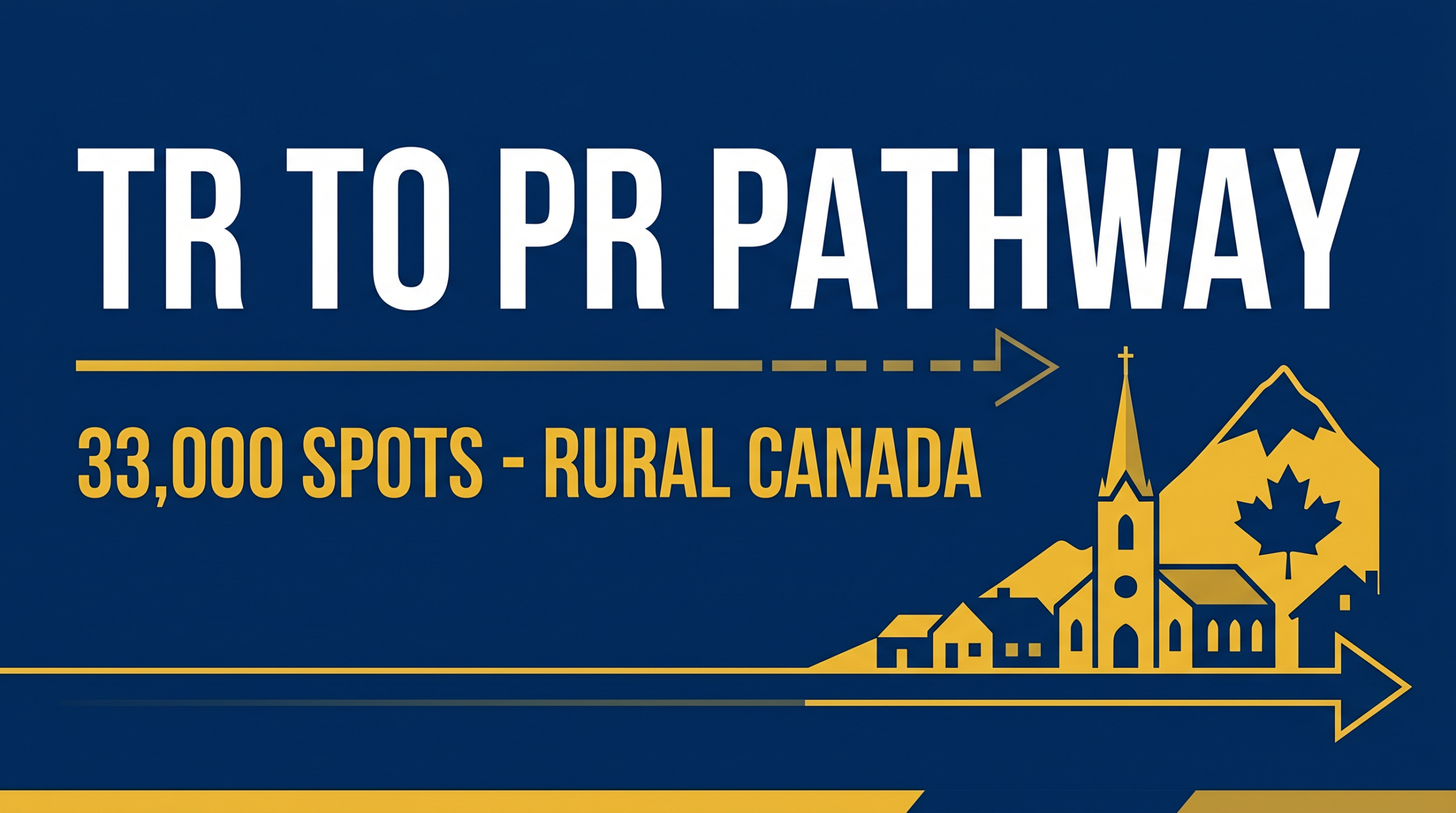
TR to PR Pathway April 2026 Update: 33,000 Spots, Rural Canada Focus
Posted by: Dimple Verma, RCIC-IRB #R708308 | VG Immigration Services Canada
Published: April 22, 2026
Reach Newcomers to Canada
Banks, insurance, real estate, tax & accounting, telecom, healthcare & education. Ask about relevant native in-article placements.
Contact Us →Canada’s TR to PR Pathway Is Back — With a Rural-First Approach
Immigration Minister Lena Metlege Diab has confirmed that Canada’s Temporary Resident to Permanent Resident (TR to PR) pathway is returning in 2026 — and this time, it looks very different from the 2021 version. With 33,000 PR spots distributed across 2026 and 2027, the program is specifically designed to address labour and population needs outside Canada’s largest urban centres. If you are a temporary resident living and working in a smaller or mid-sized Canadian community, this announcement could be the most important immigration news you hear all year.
Key Highlights
- 33,000 PR spaces available, distributed across 2026 and 2027
- Major city exclusions: Toronto, Montreal, and Vancouver are excluded — along with all 41 Census Metropolitan Areas (CMAs) as defined by Statistics Canada
- Approximately 2 years of Canadian work experience is expected to be required
- No sector restrictions: general Canadian work experience counts — not just healthcare or construction
- Applicants must demonstrate community ties, stable housing, active employment, and tax contributions
- Full eligibility criteria expected to be released very soon — the Minister used the phrase “very very very soon”
- The program complements the Provincial Nominee Program (PNP) and Atlantic Immigration Program (AIP)
- Provinces receive approximately 50% of the federal PR allocation
- Key questions — including PGWP holders, family members, language requirements, and CRS scores — remain unanswered
What the Minister Confirmed
In a video interview posted on April 18, 2026, Minister Diab laid out the core framework of the upcoming TR to PR pathway. The program will create 33,000 pathways to permanent residency spread over 2026 and 2027. While the full regulatory details have not yet been published, the Minister was clear about the program’s intent: to support temporary residents who have already planted roots in Canada — particularly in communities that fall outside major urban zones.
One of the clearest signals from the announcement is the work experience requirement. Applicants are expected to have roughly two years of Canadian work experience. This is a notably higher bar than the one-year threshold often associated with the Canadian Experience Class (CEC) or the Atlantic Immigration Program. The intent appears to be prioritizing individuals who have demonstrated sustained commitment to the Canadian labour market, not those who arrived recently and are still building their professional history here.
The Minister also emphasized that this pathway is not sector-specific. Earlier speculation had pointed to healthcare and construction as the primary focus areas, but the confirmed program is broader. Any field of Canadian work experience appears to count, provided the applicant can show they are genuinely integrated into their community — through housing, employment, and tax participation. This is a meaningful distinction that opens the door to a much larger pool of eligible temporary residents.
Excluded Cities: Why CMAs Don’t Qualify
The most consequential element of the 2026 TR to PR design is its geographic restriction. The program explicitly excludes Canada’s Census Metropolitan Areas (CMAs) — a classification defined by Statistics Canada. A CMA is an area with an urban core of at least 100,000 people and surrounding municipalities that have a high degree of social and economic integration with that core. There are 41 CMAs across Canada, and applicants living within any of them will not be eligible for this pathway.
While Toronto, Montreal, and Vancouver are the three most widely recognized exclusions, the list extends far beyond these cities. Other areas that likely fall under CMA classification include Hamilton, Kitchener-Waterloo, London, Halifax, Victoria, Winnipeg, Calgary, Edmonton, Ottawa-Gatineau, and Quebec City, among others. This means that even temporary residents living in mid-sized urban areas — not just Canada’s biggest cities — may find themselves outside the eligible geography for this program.
For temporary residents currently living in a CMA, this does not necessarily mean the door is closed. Relocating to a non-CMA community before the application window opens could be a strategic option worth exploring — provided the move is genuine and supported by actual employment and housing. Immigration authorities will be looking for real community integration, not last-minute address changes. If you are unsure whether your current location falls within a CMA, speaking with an RCIC before the portal opens is a practical first step. You can book a consultation with Dimple Verma at VG Immigration Services to assess your situation now.
Start your secure Immigration intake
Skip the back-and-forth. Complete a structured intake in 25 minutes. Reviewed by Dimple Verma, RCIC-IRB. No payment required to start.
Who Qualifies: Work Experience, Housing, Community Ties
Based on what Minister Diab confirmed, the eligibility profile for this program centres on genuine integration into a non-CMA Canadian community. The anchor requirement is approximately two years of Canadian work experience. This threshold is intentionally set higher than comparable programs, reflecting the government’s goal of selecting individuals who have already proven themselves as long-term contributors to the Canadian economy. If you arrived in Canada in late 2025 or early 2026, it is likely that you will not meet this threshold when the program opens — a reality worth planning around now.
Beyond work experience, the Minister highlighted three additional pillars: housing, community ties, and tax participation. Applicants will need to show that they have stable, established housing in an eligible (non-CMA) area. Community ties go beyond employment — they include things like involvement in local organizations, long-term residency in a specific community, and social integration. Tax contributions speak directly to whether an applicant has been filing taxes as a working resident of Canada. These elements together paint a picture of someone who is already functioning as a de facto permanent resident — the program, in essence, aims to formalize that status.
Because the program is not sector-restricted, the eligible applicant pool is broad. Whether you work in retail, manufacturing, logistics, agriculture, technology, hospitality, or any other sector, your Canadian work experience should count. The key factor is not what you do but how long you have been doing it — and where. Temporary residents who have been steadily employed in a non-CMA community for approximately two years, have filed their taxes, and have established housing are the profile this program appears to be designed for.
What’s Still Unknown
Despite the significant details the Minister shared, several critical questions have not yet been answered. One of the most pressing involves Post-Graduate Work Permit (PGWP) holders and international graduates. It is not yet confirmed whether this group will be eligible or whether study-related time in Canada counts toward the two-year work experience requirement. Similarly, it is unclear whether family members — spouses, dependent children — living with the principal applicant in a non-CMA area will be included in an application or require separate streams. These are not minor details; they will determine whether this pathway is viable for a large segment of the temporary resident population.
Language requirements and Comprehensive Ranking System (CRS) scores have also not been addressed publicly. It is unknown whether the program will use an Express Entry-style points system, require specific IELTS or CELPIP scores, or rely on a simpler eligibility-based model. The distribution of the 33,000 spots across 2026 and 2027 — whether equal, weighted, or phased by province — also remains unclear. Provinces receive approximately 50% of the federal PR allocation, so there may be regional quotas or provincial involvement in processing. The government has said full criteria will be released very soon, and that timeline now appears to be measured in weeks rather than months.
How This Differs from 2021 TR to PR
Canada launched a TR to PR pathway in 2021, and the experience left many applicants frustrated and exhausted. That version opened with a fixed cap, and the portal filled to capacity on the very first day — in some cases within hours. The system crashed under the volume of simultaneous applications, and many eligible applicants who attempted to submit were locked out. Those who did get through faced processing timelines stretching from 12 to 24 months, creating prolonged uncertainty for families and workers who had already been in Canada for years. The 2021 pathway was also broader in geographic scope — it did not carry the rural or non-CMA restriction that defines the 2026 version.
The 2026 pathway appears to have been designed with several of those lessons in mind. The rural and non-CMA geographic focus is entirely new, representing a significant structural departure from 2021. The higher work experience threshold — approximately two years compared to the one-year bar that applied to certain 2021 streams — narrows the eligible pool by design, which may reduce application volume and system strain. The non-sector-specific approach is also a change from what many analysts had predicted for a 2026 pathway. Whether the application portal will be more robust this time around remains to be seen, but the government appears to be prioritizing a more targeted and orderly program. Staying informed and prepared before the portal opens — rather than scrambling on launch day — is the single most important thing applicants can do differently this time.
What This Means for You
If you are a temporary resident living and working outside a Census Metropolitan Area, now is the time to take stock of your situation. Start by confirming that your current location is not classified as a CMA under Statistics Canada’s definitions — this is a binary eligibility factor and there will be no exceptions. If you are in a qualifying area, begin organizing the documents that will support your application: employment records covering approximately two years, T4 slips and Notice of Assessment documents to demonstrate tax filing, a lease or mortgage to establish housing, and any evidence of community involvement or long-term ties to your area.
Language testing is another area where preparation matters now. Even though official language requirements have not been confirmed, it is reasonable to expect that English or French proficiency will play a role in the final criteria. If you do not already have a current IELTS General Training or CELPIP score, booking a test now means you will have results in hand before the program officially opens. Tests book up quickly when major immigration announcements are made, and delays in getting a score should not be the reason you miss an application window.
Most importantly, do not wait for the official criteria release to start preparing. The government has signalled that details are coming very soon. By the time the portal opens, competition for spaces could be intense — and applicants who have their documents organized, their language tests completed, and a clear understanding of their eligibility will be positioned to apply quickly and accurately. A single error or missing document can delay or derail an application. Working with a licensed immigration consultant before you submit is one of the most effective ways to protect your application from preventable mistakes. Visit vgis.ca to learn more about how VG Immigration Services supports TR to PR applicants at every stage.
How VG Immigration Can Help
Navigating Canada’s immigration system requires expert guidance. Dimple Verma, RCIC-IRB (R708308), Commissioner of Oaths, at VG Immigration Services can help you understand your options and build the strongest possible application.
📅 Book a Consultation | Visit vgis.ca | 💬 WhatsApp
VG Immigration Services Inc. | 211B-9300 Goreway Drive, Brampton, ON L6P 4N1 | +1 416-578-9269 | immigration@vgis.ca