
Certificate of Qualification 2026: Pest Control COQ Compared

By Dimple Verma, RCIC-IRB R708308 — VG Immigration Services Inc.
Published June 25, 2026 · Based on direct IRCC correspondence and current canada.ca guidance
Pest Control as a Certificate of Qualification Trade for Express Entry: What IRCC Told Us Directly
Pest control technicians and exterminators are licensed by every Canadian province, but whether that provincial licence counts as a Certificate of Qualification (COQ) for Express Entry’s Federal Skilled Trades (FST) program — or for the 25 / 50 CRS points bonus under any Express Entry stream — is one of the most misunderstood questions in Canadian skilled-trades immigration. On May 8, 2026, VG Immigration emailed the IRCC helpline directly to clarify the rules for pest control practitioners in Nova Scotia, Alberta, and British Columbia. On May 19, 2026, IRCC replied. This article unpacks that exchange line-by-line, compares the pest control credentialing pathway across Ontario, Alberta, and Nova Scotia, and explains exactly how a provincial pesticide licence interacts (or doesn’t) with the 2026 Express Entry framework.
Reach Newcomers to Canada
Banks, insurance, real estate, tax & accounting, telecom, healthcare & education. Ask about relevant native in-article placements.
Contact Us →Pest control sits in a frustrating regulatory grey zone: it is regulated, licensed, and credentialed in every province, but it is not a Red Seal trade, not in the 2026 Federal Skilled Trades NOC list, and not recognized by Skilled Trades Ontario as an apprenticeship. That mismatch matters more than ever now that IRCC’s proposed 2026 reforms tighten COQ recognition to Red Seal-designated trades only. If you are a pesticide applicator hoping to use your provincial certificate for CRS points or FST eligibility, you need to read what IRCC actually said — not what generic blogs and consultants are telling you.
Are you a pest control applicator wondering if your licence counts as a Certificate of Qualification?
Every case is different. Don’t guess at NOC mapping, COQ eligibility, or FST scoring on your own — a 30-minute strategy review with our RCIC can save you months of wasted effort and tens of thousands in failed applications.
Key Highlights at a Glance
- IRCC’s official position (May 19, 2026): “We are not able to confirm in advance whether a Pesticide Exterminator Licence would be accepted as a Certificate of Qualification for the purposes of claiming CRS points. This determination would be made by the responsible officer following a review of the complete application and supporting evidence.”
- Pest control is NOC 73202, TEER 3 — “Pest controllers and fumigators.” It is not a Red Seal trade and is not on the 2026 FST eligible NOC list of 25 trades.
- CRS bonus points: 25 points if you have a COQ + CLB 5 in all four language abilities; 50 points if you have a COQ + CLB 7 in all four — but only if IRCC accepts your provincial credential as a COQ.
- Province-by-province credentials: Ontario issues Exterminator Licences under the Pesticides Act (MECP); Alberta issues a Pesticide Applicator Certificate via Alberta Environment and Protected Areas; Nova Scotia issues a Pesticide Applicator Certification via NS Environment and Climate Change.
- None of these provincial licences are issued by a provincial “apprenticeship authority” — which is the exact body IRCC’s official guidance points to for COQ verification.
- 2026 Express Entry reforms (proposed): Tighten COQ recognition to Red Seal-designated trades, narrow FST eligibility further, and stack a high-wage factor on top of NOC + Job Bank median wage data.
- Bottom line: A pest control provincial licence is possibly usable as a COQ, but the burden of proof is entirely on the applicant, and approval depends on the officer’s discretion.
We Asked IRCC Directly: Here’s the Exchange
On May 8, 2026, Dimple Verma (RCIC-IRB R708308) wrote to the IRCC client support helpline on behalf of a prospective client researching pest control immigration pathways. The email asked three specific operational questions about Nova Scotia, Alberta, and British Columbia pest control certification — whether the provincial licence requires prior work experience or a job offer to be issued, whether the applicant must reside in the issuing province, and whether the licence is interprovincially valid.
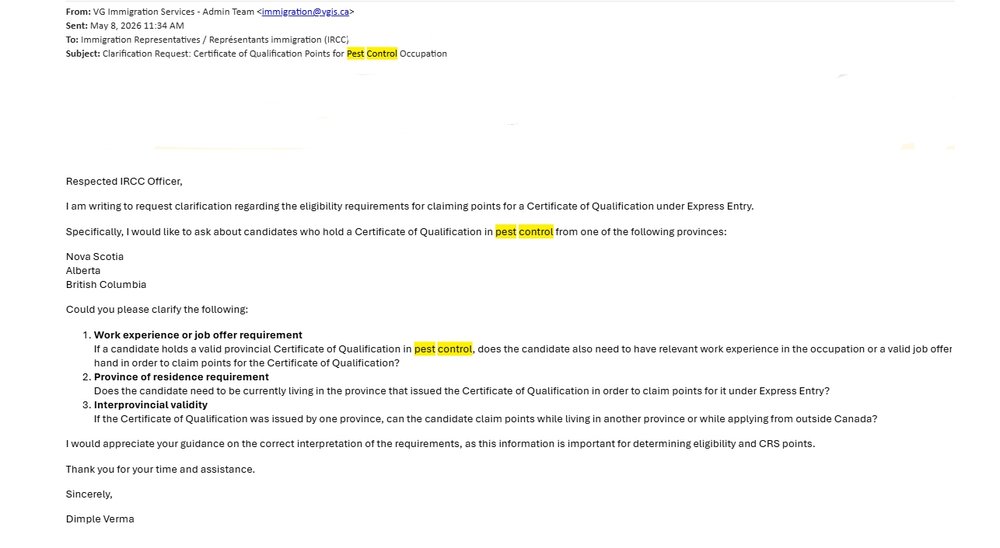
Eleven days later, on May 19, 2026 at 11:31 AM, IRCC responded. The reply is short, but it is the most authoritative answer any applicant or consultant is likely to receive without filing a full application:
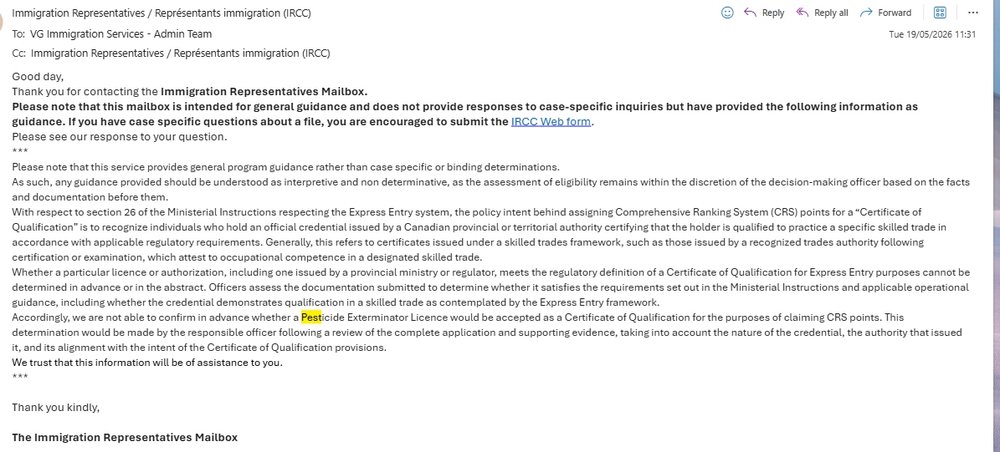
— IRCC Client Support, May 19, 2026
What this response actually means
IRCC’s reply is carefully worded and tells us three concrete things:
- There is no pre-approval mechanism. You cannot get a binding answer about your pest control licence until you submit a complete Express Entry application and an officer reviews it.
- The burden of proof is entirely on the applicant. IRCC will look at “the complete application and supporting evidence.” If you cannot affirmatively demonstrate that your provincial licence meets the regulatory definition of a Certificate of Qualification, it will not be credited.
- The legal framework is IRPR + IRCC program guidance. That means s. 87.2 of the Immigration and Refugee Protection Regulations (Federal Skilled Trades) and the operational COQ definition — issued by the provincial or territorial body authorized to govern that trade.
Translation: officers have wide discretion, and pest control practitioners need to build the strongest possible documentary case before they submit.
What Counts as a “Certificate of Qualification” Under IRCC’s Rules
Under IRCC’s Federal Skilled Trades program guidance, a Certificate of Qualification is an official document issued by a provincial, territorial, or federal authority that proves you are qualified to work in a designated skilled trade in Canada. To be valid for Express Entry purposes, the certificate must:
- Be issued by the body that regulates the trade in the province or territory where you intend to live and work (or by Canada’s federal regulator if the trade is federally regulated)
- Demonstrate that you have met all the requirements to practise the trade in that jurisdiction — usually a combination of training, supervised work hours, and a passed certification exam
- Show that the trade itself appears on IRCC’s eligible NOC list for the FST stream (or the broader Express Entry trades category)
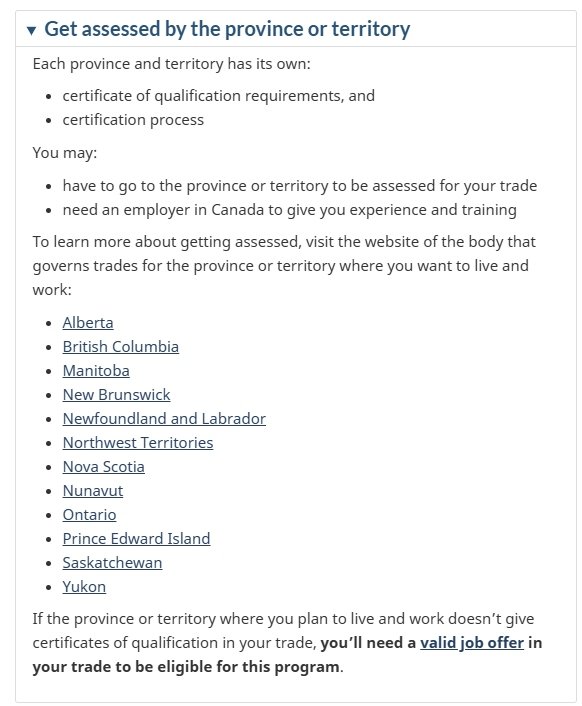
For most trades, the issuing authority is the provincial apprenticeship body — for example, Skilled Trades Ontario, the Industry Training Authority in British Columbia, or Apprenticeship and Industry Training in Alberta. For the 54 Red Seal trades, the Red Seal endorsement issued by a provincial apprenticeship authority is the gold standard COQ.
Pest control falls outside this clean architecture — and that is precisely why IRCC’s response to VG was non-committal.
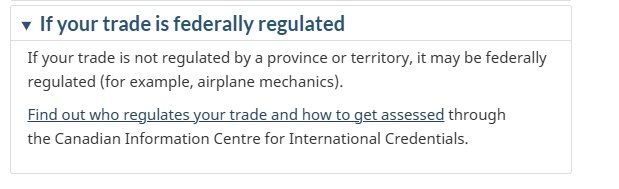
Pest Control = NOC 73202, TEER 3 — and Not a Red Seal Trade
The first reality check for any pest control applicant is the NOC classification. Pest controllers and fumigators are coded under NOC 73202, TEER 3 in Canada’s 2021 NOC framework. This is a real, recognized occupation — but TEER 3 placement and the absence of Red Seal designation create three structural problems:
Start your secure Immigration intake
Skip the back-and-forth. Complete a structured intake in 25 minutes. Reviewed by Dimple Verma, RCIC-IRB. No payment required to start.
- Not Red Seal: There are 54 Red Seal trades in Canada. Pest control is not one of them. The Red Seal program covers trades like electrician, plumber, automotive service technician, welder, carpenter, cook, hairstylist, heavy duty equipment technician, and roofer. Pest control was never added.
- Not in the 2026 Trades category list: IRCC’s category-based draws for the trades category use a specific list of 25 NOC codes. NOC 73202 (pest controllers and fumigators) is excluded.
- Not in the FST eligible NOC list for 2026: The Federal Skilled Trades program restricts eligibility to a defined set of major and minor NOC groups under TEER 2 / TEER 3 within construction, manufacturing, agriculture, food processing, transport, and certain service categories. Pest control falls outside the FST eligibility table.
This is why we say pest control occupies a “regulatory grey zone.” It is undeniably a skilled, regulated occupation in every province — but IRCC’s Express Entry architecture was built around Red Seal and apprenticeship-authority-issued credentials, not provincial environmental ministry licences.
Ontario vs Alberta vs Nova Scotia: Pest Control Credential Comparison
Every Canadian province regulates pest control independently. There is no national certification, no Red Seal endorsement, and no interprovincial mobility agreement specifically for pesticide applicators. Here is how the three most relevant provinces stack up for 2026 immigration purposes:
| Feature | Ontario | Alberta | Nova Scotia |
|---|---|---|---|
| Credential name | Exterminator Licence (multiple classes: Structural, Landscape, Agricultural, Industrial, Mosquito/Biting Flies, etc.) | Pesticide Applicator Certificate (multiple service categories) | Pesticide Applicator Certification (categorized by use sector) |
| Issuing authority | Ministry of the Environment, Conservation and Parks (MECP), under the Pesticides Act | Alberta Environment and Protected Areas (training delivered via Lakeland College) | Nova Scotia Department of Environment and Climate Change |
| Issued by provincial apprenticeship authority? | No — not a Skilled Trades Ontario trade. No apprenticeship pathway. | No — not an Alberta Apprenticeship and Industry Training trade. | No — not a Nova Scotia Apprenticeship Agency trade. |
| Training + exam structure | Self-study or approved training course + provincial certification exam administered by MECP-approved exam providers; technicians work under a licensed exterminator’s supervision. | Self-study manual + Lakeland College exam (proctored online or in person); category-specific competency exams. | Approved training course + closed-book exam administered by NS Environment; renewable certification with continuing education. |
| Validity period | Up to 5 years, renewable with refresher / re-examination. | 5 years; renewal by re-exam or approved CEUs. | Typically 5 years; renewal by re-exam. |
| Prior work experience required to be issued? | No — but technician licence requires sponsorship by a licensed exterminator-employer. | No — based on passing the exam. | No — based on passing the exam. |
| Job offer required to be issued? | Effectively yes for technician class (you must work for a licensed operator). | No. | No. |
| Province of residence required? | No formal residency requirement to write the exam, but practical compliance requires Ontario operations. | No residency requirement to write the exam. | No residency requirement to write the exam. |
| Interprovincial validity | Ontario licence is not automatically valid in any other province. | Alberta certificate is not automatically valid outside Alberta; some categories have limited reciprocity agreements. | Nova Scotia certification is not automatically valid outside NS. |
| Likely to be accepted as a Certificate of Qualification? | Possibly — at officer discretion. Strongest argument when combined with full NOC 73202 work history. | Possibly — at officer discretion. Same caveats as Ontario. | Possibly — at officer discretion. Same caveats as Ontario. |
The structural pattern is the same in all three provinces: pesticide applicator licensing is administered by the environmental ministry, not the apprenticeship authority. This single fact is the heart of why IRCC cannot give applicants a pre-confirmation — the credential does not come from the body their guidance points to.
Don’t gamble your Express Entry application on a misclassified credential.
VG Immigration audits your provincial pesticide licence, NOC mapping, work-experience documentation, and language test scores before you ever submit — so you know exactly where you stand.
How the CRS Awards Points for a Certificate of Qualification (25 or 50)
If IRCC accepts your provincial pesticide licence as a Certificate of Qualification, it can unlock up to 50 additional CRS points under the “skill transferability” section of the Comprehensive Ranking System. The points are awarded on a sliding scale based on your Canadian Language Benchmark (CLB) scores:
| CLB Level (all four abilities) | COQ Points Awarded | Notes |
|---|---|---|
| CLB 4 or below in any ability | 0 points | No COQ bonus — language floor not met. |
| CLB 5 or 6 in all four abilities | 25 points | First tier — meaningful boost but limited. |
| CLB 7 or above in all four abilities | 50 points | Maximum tier — typically the difference between an ITA and the long wait. |
For pest control applicants, the math is brutal but instructive: a CLB 7+ profile with an accepted provincial pesticide licence gains 50 transferability points. The same profile without an accepted COQ — even with the same work experience — sees zero. In a competitive draw environment where program-specific cutoffs hover between CRS 480 and CRS 540 (and category-based draws fluctuate between CRS 379 for Trades and CRS 547 for French Language Proficiency in 2026), 50 points is decisive.
Equally important: you only see this bonus on your CRS score breakdown once your profile is accepted into the pool and IRCC has validated your inputs — including your COQ.
2026 Express Entry Reforms: Why COQ Recognition Is Tightening
IRCC’s proposed 2026 reforms — currently under consultation and previewed in our Express Entry overhaul overview — are pushing the FST and trades streams in a more restrictive direction:
- COQ recognition narrowing to Red Seal trades only. The most consequential change being floated is restricting COQ-based CRS points to the 54 Red Seal trades, removing officer discretion for non-Red-Seal credentials. If implemented, this would essentially close the door on pest control practitioners using their provincial licence for points.
- NOC list compression for the trades category. The 2026 category-based draws use a list of 25 NOC codes. NOC 73202 (pest controllers and fumigators) is not on that list and is unlikely to be added.
- High-wage factor stacking. Under the proposed framework, an applicant’s job offer wage will be compared against Job Bank’s median wage for that NOC. Wages above the median earn additional weighting; wages below are penalized. NOC 73202 median wages vary widely by province and category, so pest control applicants need to research this carefully.
- PNP integration. Provinces are increasingly nominating Red Seal trades and high-demand sectors via PNP, but pest control rarely appears in provincial demand lists outside Ontario and Alberta.
If you are a pest control practitioner targeting Canadian PR via Express Entry, the strategic window is now — before any of these reforms become operational policy.
What This Means for You: Practical Implications
If you currently hold or are pursuing a provincial pesticide applicator licence and you want to use it for Express Entry, here is the realistic playbook for 2026:
1. Document everything as if you are building a litigation file
Because IRCC will not pre-confirm your credential, the strength of your application is the strength of your evidence. You need: certified copies of your provincial licence, the official regulation under which it is issued (e.g., Ontario Pesticides Act), the licensing authority’s published competency standards, your training transcripts, your exam results, your supervised hours log, and a detailed work-experience letter that maps your duties to NOC 73202.00 line items.
2. Maximize your language scores — aim for CLB 9+
If COQ recognition is uncertain, language is the lever you control completely. CLB 9 in all four abilities adds 124 CRS points for skill transferability combinations and unlocks French bilingual bonuses if applicable. See our complete language testing guide for 2026.
3. Layer a PNP nomination if possible
A PNP nomination adds 600 CRS points and effectively guarantees an ITA. Streams in Ontario (OINP), Alberta (AAIP), and Saskatchewan (SINP) periodically open targeted occupational categories — sometimes including environmental services or related sectors. Track our trades and PNP draw coverage to spot openings early.
4. Consider a Canadian work permit pathway first
If your home-country pesticide certification is unlikely to be recognized as a Canadian COQ, the cleanest strategy is often to come to Canada on a work permit, accrue 12 months of Canadian work experience under NOC 73202 (TEER 3 qualifies for Canadian Experience Class), and apply through CEC — where COQ recognition matters less because your Canadian work experience does the heavy lifting.
5. Avoid these common mistakes
- Claiming COQ points without supporting evidence — this can lead to misrepresentation findings.
- Assuming a home-country pest control certification automatically qualifies — almost never does.
- Submitting an FST application when pest control is not on the FST eligible NOC list — the application will be returned.
- Treating online “consultant” advice as authoritative — only an RCIC or lawyer should be assessing COQ-style edge cases.
How VG Immigration Can Help
At VG Immigration Services Inc., principal consultant Dimple Verma (RCIC-IRB R708308) personally handles non-standard skilled-trades files like pest control. Our process for COQ-edge-case files includes:
- Full NOC mapping audit — verifying you qualify under NOC 73202 (or, in some cases, under a more advantageous adjacent NOC)
- Provincial credential package preparation — translating, certifying, and contextualizing your licence so an IRCC officer can map it to s. 87.2 IRPR
- Language test strategy — CELPIP, IELTS General, PTE Core, TEF Canada, or TCF Canada selection based on your strengths
- PNP eligibility scan across all 11 provinces / territories — including Atlantic Immigration Program endorsements where applicable (see our 2026 AIP changes guide)
- Express Entry profile optimization — placing your highest CRS-relevant facts in the strongest positions on your profile
- Direct IRCC correspondence on novel questions — as we did for pest control in May 2026
For closely related Express Entry coverage from this site, see our June 2026 next-draw prediction, our June 24 Physicians draw analysis (271 ITAs, CRS 223), our June 23 CEC draw (4,000 ITAs, CRS 516), and our Francophone pathway decision tree if you have French language ability.
Already hold a provincial pesticide licence? Let us audit it.
Send us your licence, your training records, and your work-experience documents. We will tell you exactly how strong (or weak) the COQ argument is for your file — and what to do about it.
VG Immigration Services Inc. · Dimple Verma, RCIC-IRB R708308 · 2 County Court Boulevard, Suite 400, Brampton, Ontario L6W 3W8 · This article is general information based on direct IRCC correspondence dated May 19, 2026, and current canada.ca guidance. It does not constitute legal advice. Immigration outcomes depend on individual circumstances and the discretion of the reviewing officer.