
CILA Writes to Minister Diab: TR to PR Program Information Gap Sparks Industry Concern

Posted by: Dimple Verma, RCIC-IRB #R708308 | VG Immigration Services Canada
Published: April 25, 2026
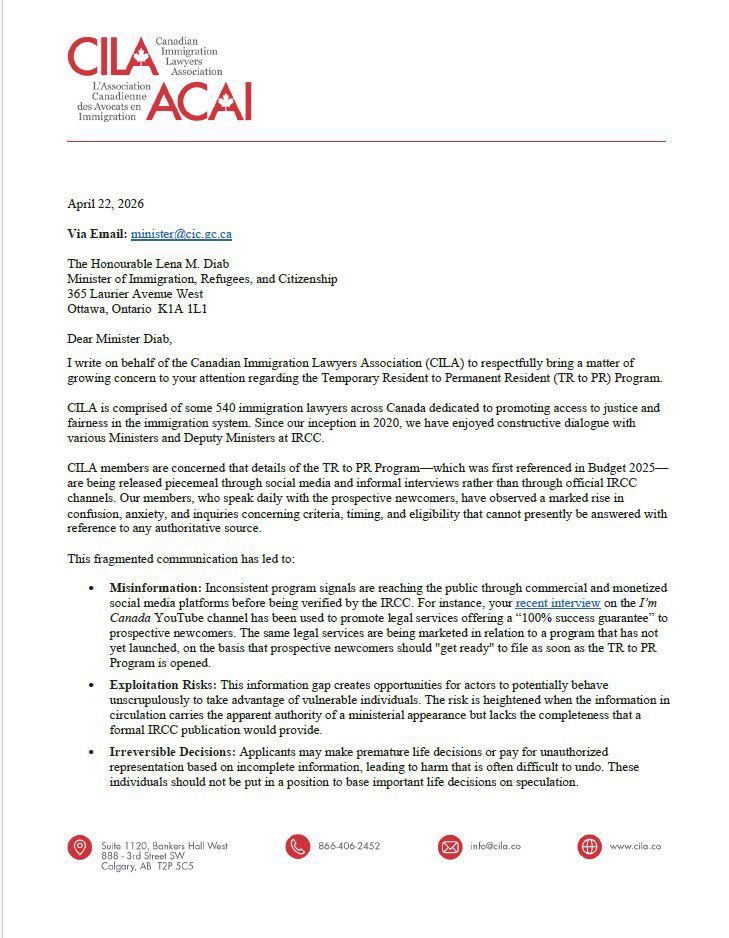
The Canadian Immigration Lawyers Association (CILA) has formally written to the Honourable Lena Metlege Diab, Minister of Immigration, Refugees and Citizenship, raising serious concerns about how information on the proposed Temporary Resident to Permanent Resident (TR to PR) Program has been reaching the public. The April 22, 2026 letter, signed by CILA Director Grace Allen and shared publicly through CILA’s website and social media, calls on IRCC to step in and clarify a program that — according to CILA — has not yet officially launched, yet is already being actively marketed to prospective newcomers.
Reach Newcomers to Canada
Banks, insurance, real estate, tax & accounting, telecom, healthcare & education. Ask about relevant native in-article placements.
Contact Us →For temporary residents, international students, and foreign workers in Canada whose status is approaching expiry, this letter is significant. It captures a feeling that many newcomers and licensed RCIC-IRB practitioners have been sharing for weeks: the rules are unclear, the timing is unclear, and the noise around the program is overwhelming.
“Inconsistent program signals are reaching the public through commercial and monetized social media platforms before being verified by IRCC.” — CILA letter to Minister Diab, April 22, 2026
Background — What Is the TR to PR Program?
The Temporary Resident to Permanent Resident (TR to PR) Program was first referenced in Budget 2025 as a pathway intended to help certain temporary residents already living and working in Canada transition to permanent residency. Beyond that initial reference, IRCC has not published full eligibility criteria, an official launch date, or formal application instructions on Canada.ca.
Despite this, ministerial appearances, social media commentary, and informal interviews on commercial platforms have been generating expectations — and selling preparation services — for a program that, in CILA’s words, “has not yet been officially confirmed or publicly explained in full.”
The X Post That Sparked Wider Awareness
On April 22, 2026, immigration lawyer and CILA member Tamara Mosher-Kuczer (@TTRRMK) shared the letter on X (formerly Twitter), tagging the official accounts of CILA (@CILAvoice), Minister Diab (@LenaMetlegeDiab), and Citizenship and Immigration Canada (@CitImmCanada). Her post used the hashtag #cndimm and quickly drew attention from lawyers, RCIC-IRBs, and prospective applicants alike.
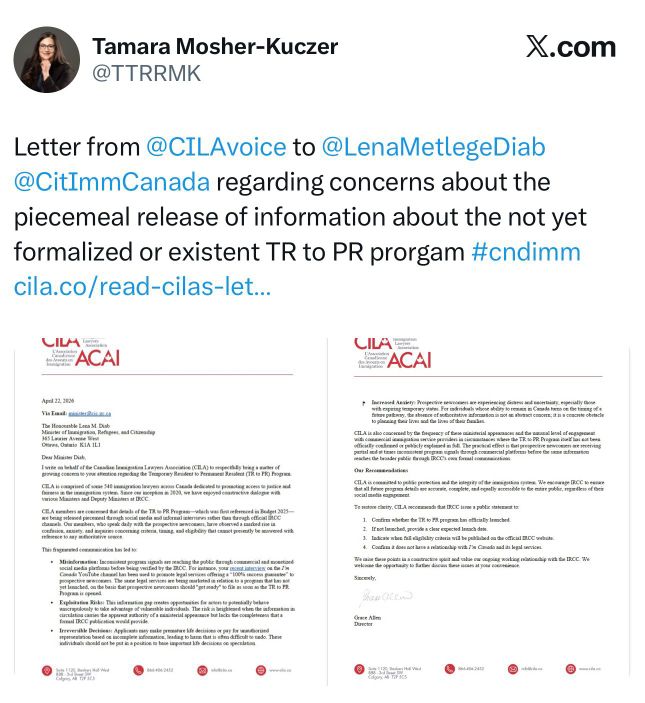
The post reads:
“Letter from @CILAvoice to @LenaMetlegeDiab @CitImmCanada regarding concerns about the piecemeal release of information about the not yet formalized or existent TR to PR program #cndimm“
That single post effectively turned a sector-internal advocacy letter into a wider public conversation — exactly the kind of conversation CILA was asking for in the first place: clear, official, and accessible information for everyone.
CILA’s Three Core Concerns
CILA represents approximately 540 immigration lawyers across Canada dedicated to access to justice and fairness in the immigration system. In its letter, the association identified three categories of harm caused by the current piecemeal communications:
1. Misinformation
According to CILA, inconsistent program signals are reaching the public through commercial and monetized social media platforms before being verified by IRCC. The letter specifically references a recent ministerial interview on the I’m Canada YouTube channel — a platform CILA notes has been used to promote legal services offering a “100% success guarantee” to prospective newcomers. Those same legal services are now being marketed in connection with a program that has not yet launched, on the basis that newcomers should “get ready” to file as soon as TR to PR opens.
2. Exploitation Risks
This information gap creates space for unscrupulous actors. CILA warns that the risk is heightened when information appears to carry the authority of a ministerial appearance but lacks the completeness that a formal IRCC publication would provide. Vulnerable applicants — many on the verge of status expiry — are particularly exposed.
3. Irreversible Decisions
Applicants may make premature life decisions or pay for unauthorized representation based on incomplete information, leading to harm that is often difficult to undo. As CILA puts it: “these individuals should not be put in a position to base important life decisions on speculation.”
Start your secure Immigration intake
Skip the back-and-forth. Complete a structured intake in 25 minutes. Reviewed by Dimple Verma, RCIC-IRB. No payment required to start.
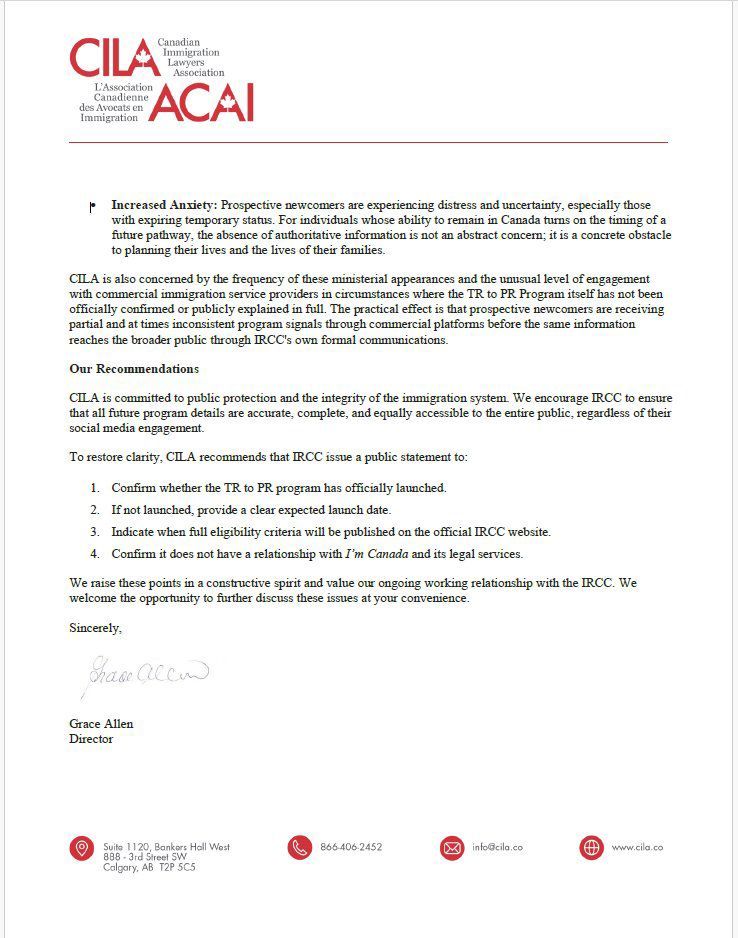
CILA also flagged a fourth concern that runs through all three: increased anxiety. Prospective newcomers — especially those with expiring temporary status — are experiencing real distress and uncertainty when their ability to remain in Canada turns on the timing of a future pathway whose details remain unconfirmed.
The Letter to Minister Diab
Below are the two pages of CILA’s letter as released publicly. The letter was sent April 22, 2026 via email to minister@cic.gc.ca and addressed to The Honourable Lena M. Diab, Minister of Immigration, Refugees and Citizenship, Ottawa.
CILA’s Four Recommendations to IRCC
To restore clarity and protect both applicants and the integrity of the immigration system, CILA asked IRCC to issue a public statement that does the following:
- Confirm whether the TR to PR program has officially launched.
- If not launched, provide a clear expected launch date.
- Indicate when full eligibility criteria will be published on the official IRCC website.
- Confirm IRCC does not have a relationship with I’m Canada and its legal services.
The letter closed on a constructive note, reaffirming CILA’s value of its working relationship with IRCC and its willingness to discuss these issues further.
Why This Matters for Temporary Residents in Canada
If you are in Canada on a study permit, work permit, post-graduation work permit, or any other temporary status that is set to expire in 2026 or 2027, you are exactly the demographic CILA’s letter is concerned about. Here’s what we recommend you do right now, regardless of whether the TR to PR program eventually launches:
Verify everything against IRCC’s official website
If a program detail is not on Canada.ca or in IRCC’s official news notices, it is not yet a confirmed rule. Marketing claims, YouTube interviews, and social media posts are not policy.
Pursue confirmed pathways in parallel
Do not pause your existing immigration strategy waiting for a hypothetical program to open. The Express Entry system, Provincial Nominee Programs (PNPs), family sponsorship, PGWP extensions, and bridging open work permits are all confirmed, active programs with clear rules. Use our free CRS Calculator and NOC Finder to map your eligibility today.
Verify your representative is licensed
In Canada, only three groups can legally represent you for immigration matters for a fee: licensed RCIC-IRBs, lawyers in good standing with a provincial law society, and Quebec notaries. You can verify a representative’s license at the College of Immigration and Citizenship Consultants public registry. Anyone offering a “100% success guarantee” is, by definition, making a promise no licensed professional can ethically make.
Beware “get ready” packages for unannounced programs
Paying for application preparation for a program that has not officially launched — and whose rules, eligibility, and document requirements are not yet known — is high-risk. Once IRCC publishes the actual eligibility criteria, the documents and proofs you may have prepared could turn out to be irrelevant or insufficient.
Where VG Immigration Services Stands
VG Immigration Services Inc. fully supports CILA’s position. As a licensed RCIC-IRB in good standing (Dimple Verma, R708308), we believe that:
- Public protection comes before marketing. No ethical immigration practitioner should be selling readiness services for a program whose rules don’t yet exist.
- Authoritative information must come from IRCC first. Our role is to interpret, apply, and represent — not to pre-announce policy.
- Paid consultations exist precisely to protect applicants. A 60-minute paid consultation with a licensed RCIC-IRB will tell you exactly what is real today, what is speculative, and which confirmed pathway gives you the strongest case in the meantime.
If you are anxious about your status, your timeline, or the noise on social media, that anxiety is real and valid. What it requires is not another viral video — it requires a structured assessment of your file against confirmed IRCC criteria, by someone with a legal duty to advise you accurately.
Frequently Asked Questions
Has the TR to PR Program officially launched?
As of the date of CILA’s letter (April 22, 2026), no. The program was referenced in Budget 2025 but full eligibility, application instructions, and a launch date have not been published on Canada.ca. CILA’s letter specifically asks IRCC to confirm or deny launch status.
Should I pay someone to “prepare” my TR to PR application now?
Paying for preparation of an application for a program with no published eligibility criteria carries significant risk. Until IRCC publishes the official rules, no one — including us — can know which documents will be required, who will qualify, or what the timing will be.
What can I actually do right now if my temporary status is expiring?
Pursue every confirmed pathway that fits your profile in parallel: extension of your current permit, transition to a different temporary status (e.g., visitor record, BOWP, OWP), Express Entry profile, PNP nomination, family sponsorship if eligible. A licensed RCIC-IRB can map all available options against your specific situation in a single paid consultation.
How do I verify my immigration representative?
Search the public registry at the College of Immigration and Citizenship Consultants (college-ic.ca) for RCIC and RCIC-IRB licenses, or the relevant provincial law society for lawyers. Always confirm the registration number — for example, ours is R708308.
Where can I read CILA’s full letter?
The letter is publicly available at CILA’s website. See the credits and sources below for the direct link.
Credits & Sources
This blog post is based on, and gives full credit to, the original publication by the Canadian Immigration Lawyers Association (CILA). All quotations and the letter images are reproduced for educational and public-information purposes, with attribution to the original source.
- Original article and letter: CILA — Read CILA’s Letter to Minister Diab on IRCC’s TR to PR Program
- Author of the original letter: Grace Allen, Director, Canadian Immigration Lawyers Association (CILA)
- X post amplifying the letter: Tamara Mosher-Kuczer (@TTRRMK) on X.com, April 22, 2026
- CILA website: cila.co
- Recipient: The Honourable Lena Metlege Diab, Minister of Immigration, Refugees and Citizenship Canada
- IRCC official portal: canada.ca
- RCIC verification: College of Immigration and Citizenship Consultants
VG Immigration Services Inc. is not affiliated with CILA, the Office of the Minister, or I’m Canada. We are reporting on a publicly issued letter and offering practical guidance to our prospective and current clients. All editorial commentary is our own.
Disclaimer: This post is for general informational purposes only and does not constitute legal or immigration advice. Immigration laws and IRCC policies change frequently. The TR to PR Program referenced is, as of the date of publication, not officially launched. For advice specific to your case, please book a paid consultation with our licensed RCIC-IRB. VG Immigration Services Inc. — Dimple Verma, RCIC-IRB #R708308.