
Ebola Immigration Measures Extended to February 25, 2027: Who Is Affected and What to Do
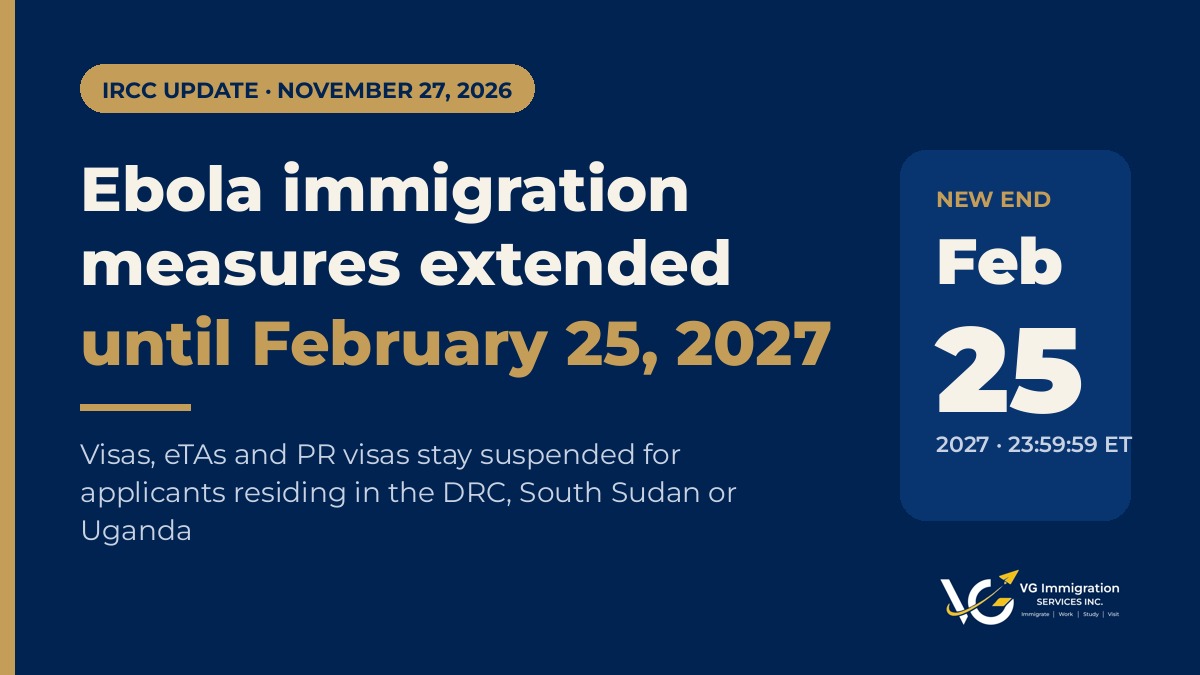
IRCC has extended its Ebola-related immigration measures again. On November 27, 2026, the day they were set to end, IRCC announced a 90-day extension to February 25, 2027, at 23:59:59 ET (IRCC notice). If you, a family member or a client applied from the Democratic Republic of the Congo, South Sudan or Uganda, approved visas and eTAs still cannot be used to travel, and pending files will not be finalized until the measures end.
This alert explains who is covered, what is suspended, what to do about passport requests and expiring documents, how to ask for an exemption, and the separate border and quarantine rules. Every point below comes from IRCC and the Public Health Agency of Canada (PHAC).
Reach Newcomers to Canada
Banks, insurance, real estate, tax & accounting, telecom, healthcare & education. Ask about relevant native in-article placements.
Contact Us →Quick answer
- New end date: 23:59:59 ET on February 25, 2027. The measures started at 23:59:59 ET on May 27, 2026 (IRCC Ebola measures).
- Who: foreign nationals outside Canada who listed the DRC, South Sudan or Uganda as their country of residence when they applied (IRCC notice).
- What: visitor visas, eTAs, TRP counterfoils and PR visas are suspended, even if already approved (IRCC).
- Processing: IRCC keeps working on files but will not approve or finalize them while the measures are in place.
- Border: foreign nationals who were in the DRC in the past 21 days cannot enter Canada. Travellers from Uganda or South Sudan who can enter must quarantine 21 days unless exempt (PHAC).
Who is covered: residence, not citizenship
IRCC applies the measures to the last country of residence listed in your application, not your citizenship (IRCC Ebola measures). The affected countries are:
- the Democratic Republic of the Congo
- South Sudan
- Uganda
In practice, this means:
- A Ugandan citizen who lived and applied from Kenya or the UAE is not affected by the immigration measures. IRCC says to request an exemption if you were notified anyway.
- A person of any citizenship who listed one of the three countries as residence is affected.
- A person who was already in Canada when the measures were put in place keeps their status and can stay for the period they were authorized (IRCC).
What is suspended
IRCC lists these documents as suspended (IRCC Ebola measures):
- temporary resident visas (visitor visas)
- electronic travel authorizations (eTAs)
- temporary resident permit counterfoils
- permanent resident visas
A suspended document is temporarily invalid and cannot be used to travel to Canada. IRCC says it will notify affected people by email, so keep your email address up to date with IRCC.
When the measures end
IRCC says it will automatically reactivate suspended documents when the measures end. If it needs more information before reactivating, it will contact you.
If your document expires while suspended
The suspension does not extend the expiry date. If your visa, eTA or other document runs out while it is suspended, you will need to apply for a new one to travel to Canada later (IRCC). If your document expires before February 25, 2027, plan for a new application.
Applications in progress
IRCC will keep processing new and existing applications from affected applicants, but it will not finalize them while the measures are in place (IRCC notice). That covers temporary and permanent residence files alike, so expect final decisions on these files to wait until at least February 25, 2027, unless IRCC grants an exemption or changes the measures again.
Passport requests: do not send your passport yet
If you are affected and receive a passport request letter, IRCC says do not send your passport to a visa application centre (VAC) until the measures have ended. VACs cannot process these submissions right now and will not hold your passport. If you send it, it will be returned and you may have to pay additional fees (IRCC Ebola measures).
Start your secure Immigration intake
Skip the back-and-forth. Complete a structured intake in 25 minutes. Reviewed by Dimple Verma, RCIC-IRB. No payment required to start.
How to request an exemption
IRCC considers exemption requests case by case. In your request you must explain and give evidence for why you should be exempt, and show that you are not a risk to public health. IRCC will look at:
- the public health risk you would pose if exempted
- steps you have taken or will take to lower that risk
- whether you urgently need protection as a member of the Convention refugee or country of asylum class, if that applies
- other humanitarian or compassionate reasons
How to submit it, according to IRCC:
- Use IRCC’s crisis web form.
- Select “I need help with something else.”
- Include your explanation and supporting documents.
IRCC gives these examples of useful evidence:
- proof you were outside the affected countries for at least 21 days before 11:59:59 p.m. ET on May 27, 2026, such as passport pages, boarding passes, accommodation receipts, rental agreements, employment records, pay stubs, bank statements or proof of enrolment
- proof of steps to reduce public health risk, such as self-isolation or quarantine, or a note from a medical professional about your health
- why your documents or application should be processed before the measures end
- any other documents that support your case
Border and quarantine rules (separate from IRCC)
PHAC runs separate border and public health measures under the Quarantine Act. They also last until February 25, 2027, at 11:59 pm EST, and apply even if you only transit through the affected countries (PHAC border measures).
- DRC in the past 21 days, foreign national: you cannot enter Canada, board a flight to Canada or transit through Canada, unless an exemption applies.
- Uganda or South Sudan in the past 21 days, foreign national: you may travel to Canada but must quarantine for 21 days on arrival unless exempt. This applies only if your own immigration document is not suspended.
- Canadian citizens, permanent residents and people registered under the Indian Act: you can enter after being in any of the three countries, but you get a health assessment and must quarantine for 21 days unless exempt.
- Quarantine plan: you need a suitable place to stay for 21 days before you arrive. Foreign nationals must arrange and pay for it and may be denied entry if they cannot sustain it.
- Penalties: breaking these measures is an offence under the Quarantine Act, with fines up to $1,000,000, up to 3 years in prison, or both.
What to do now
- Check the country of residence you listed on each application, not just your passport.
- Watch your IRCC account and email for suspension notices, and update your email if it has changed.
- Do not send a passport to a VAC on a passport request until the measures end.
- Check expiry dates. If a document lapses before February 25, 2027, plan a new application.
- If you have urgent or humanitarian reasons, request an exemption through the crisis web form with evidence.
- Sponsors and employers in Canada: plan start dates, arrival dates and family plans around a February 25, 2027 earliest date.
- Travellers returning to Canada: prepare a 21-day quarantine plan before you leave.
Related guides: Work, Study and Visitor Permits: FAQ, Permanent Residence and Express Entry: FAQ, Status, Extensions and Restoration: FAQ and our weekly update for November 22–28, 2026.
Frequently asked questions
Until when are the Ebola immigration measures in place?
IRCC extended them for 90 days. They now end at 23:59:59 ET on February 25, 2027. They have been in place since 23:59:59 ET on May 27, 2026.
Who is affected by the Ebola document suspension?
Foreign nationals outside Canada who listed the Democratic Republic of the Congo, South Sudan or Uganda as their country of residence when they applied. IRCC applies the test to the country of residence in the application, not citizenship.
Which immigration documents are suspended?
Temporary resident visas, electronic travel authorizations (eTAs), temporary resident permit counterfoils and permanent resident visas. They cannot be used to travel to Canada while the measures are in place, even if already approved.
Is IRCC still processing applications from the affected countries?
Yes. IRCC says it continues processing new and existing applications, but it will not approve or finalize them while the measures are in place.
Does the suspension extend my visa or eTA expiry date?
No. IRCC says the suspension does not extend the expiry date. If your document expires while suspended, you need to apply for a new one to travel to Canada later.
Should I send my passport to a VAC if I get a passport request?
No, not while the measures are in place if you are affected. IRCC says visa application centres cannot process these passport submissions, will return the passport, and you may have to pay additional fees.
Can I ask for an exemption?
Yes. IRCC considers exemption requests case by case through its crisis web form, using the option “I need help with something else.” You must explain why you should be exempt, give evidence, and show you are not a risk to public health.
I was already in Canada when the measures started. Is my status affected?
No. IRCC says your status in Canada is not affected and you can stay for the period you were authorized to stay.
Affected by the Ebola measures, or planning a family member’s or employee’s travel? Contact VG Immigration Services, call +1 (416) 578-9269 or email [email protected]. Dimple Verma, RCIC-IRB, can review your file, your deadlines and whether an exemption request makes sense.
This article is general information, not legal advice. It is based on the IRCC Ebola measures page, the IRCC notice of November 27, 2026 and the PHAC border measures page as of November 28, 2026. Measures can change; check IRCC before you travel or apply.