Work Permit Expiring? 4 Online PG Programs to Stay & Get PR in Canada (2026)
Posted by: Dimple Verma, RCIC-IRB #R708308 | VG Immigration Services Canada
Published: May 27, 2026 at 11:15 PM ET
Work Permit Expiring? Why Switching to an Online Postgraduate Program Could Save Your Status in Canada
If your closed work permit, open work permit, or PGWP is set to expire in the next few months, you are not out of options. A growing number of foreign workers in Canada are switching from a work permit to a study permit by enrolling in an online Ontario College Graduate Certificate — a one-year postgraduate credential that costs roughly $13,000 to $15,000 per year, can be completed entirely online, lets the student work 24 hours per week off-campus, and opens new doors into Provincial Nominee Programs (PNPs) across Canada.
Reach Newcomers to Canada
Banks, insurance, real estate, tax & accounting, telecom, healthcare & education. Ask about relevant native in-article placements.
Contact Us →At VG Immigration Services, we have helped dozens of clients in 2025 and 2026 use this exact bridge to avoid losing status, keep earning income, improve their IELTS/CELPIP scores, and pivot to a province with a faster permanent residence pathway. This guide breaks down four of the strongest online postgraduate programs we currently recommend, and the immigration playbook that goes with them.
⚠️ Work Permit Expiring in 60-120 Days?
Don’t lose your status. Switch to a study permit, keep working 24 hours/week, and stay in line for Provincial Nominee Programs. We help you pick the right program, secure your Letter of Acceptance, and file the in-Canada study permit application.
Key Highlights
- 4 online postgraduate programs in Ontario you can use as a status bridge — fully online delivery, no relocation required.
- 24 hours per week of off-campus work allowed while you study (IRCC rule effective since November 8, 2024 and confirmed in 2026 policy guidance).
- Unlimited off-campus work during scheduled academic breaks.
- Time to retake IELTS/CELPIP, upgrade French (TEF/TCF), and add 50+ CRS points.
- Strategic provincial pivot — move from Ontario to Saskatchewan, Manitoba, Alberta, New Brunswick, or PEI for easier PNP nominations after graduation.
- Important caveat: These specific programs are not PGWP-eligible because they are 100% online. We explain why this is often fine — and how to use a second on-campus program later if needed.
The IRCC Rules You Need to Understand First
Before we look at the four programs, here is the regulatory backdrop every work permit holder thinking about this pivot must know.
1. The 24-hour off-campus work rule
Effective November 8, 2024, IRCC permanently set the off-campus work limit for eligible international students at 24 hours per week during academic terms. This replaced the old 20-hour rule and the temporary 40-hour pandemic policy. The 2026 official guidance on the Government of Canada study permit page confirms this is the current legal cap. During scheduled breaks (winter break, reading week, summer term if you are enrolled in spring and fall), students can work unlimited hours, up to 180 days per calendar year.
2. You need a SIN condition printed on your study permit
To work off-campus without a separate work permit, your study permit must contain one of two specific work-authorization conditions. When we file your in-Canada study permit application, we ensure your supporting documents clearly establish full-time enrollment at a Designated Learning Institution (DLI) so IRCC issues a permit with the proper work conditions printed on it.
3. Co-op work permits are gone (April 1, 2026)
As of April 1, 2026, eligible post-secondary international students no longer need a separate co-op work permit for a mandatory work placement that is 50% or less of the study program. This is a major simplification and removes a common processing bottleneck.
4. PGWP eligibility — read this carefully
The four programs we recommend below are online graduate certificates. Under current IRCC PGWP rules, programs delivered fully online do not make graduates eligible for a Post-Graduation Work Permit. That is by design. The strategy here is not “study, then PGWP.” The strategy is: buy yourself 12 months of legal status and 24-hour work rights while you pivot your PR file — either through Express Entry CRS improvements or a Provincial Nominee Program. Many of our clients then enroll in a second, on-campus program at a public college if they decide they want a PGWP later.
🎯 Not Sure Which Program Fits Your Profile?
CRS score, NOC code, work history, and province — every detail decides whether you land in the OINP, BC PNP, SINP, or Atlantic stream. Let an RCIC build your roadmap before you commit $13,000 in tuition.
The 4 Online Postgraduate Programs We Currently Recommend (2026)
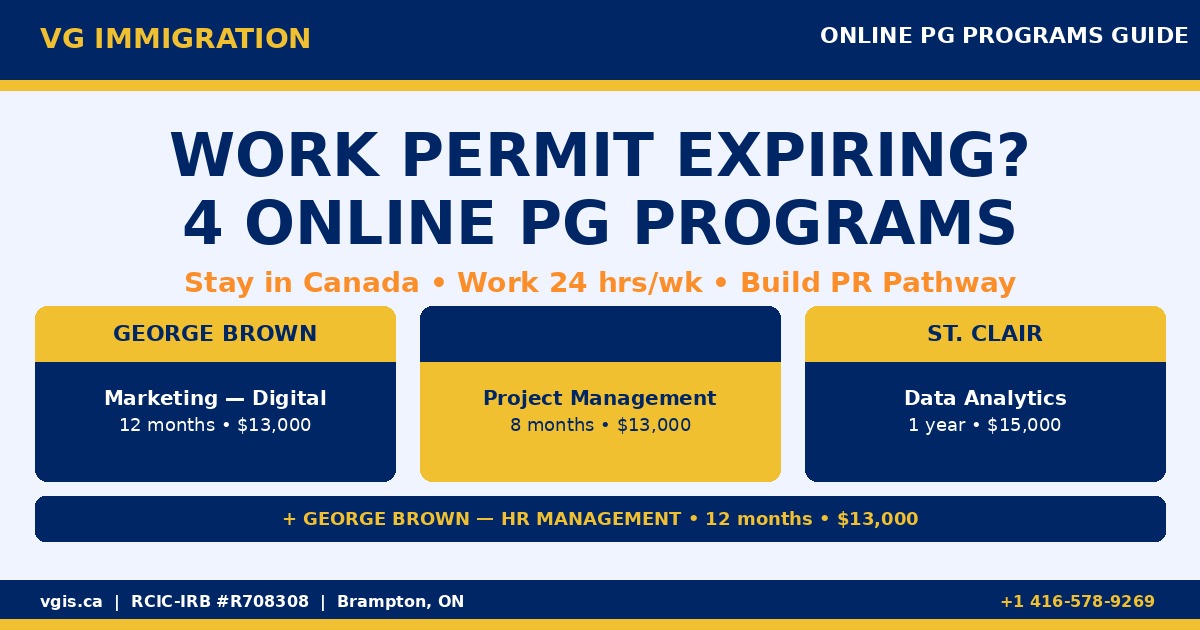
1. George Brown College — Marketing Management: Digital Media (B423)
Format: Online Postgraduate Program (Ontario College Graduate Certificate)
Duration: 12 months, full-time
Start dates: January and September
Delivery: Online + co-op work component
Annual fees: $13,000 (international)
PGWP eligible: No (online delivery)
Work to study option: Yes
Start your secure Study Permit intake
Skip the back-and-forth. Complete a structured intake in 25 minutes. Reviewed by Dimple Verma, RCIC-IRB. No payment required to start.
An ideal pick for work permit holders coming from sales, marketing, content, retail, or hospitality NOC codes who want to layer in digital marketing, analytics, paid media, and content strategy. Strong fit for clients targeting NOC 11202 (Professional occupations in advertising, marketing and public relations) and NOC 64101 (Sales and account representatives — wholesale trade), both of which appear regularly in OINP Employer Job Offer and BC PNP Tech draws.
2. George Brown College — Project Management (B425)
Format: Online Postgraduate Program (Ontario College Graduate Certificate)
Duration: 8 months, full-time
Start dates: January, May, and September (three intakes)
Delivery: Online
Annual fees: $13,000 (international)
PGWP eligible: No (online delivery)
Work to study option: Yes
The fastest of the four — only 8 months. Excellent for workers in construction, IT, engineering, and operations roles who want to formalize their experience with a Canadian credential aligned with PMI’s PMBOK framework. Three intakes per year means you can usually start the same term your work permit expires, which is critical for maintained status under IRPR section 183 if you apply before expiry. Targets NOC 12102, NOC 13100, and NOC 11202.
3. George Brown College — Human Resources Management (B428)
Format: Online Postgraduate Program (Ontario College Graduate Certificate)
Duration: 12 months, full-time
Start dates: January, May, and September
Delivery: Online + co-op
Annual fees: $13,000 (international)
PGWP eligible: No (online delivery)
Work to study option: Yes
Builds in-demand HR skills across recruitment, employee relations, HR policies, and learning & development. This program is aligned with the CHRP (Certified Human Resources Professional) coursework requirement in Ontario, which materially raises a candidate’s employability and helps justify a job offer for OINP Employer Job Offer (NOC 11200, NOC 12101). Coupled with a co-op term, it gives clients Canadian HR experience that strengthens any future PR file.
4. St. Clair College — Data Analytics (B019)
Format: Online Postgraduate Program (Ontario College Graduate Certificate)
Duration: 1 year
Start dates: September
Delivery: Online
Annual fees: $15,000 (international)
PGWP eligible: No (online delivery)
Curriculum: Python, machine learning, data visualization, business analytics, AI foundations
School: Zekelman School of Information Technology
The most technical of the four and the highest-leverage choice for clients who want to pivot into tech-adjacent NOC codes. Graduates from this program target NOC 21223 (Database analysts and data administrators), NOC 21211 (Data scientists), and NOC 21222 (Information systems specialists) — all of which are Category 5 (STEM) occupations in the federal Express Entry category-based selection rounds and appear frequently in BC PNP Tech and OINP Tech draws.
5 Strategic Reasons This Bridge Works in 2026
Reason 1 — These programs are 100% online
You do not need to relocate, break your lease, or quit your current job. You keep your housing, your bank account, your driver’s license — and you keep working up to 24 hours per week off-campus during terms (unlimited during breaks).
Reason 2 — 24 hours per week of legal off-campus work
This is the single biggest reason a study permit beats letting your work permit lapse. At the average GTA wage of $22-$28/hour for service and admin roles, 24 hours/week translates to $25,000-$35,000 of legal annual income while you study. Add summer unlimited-hours work and the financial gap closes quickly.
Reason 3 — Time to chase real PR options
Twelve months of study buys you a window to:
- Get an updated IELTS/CELPIP — even one band increase moves CRS scores by 25-50 points depending on starting level.
- Take a French test (TEF Canada / TCF Canada). NCLC 7 across all four French skills can add up to 64 CRS points and qualifies you for French-language Express Entry rounds, which had cut-offs as low as CRS 379 in 2026 draws.
- Get an Educational Credential Assessment (ECA) for both your foreign degree and your new Ontario graduate certificate (where applicable).
- Build a stronger Express Entry profile, write a new EOI, or get into a provincial pool.
Reason 4 — You can use the study period to improve your skills
Language is the highest-impact CRS lever. But a graduate certificate in HR, project management, marketing, or data analytics also expands the NOC codes you qualify for. A truck driver in NOC 73300 who completes a Project Management graduate certificate may now legitimately compete for NOC 12102 logistics coordinator roles — opening different OINP and Atlantic Immigration Program (AIP) pathways.
Reason 5 — Pivot to a province with easier PR options
After your online program, you are no longer tied to Ontario. Many of our clients use this window to plan a move to a province with friendlier PNP math:
- Saskatchewan (SINP) — Hard-to-Fill Skills sub-category: Direct nomination for in-demand occupations including healthcare, transportation, hospitality, and trades, often with lower language and work-experience thresholds than federal Express Entry.
- Manitoba (MPNP) — Skilled Workers Overseas and In-Manitoba streams: Strong community-connection points and lower minimum language thresholds (CLB 5 for many NOC TEER 4 roles).
- New Brunswick (NBPNP) and Prince Edward Island (PEI PNP): Atlantic Canada employers face severe labour shortages and frequently support newcomers with PR-supporting job offers.
- Alberta (AAIP) — Tourism and Hospitality, Rural Renewal, Accelerated Tech streams: Multiple targeted streams with no LMIA requirement when the offer is from a designated employer.
- BC PNP — Health Authority and Entry Level / Semi-Skilled streams: Direct nomination paths for specific in-demand occupations.
How the Status Transition Actually Works
The legal mechanism is straightforward but the timing has to be perfect. Here is the playbook we run for our clients:
- Choose the program based on your NOC code, target province, language scores, and budget — typically 90+ days before work permit expiry.
- Receive a Letter of Acceptance (LOA) from a DLI. We assist with the application package and the educational fit narrative.
- Pay the first-term tuition deposit (typically $6,500 of the $13,000-$15,000 annual fee).
- Obtain a Provincial Attestation Letter (PAL) where required. Ontario currently uses a college-issued PAL through the institution.
- Submit the in-Canada study permit application before your work permit expires. This triggers maintained status under IRPR section 183(5)-(7), letting you continue working under your existing work permit conditions until IRCC makes a decision on the study permit.
- Once the study permit is approved, your authorization to work shifts from “work permit holder” to “full-time student who can work 24 hours per week off-campus.”
- Begin classes on the start date. You cannot start working under student rules until your program officially begins.
What This Means for You
This pathway is not the right move for everyone. It works best if you:
- Are within 90-150 days of your work permit expiring and do not have an LMIA-supported job offer or a PNP nomination in progress.
- Have at least $13,000-$15,000 available for tuition plus $20,635 (the 2026 IRCC proof-of-funds requirement for one person) ready in your bank account.
- Are committed to using the 12 months to genuinely improve your PR file — better IELTS, French, ECA, PNP application — rather than treating it as a stalling tactic.
- Understand that an online graduate certificate does not lead to a PGWP, and that your long-term PR plan still relies on Express Entry or a PNP.
It is not the right move if you already have an active PNP file, an LMIA-supported job offer, or a strong Express Entry profile that is about to be drawn. In those cases, switching to a study permit can actually slow you down.
How VG Immigration Can Help
Dimple Verma, RCIC-IRB (R708308), Commissioner of Oaths, at VG Immigration Services helps work permit holders evaluate this exact decision every week. We assess:
- Whether the study-permit bridge is the right move based on your current CRS, NOC, language scores, and savings.
- Which of the four programs above fits your file (or whether a different DLI is better).
- The timing of the application to preserve maintained status under IRPR s.183.
- The parallel PR strategy — Express Entry profile, PNP EOI, French upgrade, ECA refresh.
- The provincial pivot — if Ontario is not working for you, which province should you actually be applying through.
We take care of the LOA application, the tuition payment guidance, the study permit submission, the proof-of-funds letter format, and (if you choose) a parallel PR roadmap for the next 12-24 months. RCIC-IRB licensing means we can also represent you in front of IRCC, ESDC, and IRB if anything escalates.
✅ Ready to Apply with VG Immigration?
We handle the LOA, the study permit application, biometrics scheduling, and the timing strategy so you never lose a single day of work authorization. RCIC-IRB #R708308.
📅 Book a Consultation | 🚀 Onboard Now | 💬 WhatsApp +1 416-578-9269
📅 Book a Consultation | Visit vgis.ca | 💬 WhatsApp
VG Immigration Services Inc. | 211B-9300 Goreway Drive, Brampton, ON L6P 4N1 | +1 416-578-9269 | immigration@vgis.ca
Disclaimer: This article is general information about Canadian immigration programs based on IRCC and provincial publications as of May 27, 2026. It is not legal advice. Tuition, intake dates, and program details may change; always verify with the institution and a licensed RCIC before making decisions. PGWP eligibility, work-hour rules, and PNP criteria are subject to IRCC and provincial updates.