Canada Immigration Weekly Update: November 7–13, 2026
Week in review: November 7–13, 2026. Verified November 14.
This week’s Canada immigration news includes a time-sensitive Northwest Territories expression-of-interest deadline, a permanent rural immigration program planned for 2027, and new provincial invitations. The main distinction for applicants is simple: an announcement, an invitation and a permanent residence approval are different steps.
Reach Newcomers to Canada
Banks, insurance, real estate, tax & accounting, telecom, healthcare & education. Ask about relevant native in-article placements.
Contact Us →Below, VG Immigration separates what changed from what you can actually do now. Figures and dates come from the official sources linked beside each update.
At a glance: what needs attention first?
- Northwest Territories: eligible Employer-Driven candidates should check the November 17 EOI deadline for the November 18 draw.
- Rural immigration: a permanent program was announced November 9, with a January 1, 2027 opening. Do not treat the announcement as an application invitation.
- Existing Hong Kong and Ukrainian PR applicants: new processing measures concern existing inventories, not a reopened application window.
- BC, PEI and Newfoundland and Labrador: new invitations were published. An invitation does not establish final nomination or PR eligibility.
1. Northwest Territories: November 17 deadline before an additional draw
The Northwest Territories announced on November 10 that its 2026 nomination allocation increased by 50, bringing the total to 350. An additional Employer-Driven EOI draw is scheduled for November 18. Profiles must be submitted by November 17 at 11:59 p.m., Northwest Territories time, to be considered.
Selected candidates should be prepared to submit a complete application within one week of their invitation. The Francophone and Business streams do not use this EOI process. See the official NTNP allocation and draw notice.
Practical next step: check stream eligibility and the employer’s supporting documents before submitting an EOI. VG’s priority for affected files is application readiness, not just profile submission. A larger allocation does not guarantee selection.
2. Permanent rural immigration program: announced now, opening in 2027
On November 9, IRCC announced a permanent Rural Community Immigration Program intended to open on January 1, 2027, with 5,500 admission spaces. The announcement envisages the 14 existing pilot communities participating, with further expansion later.
That is a future program start, not confirmation that every worker in a rural community qualifies today. Read the IRCC announcement and the official program information.
Practical next step: identify the participating community and relevant employer requirements, then check the operative rules before planning an application. For VG, the useful work now is assessing genuine community and employment fit, rather than promising access based on a headline.
3. Worker retention: provincial allocations are not a new application window
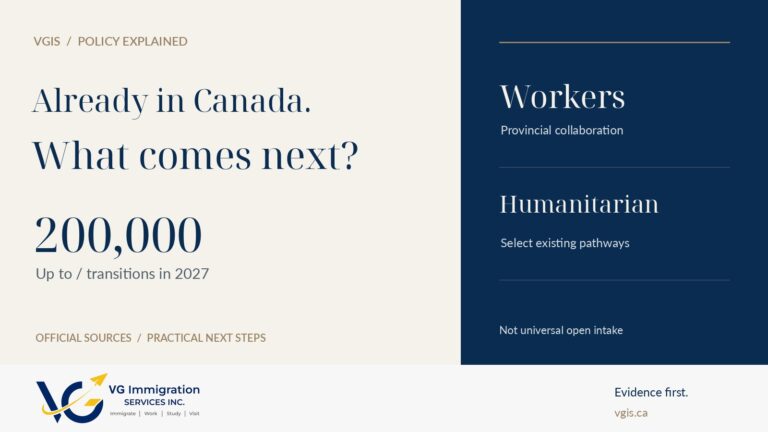
IRCC’s November 12 announcement describes optional provincial and territorial allocations for up to 100,000 workers and family members in 2027. The stated March 31, 2027 date concerns intended use of allocations; it is not an individual applicant submission deadline.
Start your secure Immigration intake
Skip the back-and-forth. Complete a structured intake in 25 minutes. Reviewed by Dimple Verma, RCIC-IRB. No payment required to start.
IRCC says this is not a new program or a reopening and that applicants do not need to contact the department or take action because of the announcement. See the official worker-retention announcement.
Practical next step: maintain lawful status and continue following the requirements of your actual application. A planning allocation is not a work-permit extension, an invitation or a promise of permanent residence.
4. Hong Kong and Ukrainian PR inventories: processing existing applications
On November 10, IRCC announced measures concerning existing permanent residence applications, with 2027 admissions of up to 32,000 Hong Kong applicants and 18,800 Ukrainian applicants. This is not a reopened intake, and the announcement does not require applicants to take action.
The official IRCC inventory announcement is the source for these figures. They should not be read as an individual processing-time guarantee.
Practical next step: monitor the actual application account and correspondence. If a personal document request arrives, its wording and deadline matter more than a general announcement.
5. Provincial invitation results published this week
British Columbia: November 13 targeted invitations
BC reported 153 childcare invitations at a minimum score of 95, 103 healthcare invitations at 72, fewer than five veterinary-care invitations at 100, and 128 construction invitations at 94. Because one category is reported as fewer than five, there is no exact total to calculate from the published figures.
Check the official BC invitation page and VG’s November 13 BC PNP draw explainer. Matching a score alone is not enough: stream, occupation and other selection conditions still matter.
Prince Edward Island: November 9
PEI published 192 Labour and Express Entry invitations and no business invitations for November 9. Confirm the result on the official PEI EOI results page. A scheduled draw date is not itself proof that invitations were issued; this recap uses the published result.
Newfoundland and Labrador: November 9 and 13
Newfoundland and Labrador reported 57 invitations on November 9: 35 under the NLPNP and 22 under the Atlantic Immigration Program. It also reported 38 NLPNP invitations on November 13. See the official invitation updates.
Practical next step for invited applicants: read your own invitation and check its submission deadline and document requirements. Provincial invitations are not permanent residence approvals. VG’s file review should focus on whether the evidence supports every claim made in the profile.
6. Two targeted IRCC processing updates
Designated representatives: IRCC published a November 12 operational update concerning designated representatives and asylum-related procedures. The underlying reforms took effect November 3, so publication and effective dates differ. This is particularly relevant to vulnerable people and minors involved in removal-related processes. The precise circumstances require case-specific review. See the official operational update and VG’s designated-representative explainer.
Start-Up Visa: a November 10 clarification identifies A77 as the relevant work-permit exemption code for the prioritization discussed in the instructions. Priority treatment and eligibility are separate questions. Check the official A77 update before applying the clarification to a file.
Your practical checklist for the coming week
- Act on a real deadline: assess the NWT November 17 cutoff immediately if the Employer-Driven stream fits your circumstances.
- Separate plans from applications: do not submit or pay for a supposed new intake based only on the 2027 announcements.
- Keep status planning separate: a future PR opportunity does not by itself authorize continued work or residence.
- Audit invitation evidence: reconcile employment, occupation and supporting records before responding to a provincial invitation.
- Use the right assessment: Ontario candidates researching their options can use VG’s OINP score calculator as a planning aid, not proof of eligibility or an invitation.
Coverage and verification notes
This is a selection of verified developments, not a claim that every Canadian immigration program was unchanged. Ontario’s update page and Manitoba’s news page could not be fully refreshed; Quebec’s news and PSTQ coverage and Saskatchewan’s intake coverage were incomplete. Express Entry’s current ministerial-instruction verification was also incomplete, so no new federal round is presented here. No relevant Nunavut announcement was verified; that does not prove none was issued. Other provincial and territorial sources reviewed did not yield an additional verified in-week item suitable for this recap.
We distinguish an official announcement date from a later start date and use “invitation” rather than “approval” where appropriate. Rules and availability can change after publication. This article provides general information, not an individual eligibility assessment.