Canada Immigration Weekly Update: October 31–November 6, 2026
Week covered: October 31–November 6, 2026. Published November 7, 2026. This Canada immigration weekly update separates rules that took effect this week from future plans and older draw results.
Express Entry candidates have a new scoring framework to check, low-wage employers have two immediate Temporary Foreign Worker Program changes, and Canada has released its next three-year immigration plan. Provincial developments also matter, particularly for applicants in Alberta, Newfoundland and Labrador, Prince Edward Island and Quebec. Here is what the verified official notices mean in practice.
Reach Newcomers to Canada
Banks, insurance, real estate, tax & accounting, telecom, healthcare & education. Ask about relevant native in-article placements.
Contact Us →The week at a glance
- Express Entry: November 3 changes took effect following an October announcement. IRCC says invitation rounds pause while existing profiles are recalculated.
- Federal planning: the November 5 levels plan sets targets for 2027–2029; its separate transition measure is not a general application intake opening.
- Employers: November 6 brought a longer maximum low-wage employment duration and an early childhood educator exception.
- Provincial programs: distinguish invitations, nominations, intake closures and updated notices. They are different steps with different consequences.
Express Entry changes took effect November 3
IRCC’s official Express Entry changes page, dated October 16, sets November 3 as the effective date. The new Labour Market Integration factor compares qualifying Canadian work experience with a qualifying high-wage job offer and awards the higher result, not both. The factor can provide up to 150 points.
The high-wage classification depends on the occupation’s NOC category and the official list, not simply the salary on an individual’s offer. Qualifying Express Entry job offers no longer need an LMIA for program eligibility or CRS points. That change does not eliminate separate work-permit requirements.
IRCC says recalculating existing profiles could take up to two weeks, with invitation rounds paused during that process. Candidates should check their profile against the revised rules and official instructions rather than treating a temporary score display as a final result.
For the occupation-by-occupation reference, see VG’s high-wage occupations guide. For evidence and offer assessment, see Express Entry job offers without an LMIA.
The 2027–2029 levels plan: targets, not immediate eligibility
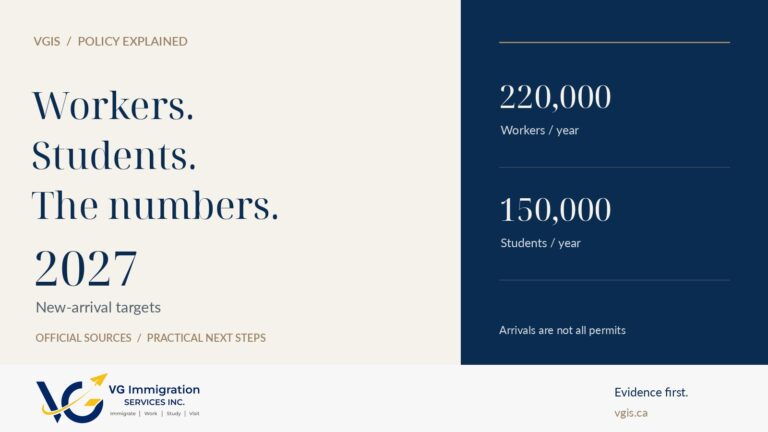
Released November 5, IRCC’s 2027–2029 Immigration Levels Plan tables set annual targets of 380,000 permanent residents and 370,000 new temporary resident arrivals. The temporary resident total comprises 220,000 workers and 150,000 students. The permanent resident plan includes 95,000 Provincial Nominee Program admissions annually.
These figures describe planned admissions for future years. They are not numbers of invitations issued this week, and a program allocation does not give an individual an entitlement to selection. Later-year targets are notional. Applicants still need to meet the requirements of an available program.
Our detailed levels-plan explainer separates the main targets from the additional transition measure.
The announced in-Canada transition measure is not a new open intake
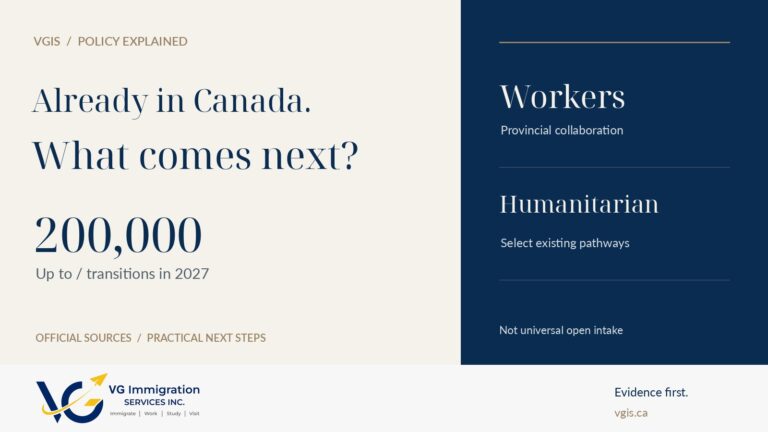
The November 5 IRCC backgrounder describes a separate, time-limited 2027 measure to process up to 200,000 people already in Canada: a workers cohort and a humanitarian cohort, with up to 100,000 people described under each. The announcement also includes workers’ families. Implementation includes cooperation with provinces and territories and processing of specified existing applications.
The backgrounder also announces making the Rural Community Immigration Pilot permanent. Neither statement should be read as a new application portal opening immediately for every temporary resident. Before spending money or changing an application strategy, identify the actual program, eligibility rules and intake instructions that apply to the person concerned.
Low-wage LMIA changes: what is effective now
ESDC’s November 6 announcement introduced two same-day changes to the Low-wage Stream of the Temporary Foreign Worker Program:
Start your secure Immigration intake
Skip the back-and-forth. Complete a structured intake in 25 minutes. Reviewed by Dimple Verma, RCIC-IRB. No payment required to start.
- Applications submitted on or after November 6 can request a maximum employment duration of up to two years, increased from one year.
- Early childhood educators join the exceptions to the refusal-to-process rule for low-wage LMIA applications in census metropolitan areas with unemployment of 6% or higher.
A longer maximum employment duration is not an automatic two-year approval or an automatic extension of an existing work permit. Employers and workers must distinguish the employment period requested, the LMIA’s conditions and the separate work-permit decision.
ESDC also proposed regional changes for March 1, 2027, contingent on provincial and territorial participation. These include potential 15% low-wage workforce caps for eligible employers in identified communities. Do not apply that proposed flexibility as though it were already available everywhere.
See VG’s low-wage LMIA changes explainer for the immediate employer implications.
Alberta: 173 invitations within this week’s window
Alberta’s AAIP processing and draw page, updated November 4, records a November 2 Rural Renewal Stream draw with 173 invitations and a minimum invited score of 51. Its allocation table reports 6,108 nominations issued against 6,603 regular spaces, leaving 495 as of that update.
The five recently listed draws total 425 invitations, but they span October 23–November 2. Only the November 2 draw falls within this recap’s October 31–November 6 window. Invitations to apply are not nominations, and the remaining allocation is a dated snapshot rather than a guarantee of future selection.
Alberta also lists additional federal spaces for qualifying physicians and Francophones separately from its regular allocation. The 495 figure should therefore not be presented as the full measure of every possible AAIP nomination route.
Newfoundland and Labrador: 75 invitations across two rounds
The official provincial invitation table lists 50 invitations on November 2, all under the Newfoundland and Labrador Provincial Nominee Program. On November 4, it lists 25 more: 24 NLPNP invitations and one Atlantic Immigration Program invitation.
The verified weekly total is 75 invitations: 74 NLPNP and one AIP. An invitation is permission to move to the application stage described by the program. It is not a provincial nomination, endorsement or federal permanent residence approval.
PEI: an AIP endorsement EOI soft launch
Prince Edward Island’s AIP Endorsement EOI page, published November 5, describes a soft launch of an expression-of-interest system. During the transition, designated employers may use the new EOI process or the traditional submission process.
Employers submit a separate profile for each candidate; selection is followed by an endorsement application. The page does not state a separate effective date for the soft launch. Its current sector restrictions should be checked before proceeding, but this recap does not characterize all conditions on the page as newly introduced this week.
Quebec: PEQ intake closed; PMI+ invitation notice updated
Quebec’s official PEQ notice says the intake that opened July 2 closed on October 31, 2026. New PEQ applications cannot be submitted, and no decision has been made on another intake period. The notice allows specified family-member additions or removals for existing files and directs prospective skilled-worker applicants toward declaring interest in Arrima.
Separately, Quebec’s International Mobility Program page, updated November 4, says communications inviting skilled workers to apply under PMI+ are suspended indefinitely. The page update does not establish when that suspension originally began. This is an invitation-status notice, not evidence that every International Mobility Program work permit has been suspended or that existing permits are cancelled.
Asylum regulations changed November 3
IRCC’s November 3 asylum-system announcement says new regulations came into force that day. They introduce a single online application process for claims made inland and at ports of entry, timelines for key government reviews, reinstatement rules, support for vulnerable claimants and exceptions to new ineligibility rules. Publication in the Canada Gazette followed on November 4.
Claimants should obtain advice on the rules and deadlines applicable to their circumstances. The announcement is not a substitute for an eligibility assessment or the instructions issued in an individual case.
A practical checklist for the coming week
- Express Entry candidates: review your NOC classification, qualifying work history and offer evidence against the current IRCC instructions.
- Low-wage employers: confirm the submission date, occupation, work location and applicable LMIA requirements before relying on the November 6 changes.
- Provincial applicants: record what you actually received: an EOI selection, invitation, endorsement or nomination. Follow the deadline in that notice.
- Quebec applicants: check the current intake status before preparing a new PEQ submission.
- Anyone considering a future federal measure: wait for the applicable official implementation details rather than assuming a broad new pathway is open.
Sources, verification and coverage limits
Material claims above are linked to primary federal or provincial sources checked for this edition. The window is the seven completed calendar days before publication, October 31–November 6, 2026. Earlier announcements are included only where a relevant effective date falls within the week, or where an updated current-status notice is explicitly identified.
Manitoba and Ontario official draw pages were inaccessible during verification, so this article does not publish unverified draw totals for them. The federal rounds page did not expose its dynamic results in the available read; no complete Express Entry draw count is claimed. BC’s latest verified draw and New Brunswick’s listed AIP selections fell outside this week’s window.
This review did not establish an in-period material notice for Nova Scotia, Saskatchewan, Yukon, the Northwest Territories or Nunavut. That is a coverage limitation, not proof that nothing changed. Program pages can change after publication; always recheck the linked official instructions before acting.
This recap provides general immigration information, not a decision on anyone’s eligibility or individualized legal advice.