Canada’s 2027 Worker and Student Targets: Work Permits, PGWPs and Study Plans Explained
Posted by Dimple Verma, RCIC-IRB, VG Immigration Services Canada
Licence R708308 | November 05, 2026 at 05:31 PM EST
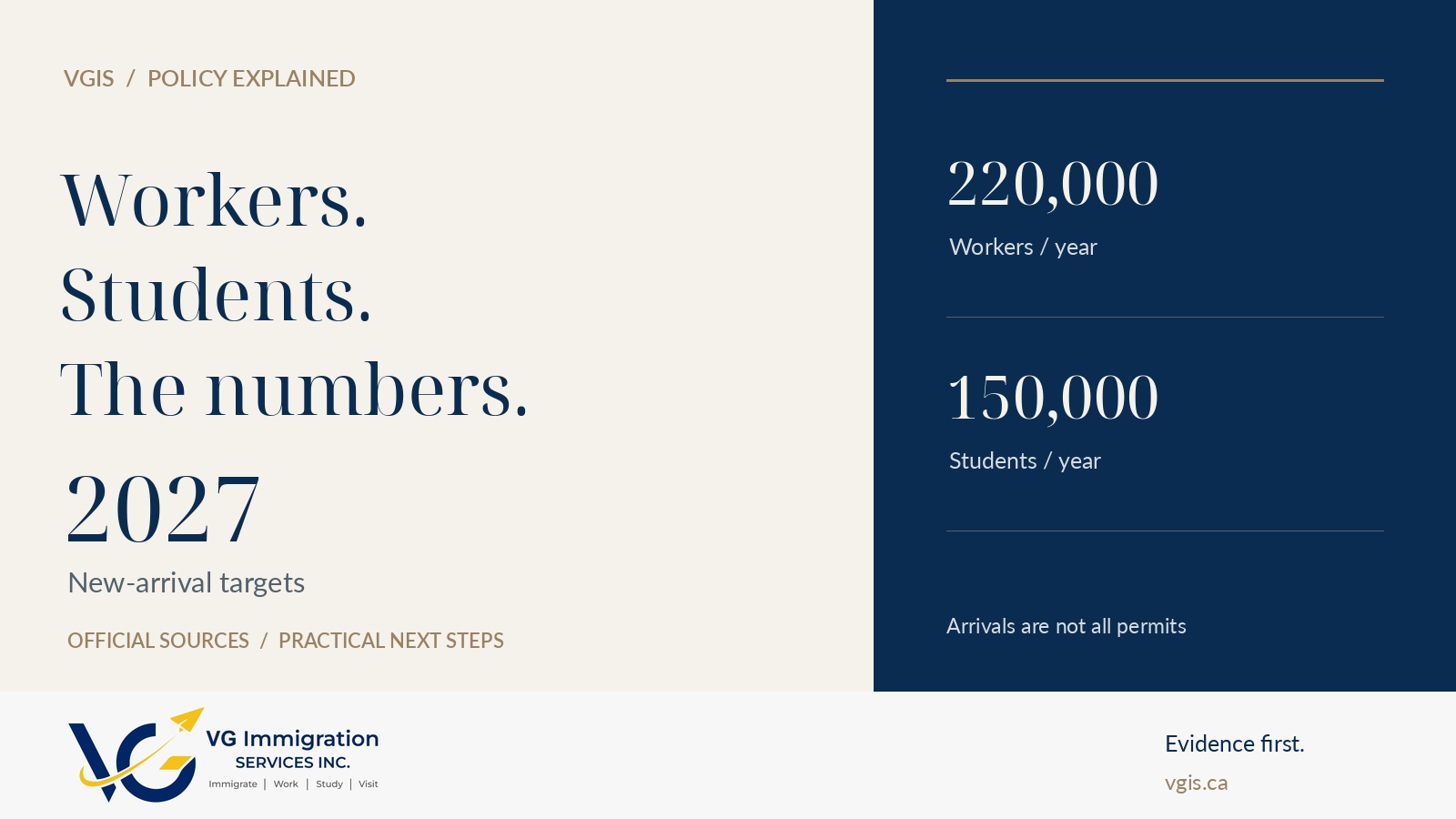
Canada’s new Immigration Levels Plan sets annual new-arrival targets of 220,000 temporary workers and 150,000 international students in 2027, 2028 and 2029. These total 370,000 new arrivals per year, but they are not a blanket cap on every work permit, study permit or status extension processed by IRCC. (Official temporary-resident table)
Reach Newcomers to Canada
Banks, insurance, real estate, tax & accounting, telecom, healthcare & education. Ask about relevant native in-article placements.
Contact Us →That distinction matters for prospective students, current students, PGWP holders and employers. This guide explains what the figures count, what they exclude and how to use them without making unsupported assumptions about your own application.
- The complete temporary-resident target table
- Is this a new cut for 2027?
- What the targets do not count
- International students: 150,000 arrivals is not 150,000 of every permit
- Temporary workers: distinguish IMP from TFWP
- What about transitioning to permanent residence?
- Three practical examples
- A practical planning checklist
- Explore the complete VGIS levels-plan series
- Frequently asked questions
- How VG Immigration Services can help
The complete temporary-resident target table
| Category | 2027 | 2028 | 2029 |
|---|---|---|---|
| International Mobility Program new arrivals | 170,000 | 170,000 | 170,000 |
| Temporary Foreign Worker Program new arrivals | 50,000 | 50,000 | 50,000 |
| Total worker arrivals | 220,000 | 220,000 | 220,000 |
| Student arrivals | 150,000 | 150,000 | 150,000 |
| Total new temporary-resident arrivals | 370,000 | 370,000 | 370,000 |
| Overall planning range | 355,000–385,000 | 355,000–385,000 | 355,000–385,000 |
The worker share is approximately 59.5% and the student share 40.5%, calculated from the official totals. IRCC describes these broadly as approximately 60% workers and 40% students, with outer-year targets subject to later adjustment. (Official plan and footnotes)
Is this a new cut for 2027?
The previous plan already projected 370,000 arrivals for 2027 and 2028, including 220,000 workers and 150,000 students. The new plan maintains those same-year targets rather than cutting them again. (Previous plan, new plan)
| Comparison | 2026 target in previous plan | 2027 target in new plan | Year-to-year change |
|---|---|---|---|
| Total arrivals | 385,000 | 370,000 | −15,000, about −3.9% |
| Total workers | 230,000 | 220,000 | −10,000, about −4.3% |
| IMP workers | 170,000 | 170,000 | No change |
| TFWP workers | 60,000 | 50,000 | −10,000, about −16.7% |
| Students | 155,000 | 150,000 | −5,000, about −3.2% |
This table compares different calendar years, unlike a comparison of old and new projections for the same year. The 2027 reductions relative to 2026 were already present in the previous plan; describing them as newly imposed November 2026 cuts would omit that history. (Previous target table, new target table)
What the targets do not count
IRCC expressly excludes visitors arriving with temporary resident visas or eTAs, permit extensions, in-Canada work and study permit applications, and asylum claimants from these new-arrival targets. Some excluded groups still form part of the broader methodology for reducing the non-permanent-resident share of the population, so “excluded from this table” does not mean “irrelevant to population planning.” (Temporary-resident footnote 2)
For applicants, this means the 370,000 figure cannot be used to calculate a personal approval probability by dividing it by every work or study application in the system. The numerator and denominator would measure different populations and events.
PGWPs are specifically excluded
IRCC says PGWPs belong within the wider IMP framework but are not included in these new-arrival targets because they are treated as an extension or change of status. Therefore, the 170,000 IMP target is not a PGWP issuance quota. (Temporary-resident footnote 3)
This exclusion does not create new PGWP eligibility or guarantee an approval. We recommend checking the current rules for the person’s institution, program, studies and application circumstances separately rather than using the levels table as an eligibility guide.
Seasonal and short-duration work also needs care
The IMP targets exclude seasonal or short-duration streams. The TFWP targets include non-seasonal workers remaining longer than a year and exclude specified seasonal workers required to enter and leave within the same calendar year. (Temporary-resident footnotes 4–7)
It is therefore inaccurate to call 50,000 a total cap on all temporary foreign workers, all LMIA applications or every agricultural worker. The table’s defined counting scope must be retained when discussing the number. (TFWP definitions)
International students: 150,000 arrivals is not 150,000 of every permit
The student line measures new international student arrivals, while in-Canada applications and permit extensions are excluded from the target framework. It should not be described as a published allocation to a particular school, a universal permit cap or a promise that every accepted student can arrive. (Student target and exclusions)
The plan’s student footnote refers to studies of six months or more at an approved designated learning institution. The table does not provide a new institution-by-institution allocation, a revised proof-of-funds amount or an individual application checklist. (Footnote 8)
Our recommendation for a prospective student is to verify the actual study-permit requirements and the academic value of the program before paying non-refundable fees. A national target is not a substitute for a coherent study plan, genuine financial evidence or a realistic post-study strategy.
Start your secure Work Permit intake
Skip the back-and-forth. Complete a structured intake in 25 minutes. Reviewed by Dimple Verma, RCIC-IRB. No payment required to start.
Temporary workers: distinguish IMP from TFWP
The IMP includes streams that do not require an LMIA, while the TFWP is jointly administered with ESDC and uses an LMIA for the relevant closed work permits. The levels plan assigns different new-arrival targets to those program groupings but does not turn every job offer into an LMIA exemption. (Footnotes 3 and 5)
Budget 2026 proposes TFWP reforms focused on regional labour-market alignment, processing and employer compliance. That policy direction should not be represented as a specific employer exemption or eligibility rule before the relevant details are issued. (Budget 2026, chapter 3)
For employers, we recommend checking the route that actually fits the job and worker. Do not assume that a larger national planning envelope substitutes for genuine duties, applicable requirements or the employer’s compliance obligations.
What about transitioning to permanent residence?
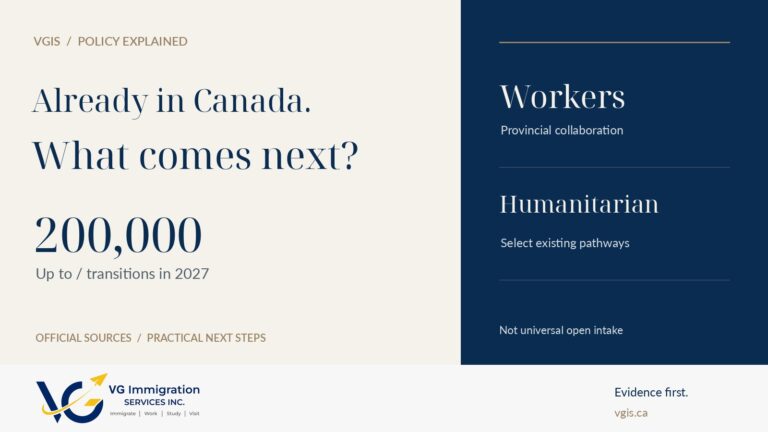
The new regular plan maintains 380,000 annual PR admissions and emphasizes economic immigration, with regular PNP admissions at 95,000 and AIP admissions at 6,000 per year. It also announces a separate time-limited measure for up to 200,000 people already in Canada through worker and humanitarian cohorts. (Official plan, IRCC backgrounder)
These are reasons to review a potential route, not proof that every worker or international graduate will transition to PR. The additional worker measure is tied to provincial collaboration and select pathways, while the humanitarian cohort concerns named existing application groups. (IRCC cohort explanation)
Read our Immigration Levels Plan guide for the broader context. We recommend building a plan around verified eligibility and current status rather than assuming that “already in Canada” alone creates a new entitlement.
Three practical examples
A student already in Canada needs more time to finish
The new-arrival target does not include in-Canada study permit applications or extensions. That classification does not decide the person’s extension: their own requirements and chronology still need review. (Official exclusions)
Recommended action: organize the current permit, school records, proposed completion timeline and financial evidence. Do not delay a necessary status decision because a headline refers to a future arrivals target.
A graduate plans to apply for a PGWP
PGWPs are explicitly excluded from the new-arrival IMP target. The graduate should not conclude either that “the 170,000 quota is full” or that exclusion makes the application automatically approvable. (PGWP footnote)
Recommended action: obtain a current eligibility and deadline review based on the actual academic record. Keep this separate from long-term PR planning.
An overseas worker has a prospective Canadian employer
The 220,000 worker figure combines distinct IMP and TFWP new-arrival targets. It does not establish which route fits a particular employer offer. (Worker table and program definitions)
Recommended action: identify the lawful work-permit category, any employer-side steps and the evidence required before booking travel or relying on a start date. Do not buy a claimed place within a national target.
A practical planning checklist
- Classify the situation: New arrival, in-Canada application, extension or transition to PR.
- Check the actual route: The levels plan is not an application checklist.
- Protect status: Calendar expiry dates and document-request deadlines independently.
- Assess education and employment honestly: Avoid invented duties, misleading letters or programs chosen solely on an unverified PR promise.
- Separate stages: Admission to a school, a job offer, a permit and PR are different decisions.
- Update the strategy: Revisit it when official operational instructions change, not only when a headline number changes.
These are VGIS recommendations for preparation. They do not replace the individualized legal and documentary requirements of an application.
Explore the complete VGIS levels-plan series
- Full 2027–2029 targets and before-and-after comparison
- The separate 200,000-person PR transition measure
- Worker, student and PGWP planning implications
Frequently asked questions
Are only 150,000 study permits available in 2027?
The published figure is a new student-arrival target, not a count of every study permit or extension. In-Canada study applications and permit extensions are excluded from the target definition. (Official footnotes)
Is the 170,000 IMP figure a PGWP cap?
No: IRCC expressly excludes PGWPs from these new-arrival targets. They are treated as an extension or change of status for this planning purpose. (Footnote 3)
Did the new plan cut the old 2027 worker and student targets?
No: the previous plan already projected 220,000 workers and 150,000 students for 2027. The new plan maintains those targets and extends the same headline figures to 2029. (Previous plan, new plan)
Does the plan guarantee a route from study or work to PR?
No such individual guarantee is provided. The separate transition measure concerns defined cohorts and select pathways, not every temporary resident. (IRCC backgrounder)
Are visitors included in the 370,000 target?
No: IRCC excludes visitors arriving with temporary resident visas or eTAs from these new-arrival targets. This does not remove the requirements applicable to an individual visitor. (Footnote 2)
How VG Immigration Services can help
VG Immigration Services can review a study or work strategy, identify which rules actually apply and separate temporary-status planning from a possible PR pathway. We can help assess documents and risks without treating an immigration target as a guaranteed outcome.
Book Consultation | Contact Us
Book now with your permit, school or employer documents and relevant application history. No consultation guarantees a permit, invitation or permanent residence.
VG Immigration Services Canada | 211-9300 Goreway Drive, Brampton ON L6P 4N1, Canada
+1 (416) 578-9269 | immigration@vgis.ca
Connect on Instagram, TikTok, WhatsApp and our contact card. Read our Privacy Policy and Legal Disclaimer; this is general information, not individualized advice.