Canada’s 200,000-Person PR Transition Measure: Workers, Families and What Is Confirmed
Posted by Dimple Verma, RCIC-IRB, VG Immigration Services Canada
Licence R708308 | November 05, 2026 at 05:31 PM EST
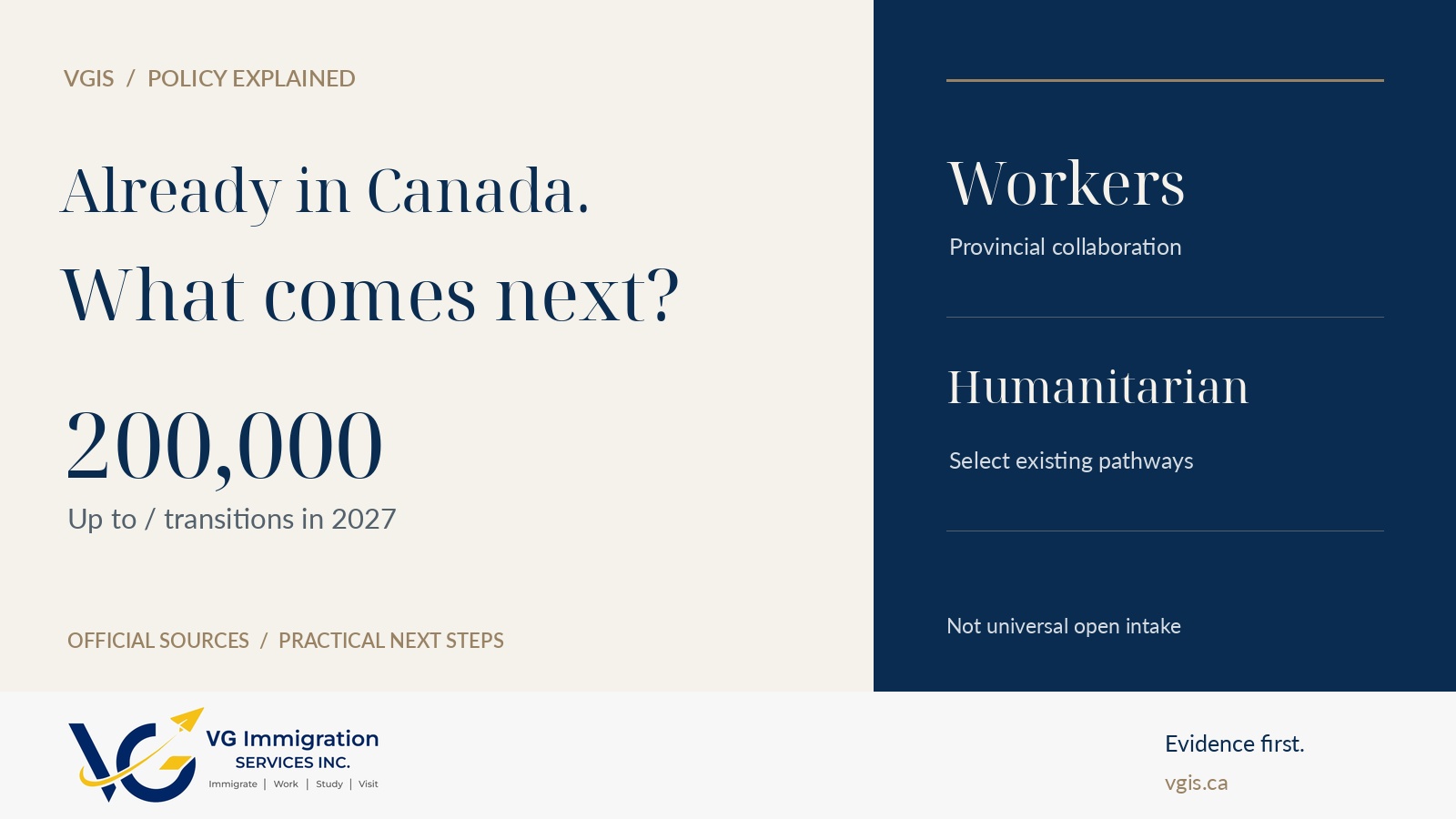
Canada has announced a time-limited measure to help up to 200,000 people already living in Canada transition to permanent residence through worker and humanitarian cohorts. IRCC says the measure provides additional admissions space to process applications under select pathways in 2027, separate from the regular Immigration Levels Plan. (IRCC’s November 5 backgrounder)
Reach Newcomers to Canada
Banks, insurance, real estate, tax & accounting, telecom, healthcare & education. Ask about relevant native in-article placements.
Contact Us →This is significant news, but “up to 200,000” is not the same as an open application portal for every temporary resident. The announcement identifies particular provincial mechanisms and existing application groups without providing a single universal eligibility checklist or registration process. (IRCC’s cohort description)
This guide explains what is confirmed and how to prepare without relying on unannounced criteria. It also explains why existing application records and temporary-status deadlines remain central.
- The two cohorts
- Worker cohort: two practical mechanisms
- Budget wording and IRCC’s operational explanation
- Humanitarian cohort: who is named?
- What remains unresolved
- How this differs from the earlier 33,000 and 115,000 initiatives
- Worked applicant scenarios
- A safe preparation checklist
- Explore the complete VGIS levels-plan series
- Frequently asked questions
- How VG Immigration Services can help
The two cohorts
| Cohort | Announced scale | Published focus |
|---|---|---|
| Workers | Up to 100,000 | People already in Canada, their families and regional labour-market needs, working with provinces and territories |
| Humanitarian | Up to 100,000 | Certain longstanding in-Canada applications and previous commitments, including named family and public-policy pathways |
| Total measure | Up to 200,000 | Additional admissions space for select pathways in 2027 |
These figures come from IRCC’s backgrounder and should not be described as 200,000 new application slots being sold or reserved. The worker paragraph mentions accompanying families, but the announcement does not publish a separate family-member quota or comprehensive counting instructions; do not add an unlimited number of dependants above the headline total. (Official measure)
Worker cohort: two practical mechanisms
Additional provincial and territorial space
IRCC says it will work with provinces and territories to provide additional space through increases to PNP allocations, which they can use to nominate workers who meet regional needs. This is distinct from the regular national PNP admissions target of 95,000 in the new plan. (Worker-cohort explanation, regular levels table)
The announcement does not tell an individual worker which province will select them, provide a complete list of occupations or guarantee a nomination. Our recommendation is to track the relevant province’s actual implementation notices rather than assume every in-Canada worker can use the same route.
Identification of certain existing federal applications
IRCC also says provinces and territories will be able to identify workers who have already submitted applications under select federal programs. Its examples include AIP and specific programs closed to new applications. (IRCC backgrounder)
| Existing application group named | What the announcement supports | What it does not establish |
|---|---|---|
| Atlantic Immigration Program | Potential identification of workers with existing applications | Automatic priority for every AIP file |
| Start-up Visa Program | Existing files mentioned among eligible program groups for provincial identification | Reopening of new SUV intake |
| Self-employed Persons Program | Existing files named | A new general self-employment PR route |
| Agri-Food Pilot | Existing files named | Reopening of the pilot |
| Home care worker programs | Existing files named | Automatic eligibility for every caregiver or a new intake date |
This table summarizes the distinction in the backgrounder; it is not a newly published eligibility regulation. Each application still needs to be checked against the eventual implementation rules and its own program requirements. (Named programs and closed-intake wording)
Budget wording and IRCC’s operational explanation
Budget 2026 describes the worker component in terms of workers eligible for Express Entry or PNP, while IRCC’s backgrounder explains additional PNP allocations and provincial identification of certain existing federal applications. These documents describe the initiative at different levels of detail; neither should be stretched into a promise that every Express Entry profile holder will receive a new invitation under the measure. (Budget 2026, chapter 3, IRCC backgrounder)
If your situation depends on how those descriptions interact, retain both documents and wait for the relevant operational instructions. VGIS would not invent a filing route to bridge an unanswered implementation question.
Humanitarian cohort: who is named?
IRCC describes up to 100,000 transitions intended to keep families together, address longstanding waits and fulfil existing commitments. The backgrounder identifies the following application groups. (Humanitarian-cohort announcement)
| Group | Stated aim |
|---|---|
| Hong Kong permanent residence pathways | Process all remaining applications under those pathways |
| Ukraine Family Reunification Pathway | Process all remaining applications under that pathway |
| Humanitarian and compassionate applications | Finalize applications from people already found eligible for PR on H&C grounds |
| In-Canada spouses, common-law partners and dependent children of Canadians and PRs | Process PR applications and reduce relevant inventories |
The H&C wording matters: “already found eligible” should not be represented as an invitation for everyone to submit a new H&C application or a guarantee that a pending eligibility decision will be favourable. Similarly, a promise to process remaining applications is not a promise to approve every file. (IRCC’s exact cohort wording)
For spouses and common-law partners destined outside Quebec, IRCC says the additional space should significantly help bring wait times closer to 12 months. This is a program-level goal, not a guaranteed completion date for a particular application, and the destination qualification should not be omitted. (Family-processing objective)
What remains unresolved
The documents reviewed announce the measure but do not provide a universal new application form, a complete province-by-province allocation or a single list of criteria covering every cohort. They also do not provide one common filing date, job-tenure threshold, language cutoff or occupational list for all applicants. (IRCC backgrounder, supplementary plan)
We would therefore treat the following as questions requiring further official instructions, not facts to fill in from social-media commentary:
Start your secure Immigration intake
Skip the back-and-forth. Complete a structured intake in 25 minutes. Reviewed by Dimple Verma, RCIC-IRB. No payment required to start.
- Worker selection: How each province will identify and prioritize workers.
- Application stage: Which dates and stages matter for each existing-file mechanism.
- Status requirements: The exact treatment of different immigration statuses under each measure.
- Family counting: Detailed counting and inclusion rules.
- Applicant action: Whether the person must submit anything new or wait for contact.
- Processing sequence: How priority is assigned within the named groups.
Do not pay someone who claims to reserve a place in an unpublished national registration system. Ask for the actual official filing instructions and a written explanation of the service being offered.
How this differs from the earlier 33,000 and 115,000 initiatives
The new plan says IRCC will continue earlier one-time initiatives for up to 115,000 protected persons and their in-Canada dependants and 33,000 work-permit holders in 2026–2027. The new time-limited measure is introduced separately. (Supplementary plan)
Those announcements should not be flattened into one application route or added together as if they were interchangeable new openings. Protected persons, workers and applicants in existing humanitarian inventories can have different legal positions and processing mechanisms. (Previous initiative explanation, new cohorts)
Our practical approach is to identify the exact initiative applicable to the file before discussing numbers. A person should not be told that merely living in Canada makes them eligible for any of these measures.
Worked applicant scenarios
A worker with an Express Entry profile but no PR application
The Budget describes Express Entry and PNP-eligible workers, but the IRCC backgrounder does not publish an automatic invitation mechanism for every profile holder. An Express Entry profile should not be treated as proof of selection under the new measure. (Budget wording, IRCC mechanism)
Recommended preparation: review genuine program eligibility, evidence and provincial options while maintaining an independent status plan. Do not wait for a presumed invitation that has not been issued.
A worker with an existing AIP application
AIP is specifically named among existing federal applications that provinces and territories may identify. That gives a concrete reason to monitor provincial instructions, but does not establish that every existing AIP file will be prioritized. (Worker-cohort details)
Recommended preparation: retain application receipts, endorsement records, employer documents and up-to-date contact information. Check official requests and deadlines before sending unsolicited duplicate applications.
A person with a pending H&C application
IRCC’s humanitarian explanation refers to people already found eligible on H&C grounds. A person awaiting an eligibility finding should not assume the announcement has resolved that assessment. (Humanitarian cohort)
Recommended preparation: identify the exact stage documented by IRCC and review any outstanding requests with an adviser. Do not confuse an acknowledgement of receipt with a positive eligibility decision.
An in-Canada spouse awaiting a decision
In-Canada family applications are named, and the backgrounder sets a wait-time improvement objective for the spouse or common-law partner class outside Quebec. Neither statement guarantees an individual decision within 12 months. (IRCC family objective)
Recommended preparation: keep relationship, address and other material updates current, respond accurately to requests and review temporary status separately. Avoid unnecessary duplicate filings intended to “join” an initiative whose process has not required that action.
A safe preparation checklist
- Identify the exact program: Record the program name, stream and existing application number privately.
- Confirm the stage: Separate profile creation, invitation, application submission, eligibility and final decision.
- Protect deadlines: Maintain a calendar for permits, official requests and other time-sensitive steps.
- Organize evidence: Collect job documents, language results, provincial records and family documents relevant to the actual route.
- Monitor the right authority: Use IRCC and the relevant province, not a generic “TR to PR” advertisement.
- Avoid duplicate applications: Confirm whether a new filing is required before submitting one.
- Obtain tailored advice: Ask what is confirmed, what is assumed and what is still missing.
These are preparation recommendations rather than government prerequisites. No one should manufacture employment, alter documents or make a false eligibility claim to fit an anticipated measure.
Explore the complete VGIS levels-plan series
- Full 2027–2029 targets and before-and-after comparison
- The separate 200,000-person PR transition measure
- Worker, student and PGWP planning implications
Frequently asked questions
Is this an open TR-to-PR program for every temporary resident?
The announcement does not establish that. It describes two cohorts and select pathways, including provincial mechanisms and existing applications, without a universal registration process. (IRCC backgrounder)
Is the 200,000 figure inside the regular 380,000 target?
IRCC describes the new measure as separate from the regular plan and providing additional admissions space in 2027. It remains an “up to” measure rather than a guaranteed number of approvals. (IRCC backgrounder)
Do I need a new application?
There is no single answer in the announcement for all cohorts. Some mechanisms concern applications already submitted, so follow the instructions for the specific pathway rather than assuming a new filing is required. (Named existing-application mechanisms)
Does the announcement reopen closed business or caregiver programs?
No reopening is established by the cited backgrounder. It expressly discusses certain programs closed to new applications in connection with existing files. (IRCC wording)
Does the announcement extend my work permit?
The cited announcement concerns PR processing space, not an automatic permit extension. We recommend a separate review of your current authorization and expiry dates rather than relying on this announcement as status protection. (Scope of the measure)
How VG Immigration Services can help
VG Immigration Services can assess whether your actual circumstances correspond to a named cohort, review your existing application stage and prepare an evidence checklist. We will distinguish an announced opportunity from a filing process that is actually available, without promising priority or approval.
Book Consultation | Contact Us
Book now with your existing application records and current immigration documents. Do not post confidential file information in public comments.
VG Immigration Services Canada | 211-9300 Goreway Drive, Brampton ON L6P 4N1, Canada
+1 (416) 578-9269 | immigration@vgis.ca
Follow Instagram, TikTok, WhatsApp and our contact card. Read our Privacy Policy and Legal Disclaimer; this is general information, not individualized advice.